Severance Pay in Korea for Foreign Workers (2026): The 1-Year Rule, the Formula, Retirement Income Tax, and the E-9 Departure Insurance
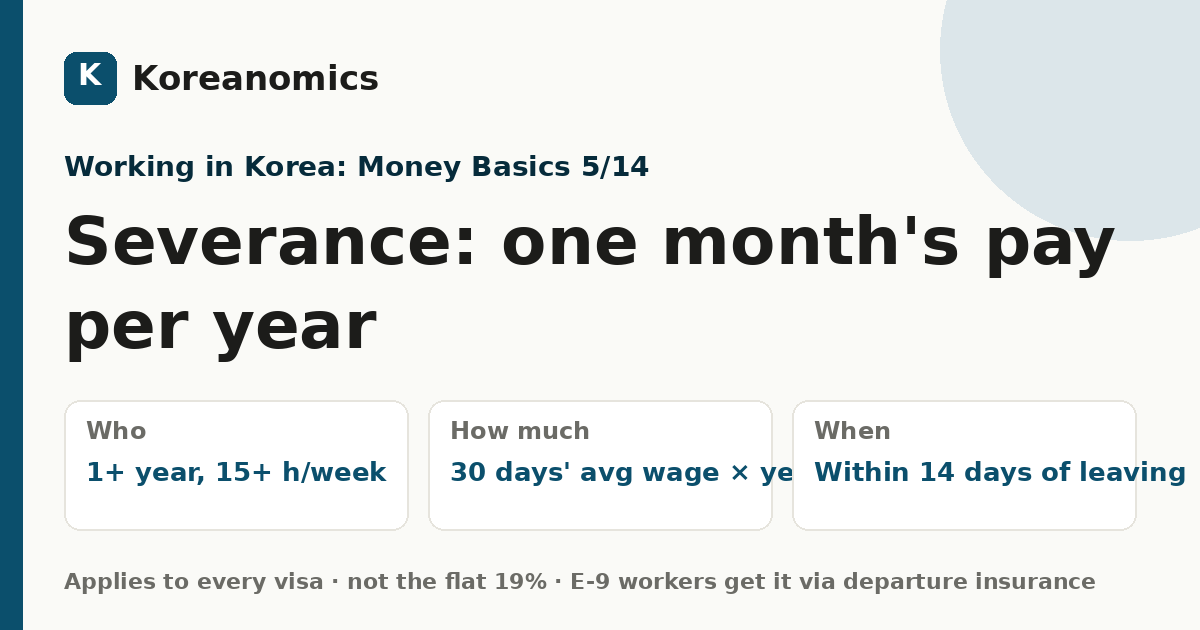
Every employee in Korea with 1+ year at 15+ hours a week gets severance: 30 days' average wage per year, paid within 14 days. Calculator incl. retirement tax.
Contents
Korea's severance pay (퇴직금, toejikgeum) is the most generous of its labour rules and the one foreigners most often lose. It is not a bonus and not conditional on good behaviour: every employee who works one year or more, at 15 or more hours a week, is owed 30 days of average wages for every year of service when the job ends, whatever the reason and whatever the visa. On a ₩3M monthly salary, a three-year contract ends with a cheque of about ₩9M — roughly a tenth of everything you earned.
Severance pay + retirement income tax estimator (2026)
Average daily wage = (last 3 months' pay + 3/12 of annual bonuses and leave pay) ÷ calendar days in those 3 months, never below the ordinary daily wage. Severance = daily wage × 30 × service days ÷ 365. Tax: 2026 retirement-income schedule (service-year deduction → annualised income → conversion deduction → brackets ÷ 12 × years), +10% local.
Who is entitled
The Act on the Guarantee of Employees' Retirement Benefits applies to every workplace with at least one employee, since December 2010 including businesses with fewer than five staff. The conditions are two: one year of continuous service and 15 or more hours a week averaged over four weeks. Nationality and visa are irrelevant — E-2 teachers, E-7 engineers, E-9 factory workers, F-6 spouses on part-time contracts, D-2 students on a 20-hour job all qualify once they pass the year mark.
"Continuous" is the word employers play with. Renewing a one-year contract does not reset the clock. Being made to sign as a "new" employee after a one-day gap does not reset it either, if the work in fact continued. A three-month probation counts. Unpaid leave generally counts as service. What does break continuity is an actual resignation followed by re-hiring after a real gap, or a transfer to a different legal employer.
The formula
Severance = average daily wage × 30 × (days of service ÷ 365).
The average wage (평균임금) is the total pay of the three months before you left — base, overtime, allowances, everything taxable or not — divided by the number of calendar days in those months (89–92). Annual bonuses and unused-leave pay are added at 3/12 of what was paid in the last year. If the result is lower than your ordinary wage (통상임금, the fixed contractual pay per day) — because you were on reduced hours or unpaid leave before leaving — the ordinary wage is used instead. Our Korean-language sister page on ordinary wage explains the 2024 Supreme Court change that pulled most fixed bonuses into it.
An employee who earned ₩3.2M a month for exactly three years therefore gets about ₩3.2M × 3 = ₩9.6M — the "one month per year" rule of thumb, slightly adjusted for the 30-day versus calendar-month difference.
Payment is due within 14 days of the last working day. Companies with a retirement pension plan (DB or DC, 퇴직연금) pay through it: in a DC plan the money has been accumulating in your name at 1/12 of annual pay per year and you get the balance, which can be more or less than the formula depending on the investment returns. Since April 2022 severance above ₩3M for employees under 55 is transferred to an IRP account rather than paid in cash; a departing foreigner can then withdraw the IRP in full (Part 14 covers the mechanics, and Part 7 of our investing course the tax).
Retirement income tax
Severance is not salary. It is retirement income, taxed on its own with two deductions that make the effective rate low for short service: a service-year deduction (₩1M per year for the first five years, ₩2M per year for years 6–10, ₩2.5M for 11–20) and a conversion deduction applied after the amount is annualised over your service years. The remaining amount is run through the normal 6–45% brackets, divided back by 12 and multiplied by the years. For three years and ₩9.6M the tax is roughly ₩100,000; for ten years and ₩50M it is around ₩1.2M. The calculator shows the exact steps.
Two things do not affect it: the 19% flat rate (retirement income is outside it), and your residency status — a non-resident's Korean severance is taxed the same way at source.
E-9 and H-2 workers: the departure guarantee insurance
Employers of E-9 and H-2 workers with five or more staff do not pay severance directly. Instead they pay 8.3% of monthly ordinary wage into a departure guarantee insurance (출국만기보험) with Samsung Fire under the EPS system. When the worker leaves Korea, the insurer pays out the accumulated amount — at the airport counter or into a home-country account within 14 days of departure. Because 8.3% of ordinary wage over the years often comes to less than the statutory formula (overtime and bonuses are excluded from the base), the employer must top up the difference when the worker leaves; ask the EPS centre to calculate it. The claim window is three years.
A related product, the return-cost insurance (귀국비용보험, ₩400,000–600,000 depending on nationality, paid by the worker in the first months), is refunded on departure as well.
When it is not paid
Unpaid severance is the single most common labour complaint by foreign workers. The remedy is administrative, free and does not require a lawyer: file a jinjeong (진정) at the regional Labour Office (고용노동청) with your contract, payslips and bank records. The office summons the employer, calculates the amount, and if it is not paid, refers the case for prosecution — employers pay in most cases at that stage. Interest of 20% a year runs from the 15th day. The Ministry's counselling line 1350 has English, Chinese, Vietnamese and other languages, and the Foreign Workers Support Centres (외국인노동자지원센터) help with the paperwork.
If the company has gone bankrupt, the state pays severance up to a ceiling through the Wage Claim Guarantee Fund (체당금), which covers the last three years of unpaid severance. Your visa status does not affect the claim; you can even file after leaving Korea through a representative.
Severance arrives when a job ends. Health insurance is the deduction that keeps going whether you work or not — and for foreigners it has a minimum premium and a visa-renewal sting. That is the next part.
Frequently asked questions
My contract says severance is included in my monthly salary. Is that legal?
No. Since a 2010 Supreme Court ruling, 'severance included in salary' clauses are void. The employer still owes statutory severance at the end, though it may try to reclaim the extra it paid. If you were told your E-2 or hagwon salary 'already includes' severance, you are still entitled to it after one year.
I am on an E-2 teaching contract of exactly 12 months. Do I qualify?
Yes — one year of continuous service is the threshold, and a 12-month contract meets it. The most common trick is ending the contract a few days before the anniversary, or making you re-sign as a 'new' employee; both are treated as continuous employment by the Labour Ministry if the work continued.
Is severance taxed at the 19% flat rate if I elected it?
No. Severance is retirement income, taxed under its own schedule with large service-year deductions, regardless of which income-tax regime you chose for salary. For a few years of service the effective rate is usually 0–3%.
Does the employer's DC pension plan replace severance?
Yes, if the company runs a retirement pension (DC or DB). In a DC plan the employer has been depositing at least 1/12 of your annual pay into your account each year; you receive the balance (plus investment returns) instead of a lump-sum calculation. Foreigners leaving Korea can withdraw the IRP in full — see Part 14.
My employer says they can't pay because I resigned.
Resignation, dismissal, contract expiry — the reason does not matter. Severance is owed for any termination after one year. If it is not paid within 14 days, file a complaint (진정) at the local Labour Office; unpaid severance carries 20% annual interest and the office has an English-speaking counsel line at 1350.
Sources
※ This guide is general information for foreign residents of Korea, not tax, legal or immigration advice. Rules differ by visa, nationality and tax treaty and change every year; confirm with the National Tax Service (126 → 7), NPS (1355), NHIS (033-811-2000) or Immigration (1345) before acting.