D-10 Job-Seeker and F-2-7 Points Visa in Korea (2026): How the Points Work, the 2025 D-10 Reform, and the Path from Work Visa to Residency
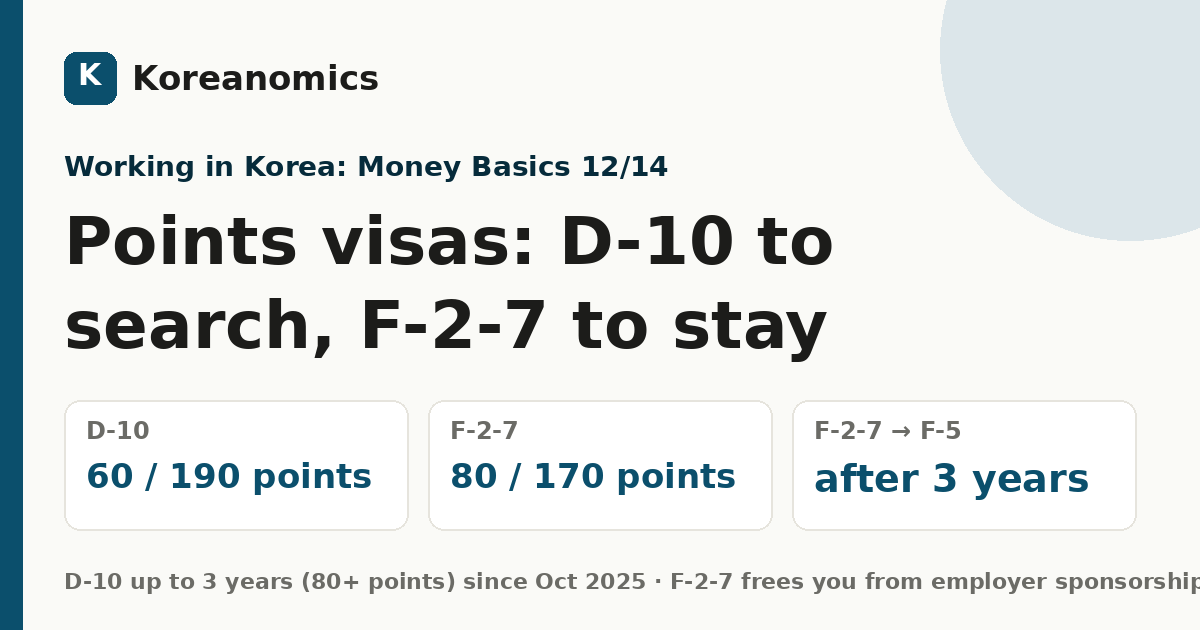
Korea's points visas: D-10 job-seeker (60 of 190 points, up to 3 years since 2025) and F-2-7 residence (80 of 170), which frees you from employer sponsorship.
Contents
Two Korean visas are decided by adding up points rather than by an employer's sponsorship: the D-10 job-seeker visa, which buys time to find or change a job, and the F-2-7 points-based residence visa, which ends the dependence on a sponsor altogether. Both use a card of points for age, education, Korean ability, income and Korean experience; both were revised in 2025. This part explains how they fit into a working life in Korea, what the points reward, and where the money rules from earlier parts reappear.
D-10: buying time
The D-10 (구직) exists for people who are between jobs or between study and work: E-series professionals whose contract ended, D-2 graduates of Korean universities, and graduates of top-ranked foreign universities who want to look for Korean work. It is a points test — 60 of 190 points in the standard case, with a higher bar (80) for nationals of 21 countries Immigration treats as high-risk — scoring age (younger is better), education (a Korean degree or a degree from a top-500 university scores highest), Korean language, work experience in Korea, and income in the previous job. E-7 holders who worked in Korea in the last year and Korean university graduates in the last three years usually clear 60 without difficulty.
The October 2025 reform changed the duration. Previously the D-10 was six months at a time, up to two years; now an applicant with 80 points or more is granted one year at a time up to 3 years in total, and lower scorers keep the six-month grants. The separate D-10-2 internship subtype allows up to one year of paid training with a company in your field.
Money on a D-10: you cannot take a regular job, so no salary and no workplace insurance. You become a regional NHIS subscriber at the foreigner minimum (Part 6) if you have been in Korea six months — budget ₩158,630 a month. If your previous job carried employment insurance, the D-10 is the status that lets you claim unemployment benefit (Part 7). Bank accounts remain open; a D-10 is a registered status and keeps your ARC.
When you receive an offer, the change to E-7 is done in-country; the new employer must meet the 2026 salary floors and ratio rules in Part 9.
F-2-7: the visa that belongs to you
The F-2-7 (점수제 거주) is the professional's route out of sponsorship. Eligibility: you hold, or held in the last few years, an E-1 to E-7, D-2 to D-10 or similar status, have lived in Korea at least a year (some categories differ), and score 80 of 170 points. The card rewards:
- Age — peaking in the late 20s to mid-30s.
- Education — a Korean master's or doctorate scores most; any bachelor's scores; a Korean degree adds a bonus.
- Korean language — TOPIK level or KIIP stage completed; this block can be a quarter of the passing score.
- Income — annual income relative to per-capita GNI, from the previous year's tax record (the year-end settlement receipt of Part 3 is the evidence).
- Korean experience — years of legal employment or study in Korea, Korean professional licences, volunteer hours, and living outside the capital region.
- Deductions for immigration violations, criminal fines and unpaid taxes or NHIS premiums.
The current card was revised in 2023 and adjusted again in 2025 to favour regional residence and Korean-university graduates; Immigration publishes the full table on Hi Korea and re-scores you at each renewal.
What the F-2-7 gives: freedom to change jobs, freelance or start a business without permission; a working spouse (F-2 dependants may work); renewal for up to three years at a time; and after three years on F-2-7 (with a maintained income and points), eligibility for F-5 permanent residence, which has no expiry and — after a further period — the option of naturalisation. It does not exempt you from any of the money rules in this course: same tax, same social insurance, same pension refund position by nationality if you leave.
The path in one table
| Stage | Typical status | Money rules that bite |
|---|---|---|
| Arrive with a job | E-7 (or E-2, E-1…) | Salary floor (Part 9), employer-sponsored, flat-tax decision (Part 2) |
| Between jobs | D-10, up to 3 years at 80+ points | Regional NHIS minimum, unemployment benefit if insured |
| Second job | E-7 change of workplace | New employer's ratio and floor checked again |
| 1–3 years in, 80 points | F-2-7 | Free to change jobs; income recorded via year-end settlement counts for points |
| 3 years on F-2-7 | F-5 permanent residence | Compulsory employment insurance already applies (F-2); no sponsor ever again |
The alternative routes to F-5 — investment, marriage, high-income professionals, and the E-7-4 skilled-worker route via F-2-R regional visas — exist but are outside this course.
Where the numbers come from
The income and tax records that both cards score are the ones this course has been building: your year-end settlement withholding receipt (Part 3) proves last year's income; your NHIS and NPS payment records prove there are no arrears; the E-7 salary floor (Part 9) proves the job that qualifies you was a real one. Keep the PDFs each February — Immigration asks for the receipts, not the payslips.
The largest single group of E-visa holders in Korea is still English teachers on E-2, whose pay package is unlike any other — housing, flights and severance on top of a modest salary. Their money is the next part.
Frequently asked questions
I lost my E-7 job. How long do I have?
Report the end of employment to Immigration within 15 days. You can then apply for a D-10 (or, if you are not eligible, a short grace period). Do not wait for the visa expiry date printed on your ARC — the E-7 is only valid while the sponsored employment continues.
Can I work on a D-10?
Not in a regular job. A D-10 permits job-seeking, interviews and, with permission, an internship or short-term work related to your field (the D-10-2 'internship' subtype for up to one year). Taking ordinary paid work is a violation. Once you have an offer, change to E-7 in-country.
What is the practical difference between F-2-7 and E-7?
An F-2-7 belongs to you, not to your employer. You can change jobs without permission, freelance, run a business, and your spouse can work. It is renewable, leads to F-5 permanent residence after three years, and is not affected by the E-7 salary floors. The cost is the points test and, on renewal, proof that you still earn a living.
Do I need TOPIK for F-2-7?
Korean language is one of the largest point blocks in the F-2-7 card, and most applicants cannot reach 80 without some Korean — TOPIK 3–4 or completion of KIIP stages typically. It is not formally 'required', but in practice a zero-Korean application has to make up the points with income, age and a Korean degree.
Sources
※ This guide is general information for foreign residents of Korea, not tax, legal or immigration advice. Rules differ by visa, nationality and tax treaty and change every year; confirm with the National Tax Service (126 → 7), NPS (1355), NHIS (033-811-2000) or Immigration (1345) before acting.