Year-End Tax Settlement (연말정산) for Foreigners in Korea: Timeline, What You Can Claim, Why Your February Pay Changes (2026 Guide)
How Korea's Jan–Feb year-end tax settlement works for foreign employees: Hometax, the credits you can claim (rent, cards, pension savings) and refund timing.
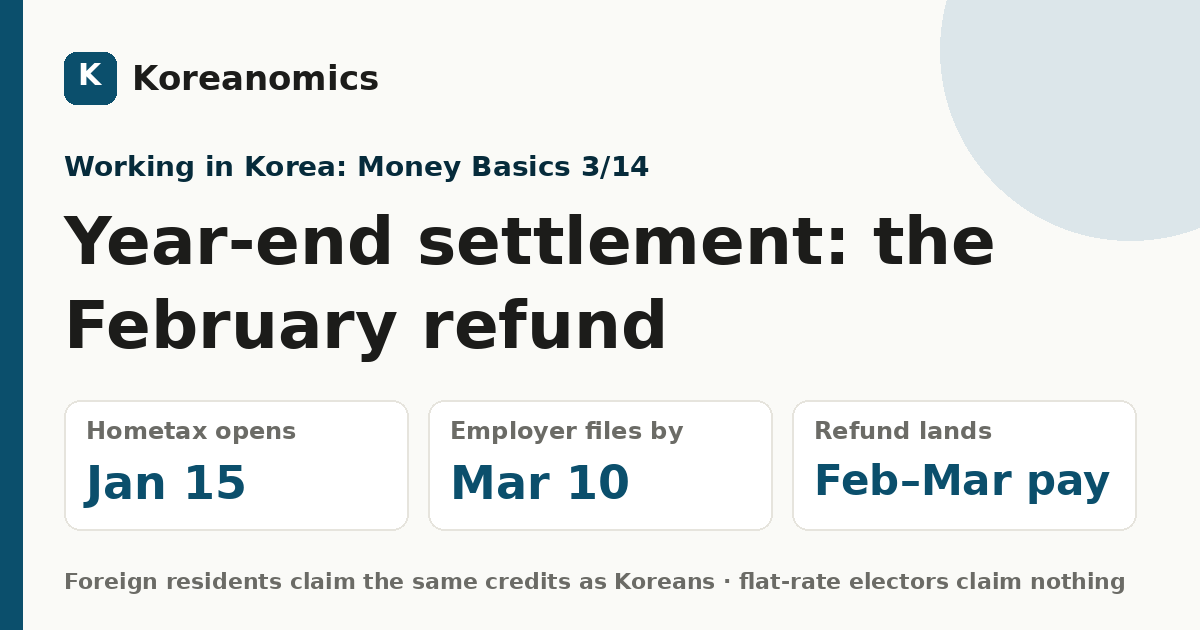
Korea has no April tax return for employees. Instead, every January your employer recalculates the whole previous year's income tax with your deductions and credits, compares it with what was withheld month by month, and settles the difference in your February or March pay. This is 연말정산 (yeonmal jeongsan), the year-end tax settlement. More than 700,000 foreign workers went through it for tax year 2025. The mechanics are the same as for Koreans; what differs is which credits you are eligible for, and whether the 19% flat rate (Part 2) has switched them all off.
Year-end settlement estimator — refund or extra tax? (tax year 2026)
Simplified: rent credit 17% (salary ≤ ₩55M) / 15% (≤ ₩80M) on rent up to ₩10M; card deduction 15% of spending above 25% of salary (capped ₩3M/₩2.5M, debit/cash treated as card); pension-savings credit 16.5%/13.2%; other special credits at 15%. Standard ₩130,000 credit applies only when no special credits are claimed. A real settlement has more rules — this shows the direction and rough size.
The timeline
| When | What happens |
|---|---|
| Early January | Employer asks you to consent to Hometax "bulk data provision" (일괄제공) — say yes, it lets HR pull your records directly |
| January 15 | Hometax simplified service (간소화) opens with your insurance, medical, card, pension and rent-related records |
| Late January – mid February | You add anything Hometax does not have (rent contract and bank transfers, donations abroad, dependents' documents) and submit the deduction form (소득·세액공제신고서) to HR |
| February or March pay | Refund or additional tax appears as a payslip line |
| March 10 | Employer files the payment statement with the NTS |
| March 18 | NTS releases bulk refunds to employers (2026) |
Foreign employees who start mid-year, or who elected the flat rate, follow the same calendar. If your company's HR handles it in Korean only, the NTS English guide (published every January) and the 1588-0560 helpline cover every form.
What foreign residents can claim
If you spent 183 days or more in Korea in the tax year (or have a Korean domicile), you are a tax resident and the Income Tax Act applies to you exactly as to a Korean employee. In practice this means:
- Basic deduction ₩1.5M each for you, a spouse and dependents with little income — including family outside Korea if you support them and can document the relationship (a certified family register or birth certificate with translation).
- Rent credit (월세 세액공제) — since tax year 2021 foreigners are eligible even though they cannot be registered as a household head: 17% of rent if salary ≤ ₩55M (15% up to ₩80M), on up to ₩10M of annual rent, for a home of 85㎡ or less, if you own no home. You need the lease in your name and bank-transfer records; the landlord's consent is not required.
- Housing loan interest / jeonse loan repayments and, from tax year 2025, the housing subscription savings deduction.
- Card and cash-receipt deduction — 15% (30% for debit cards/cash receipts, 40% for traditional markets and public transport) of spending above 25% of salary. Register your card and phone number on Hometax so cash receipts are recorded.
- Insurance premiums (12%, up to ₩1M), medical expenses above 3% of salary (15%), education (15%), donations (15%, 30% above ₩10M) — Korean institutions appear in Hometax automatically; foreign ones need receipts.
- Pension savings / IRP contributions: 16.5% (salary ≤ ₩55M) or 13.2% credit on up to ₩9M — but see the flat-rate warning below.
- Marriage credit ₩500,000 per person for marriages registered 2024–2026.
Non-residents (under 183 days, no Korean domicile) get only the basic deduction for themselves, the pension premium deduction and the standard credit.
Flat-rate electors get nothing on this list. The 19% election replaces the entire deduction system; the settlement still happens, but it only reconciles 19% × gross with what was withheld.
What HR will ask you for
Hometax covers Korean insurance, hospitals, cards, banks and pension providers. You supply the rest: the lease and rent transfers, proof of dependents (apostilled or consular-certified for foreign documents), receipts for donations or education abroad, and — if you changed jobs — the withholding receipt (근로소득 원천징수영수증) from the previous employer so both incomes are settled together. Missing something in February is not fatal: you can file a correction claim (경정청구) within five years, or include it in a May comprehensive return.
Reading the result
The settlement line on your payslip is the difference between the final tax and the twelve months of estimated withholding. A refund means the table over-estimated — common if you have dependents, rent, or significant card spending, because the monthly table assumes none of them. Extra tax is common after a bonus, a mid-year raise, or a second job. Neither is a penalty; it is simply the year's true bill arriving.
If you also received income that is not salary — freelance fees, rental income, foreign-source income after five years of residence — the year-end settlement does not cover it. That goes on the May comprehensive income tax return, which for a foreign resident works the same way as for a Korean (our Korean-language guide covers the mechanics).
The next part turns to the deduction that most foreigners think of as money lost — National Pension — and how to get it back.
Frequently asked questions
My February salary was higher than usual. Is that a raise?
Almost certainly not — it is the year-end settlement refund. Your employer withheld a table-based estimate all year; in January the real tax is calculated with your deductions and credits, and the difference is added to (or, if you underpaid, taken from) the February or March salary. Check the payslip line 연말정산 환급 or 연말정산 추징.
Can I do the year-end settlement myself in English?
The work is done by your employer's payroll; you supply documents. Hometax (hometax.go.kr) has an English mode for the simplified service (간소화) where you download a PDF of your insurance, medical, card and pension records and hand it to HR. The NTS runs a foreign-language helpline at 1588-0560 and publishes an English 'Easy Guide for Foreigners' every January.
I left my job in June. Do I still get a settlement?
Your old employer does a 'mid-year settlement' on your final pay with basic deductions only. If you start a new job the same year, give the new employer the withholding receipt (원천징수영수증) from the old one so both incomes are settled together in January. If you do not work again that year, you can file a May comprehensive return to claim credits you missed.
I am a non-resident (under 183 days). What can I claim?
Only the basic deduction for yourself, your pension premium deduction and the standard credit. No dependents, no rent, no card, no insurance or medical credits. Non-residents are taxed only on Korean-source income.
Sources
※ This guide is general information for foreign residents of Korea, not tax, legal or immigration advice. Rules differ by visa, nationality and tax treaty and change every year; confirm with the National Tax Service (126 → 7), NPS (1355), NHIS (033-811-2000) or Immigration (1345) before acting.