Leaving Korea: The Money Checklist (2026) — Pension Refund, Severance, Final Tax, IRP Withdrawal, Health Insurance, Bank Transfers, Deposit, ARC
Your last month in Korea, in order: pension refund, severance, mid-year tax settlement, IRP withdrawal, NHIS closure, sending money home, deposit, ARC return.
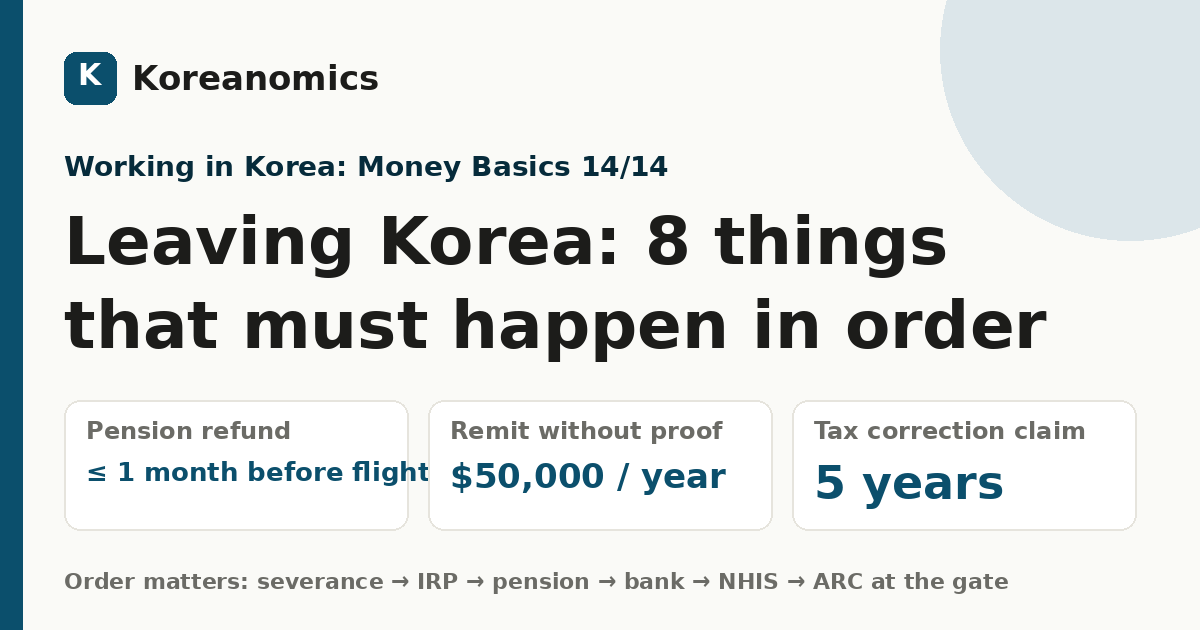
Every part of this course has ended with money that arrives later: severance within 14 days, a pension refund after departure, a tax refund in February, an IRP balance, a housing deposit. Leaving Korea is where they all come due at once, and the order you do things in decides whether they reach you. Here is the sequence for the last 30 days, with the rule behind each step.
Four weeks out
1. Fix your last working day and get it in writing. Severance (Part 5) is due within 14 days of that date; the departure guarantee insurance for E-9 workers is claimable from that date; your NHIS workplace enrolment ends on it; the year-end settlement is done on it. Ask HR for three documents at the same time: the certificate of employment (재직증명서), the withholding receipt (근로소득 원천징수영수증) for this year once the final pay is processed, and the separation certificate (이직확인서) if you have employment insurance. The withholding receipt is also what the bank will ask for when you send money home.
2. Understand the final tax settlement. When an employee leaves mid-year, the employer runs a mid-year settlement (중도퇴사 연말정산) on the final pay using only basic deductions — no rent credit, no card deduction, no pension savings — so it usually shows a small refund or nothing. If you had credits to claim, you have two options: file a comprehensive income tax return in May of the following year (from abroad, through Hometax with a Korean digital certificate, or through a tax agent), or a correction claim (경정청구) within five years. Flat-rate electors have nothing to reconcile beyond 19% of gross. Non-residents who earned Korean income after leaving (rent, dividends) file a separate return or are taxed at source (Investing course, Part 3).
3. Decide about the IRP. If severance was paid into an IRP, a foreigner leaving Korea permanently may withdraw the entire balance; the provider withholds retirement income tax (Part 5's calculator shows it — small for a few years' service) and pays the rest to your Korean account. Do this at the securities firm or bank that holds it, with proof of departure (ticket) and your ARC. Same for a pension savings account (연금저축) if you opened one for the tax credit: withdrawing early claws back the credit at 16.5%, which is still better than abandoning the balance.
Two weeks out
4. Apply for the National Pension refund (Part 4) — at any NPS branch within one month before your flight, with passport, ARC, e-ticket and a bank account (foreign, or Korean if you will keep it open until the money lands, typically 1–3 weeks after departure is confirmed). If you are not eligible by nationality or visa, ask instead for the insurance-period certificate (가입기간 확인서) for your home pension authority. The airport counter is the backup, not the plan: queues and missing documents at the gate are the commonest reason refunds are never claimed.
5. Move the money. Go to your bank's foreign-exchange desk with your passport, ARC, employment certificate and withholding receipt: income earned in Korea can be remitted in full against that evidence, and the bank stamps your passport or records the transfer under your name so it is not counted against the $50,000 no-proof annual limit that applies to unexplained transfers by foreign residents. Wires to your own account abroad take 1–3 days; the receiving bank's fees are often larger than the Korean side's. Apps (Wise, Sentbe, GME, Hanpass and others licensed in Korea) are cheaper for amounts under the app's limit, and they also require the ARC and source documents. Cash over $10,000 leaving the country must be declared.
If you still have a limited-transaction account (한도제한계좌 — ₩3M a day at the counter, ₩1M online/ATM, the default for new foreign customers), have the limit lifted first by showing the same employment documents; a large final wire cannot go through a limited account.
6. Housing deposit and utilities. Give the landlord written notice at least a month ahead (most leases say one month; jeonse leases two). The deposit (보증금) is returned on the day you hand over the keys against the final utility bills; insist on a bank transfer to your Korean account, not "later". Settle gas (call the regional gas company for a meter reading), electricity (KEPCO 123), internet and phone — the phone contract's early-termination fee is the one people forget, and unpaid telecom bills are the commonest debt foreigners leave behind. Mobile numbers can be kept for a few months on a suspended plan if you need Korean SMS verification for bank apps from abroad.
The last days
7. Health insurance. Your workplace enrolment ends automatically on the last working day and a regional enrolment starts the next day at the ₩158,630 minimum (Part 6). Tell the NHIS your departure date so the regional premium is not billed, and claim any premium paid for months after you leave. Arrears left behind follow you to the next visa application.
8. At the airport: return the ARC. Hand your Alien Registration Card to the immigration officer at departure — it is returned on final departure and your registration is cancelled. This is also the moment your status ends, which triggers the pension and departure-insurance payments and closes the NHIS record. If you hold an F-visa and plan to come back within the re-entry period, do not surrender the card; ask for a re-entry permit exemption instead.
The order, in one line
Final pay and documents → IRP withdrawal → pension refund application → bank remittance with proof → deposit and utilities → NHIS notification → ARC at the gate. Do the pension before the bank, and the bank before closing the account, and the account only once the deposit, the severance and any tax refund have landed.
After you have gone
Three things can still be claimed from abroad: the pension refund (within five years), unpaid wages or severance (through a Korean representative to the Labour Office — no time bar on the complaint, though the three-year civil limit applies), and tax overpayments (correction claim within five years). Keep your ARC number, your withholding receipts, and your Korean bank details; they are the keys to all three.
This ends the Money Basics course. If you are staying, the natural next step is what to do with the won you have saved — the Investing in Korea as a Foreigner course starts with opening a brokerage account on an ARC.
Frequently asked questions
Can I close my Korean bank account from abroad?
Usually not without a Korean phone number and ARC, which is why you should empty and close it before you go, or keep it open with a small balance and internet banking set to a foreign phone (some banks allow this for a year). Most banks let you open a foreign-currency account and wire the balance out before closing.
How much can I send home when I leave?
Money you earned in Korea can be remitted without limit if you show the source — employment certificate and payslips or the withholding receipt — at the bank counter. Without proof, banks allow up to $50,000 a year per person. Above $10,000 in a single transfer the bank reports to the tax office, which is normal. Cash over $10,000 must be declared at customs.
I paid health insurance for the month after I leave. Refund?
Yes — premiums for the period after your departure are refundable. Visit an NHIS branch in your last week with the flight ticket, or call 1577-1000 (7 for foreign languages) after departure; refunds go to a Korean account, so do this before closing it.
What about the money in my IRP?
Severance transferred to an IRP (Part 5) can be withdrawn in full by a foreigner leaving Korea permanently — retirement income tax is then withheld (small for short service). Withdraw before you go: IRPs cannot be operated from abroad, and dormant balances are eventually moved to the dormant-deposit fund, from which reclaiming is slow.
Sources
- National Pension Service — Lump-sum refund application before departure and from abroad
- National Tax Service — foreigners' departure: mid-year settlement and comprehensive return (English)
- Foreign Exchange Transactions Regulations, Art. 4-3 (overseas remittance by foreign residents)
- Immigration Service — return of Alien Registration Card on final departure
※ This guide is general information for foreign residents of Korea, not tax, legal or immigration advice. Rules differ by visa, nationality and tax treaty and change every year; confirm with the National Tax Service (126 → 7), NPS (1355), NHIS (033-811-2000) or Immigration (1345) before acting.