Unemployment Benefits in Korea for Foreigners (2026): Which Visas Are Covered, 60% of Pay up to ₩68,100 a Day, 120–270 Days — Calculator
F-2/F-5/F-6 holders are insured automatically; E-7 and other E-visas only if enrolled; E-9/H-2 only with the unemployment option. 2026 benefit calculator.
Contents
Employment insurance (고용보험) is the deduction foreigners understand least. It is 0.9% of pay, it appears on some payslips and not others, and the benefit it buys — up to nine months of job-seeker's allowance at roughly ₩2M a month — is claimed by very few foreign workers, partly because many do not know they are insured and partly because the visa system makes claiming awkward. This part sorts out who is covered, what you get, and how the visa question is handled.
Job-seeker's allowance calculator (2026)
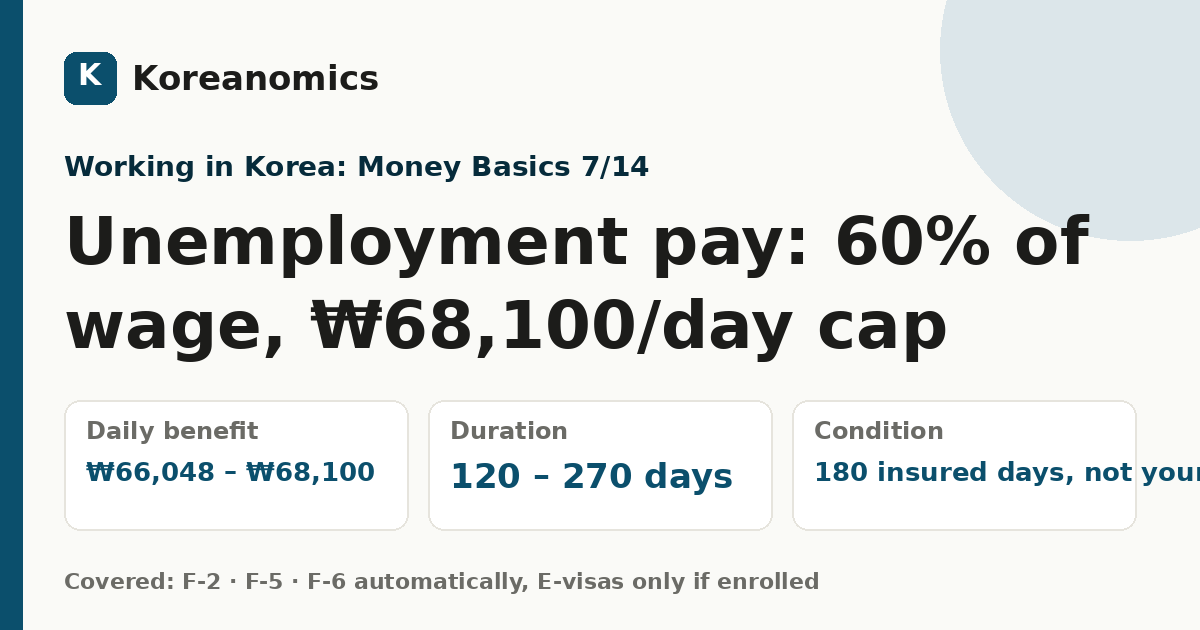
Daily benefit = 60% of average daily wage (monthly pay ÷ 30), capped at ₩68,100 and floored at ₩66,048 (80% of 8 hours at the 2026 minimum wage). Duration by age and insured period: under 50 → 120/150/180/210/240 days; 50+ or disabled → 120/180/210/240/270. Requires 180 insured days in the last 18 months and involuntary separation.
Who is insured
The Enforcement Decree of the Employment Insurance Act sorts foreign workers into three groups:
| Visa | Cover | The 0.9% deduction |
|---|---|---|
| F-2 (resident), F-5 (permanent), F-6 (spouse) | Compulsory, like Koreans | Always taken |
| E-9, H-2 | Employment-stability part compulsory; unemployment-benefit part optional, chosen at enrolment | Taken only if the unemployment part was chosen |
| E-1 to E-7, E-10, D-7/D-8/D-9, D-10 and the rest | Voluntary — the worker (and employer) can opt in; if you do, the full scheme applies | Taken only if enrolled |
| F-4 (overseas Korean) | Voluntary | Same |
So the first thing to check is your payslip. A line reading 고용보험 with an amount equal to 0.9% of pay means you are in. Many large employers enrol E-7 staff automatically because the paperwork is identical to Korean hires; many hagwons do not enrol E-2 teachers because it costs the school 1.15% or more on top. You can ask to be enrolled at any time; it takes effect from the enrolment date and the 180-day clock starts then.
The conditions
Four conditions, all of which must be met:
- 180 insured days (paid days, roughly 7–8 months of work) in the 18 months before separation, across all insured Korean jobs.
- Involuntary separation: dismissal, redundancy, closure, expiry of a fixed-term contract, or resignation for a recognised reason. Quitting because you found a better job or want to travel does not qualify; quitting because of two months' unpaid wages, harassment, or a relocation that makes the commute over two hours does.
- Able and willing to work, proven by registering at a Job Centre (고용센터) within about two weeks, attending the orientation, and reporting job-search activity every four weeks.
- Legal status that allows job-seeking in Korea. This is the foreigner-specific hurdle.
The visa problem, and the D-10 answer
Unemployment benefit is a domestic benefit: it is paid only while you are in Korea, and only while your status permits looking for work. An E-7 holder whose employment ends has 15 days to report the change and, in practice, must obtain a D-10 job-seeker visa (granted to most E-1–E-7 holders with a track record in Korea, for up to six months at a time) or a grace period from Immigration to remain. With a D-10 in hand you register at the Job Centre and claim like anyone else. F-visa holders have no such problem — their right to stay does not depend on employment.
E-9 workers who chose the unemployment part can claim between employers if they are within their permitted job-change window (Part 10), which is the main reason the option exists.
Leaving Korea ends the entitlement — benefits are not paid abroad, and not paid retroactively if you return.
What you receive
The daily benefit is 60% of your average daily wage over the three months before separation, within a band: a ceiling of ₩68,100 and a floor of ₩66,048 (80% of the minimum wage for an 8-hour day in 2026). Because the ceiling is reached at a monthly pay of about ₩3.4M, most claimants receive within a few thousand won of the maximum: about ₩2.04M per 30 days.
Duration depends on age and total insured years:
| Insured period | Under 50 | 50+ or disabled |
|---|---|---|
| Under 1 year | 120 days | 120 days |
| 1–3 years | 150 | 180 |
| 3–5 years | 180 | 210 |
| 5–10 years | 210 | 240 |
| 10+ years | 240 | 270 |
There is a seven-day waiting period, and repeat claimants within five years face reductions under rules introduced in 2024. The benefit is tax-free.
How to claim
- Get the separation certificate (이직확인서) from your employer — they must file it with the Job Centre within 10 days of your request; without it, nothing moves.
- Sort out your status (D-10, F-visa, or grace period).
- Register as a job-seeker on worknet.go.kr (now 고용24), then visit the Job Centre for your district with your ARC and bank book. The centres in Seoul, Ansan, Gimhae and other foreigner-dense areas have interpreters; elsewhere bring a Korean-speaking friend or use the 1350 line's three-way interpretation.
- Attend the first recognition day (usually two weeks later), then report job-search activity every four weeks — applications, interviews, or training count. Payment lands within a few days of each recognition.
Take a job during the claim and you may receive an early re-employment allowance (조기재취업수당): half of the remaining benefit as a lump sum if you find work with more than half the days left and keep it for 12 months.
The next part turns to the floor under all these numbers — the 2026 minimum wage — and to the two deductions that are legal only for E-9 workers.
Frequently asked questions
I'm on E-7 and my payslip shows 고용보험. Am I covered?
If the 0.9% employee deduction has been taken, you were enrolled — E-7 holders can join voluntarily and many employers enrol them by default. You then have the same rights as a Korean, subject to the 180-day and involuntary-separation conditions. If there is no deduction, you are not covered and cannot claim.
Can I claim if my contract simply expired?
Yes. Non-renewal of a fixed-term contract counts as involuntary separation, as do dismissal, redundancy, company closure and resignation for a recognised reason (unpaid wages for 2+ months, harassment, a 2-hour+ commute after relocation). Voluntary resignation for personal reasons does not qualify.
My E-7 visa is tied to my employer. Can I stay to job-hunt and claim?
You must report the change to Immigration within 15 days and change to a D-10 job-seeker visa (or get a grace period) to remain legally. Benefits are paid only while you are in Korea with a status that permits job-seeking; a D-10 qualifies. Leaving Korea ends the claim.
How much do I actually get?
60% of your average daily wage over the last 3 months, but never more than ₩68,100 a day (about ₩2.04M a month) and never less than 80% of the minimum wage for 8 hours — ₩66,048 a day in 2026. Since most salaries above ₩3.4M hit the cap, nearly everyone receives between ₩1.98M and ₩2.04M a month.
Sources
- Employment Insurance Act, Art. 40 (eligibility), 45–46 (benefit amount), 50 (duration)
- Enforcement Decree of the Employment Insurance Act, Art. 3-3 (coverage of foreign workers by visa)
- Ministry of Employment and Labor — 2026 daily benefit ceiling ₩68,100 and floor
- Korea Employment Information Service — foreign-worker employment insurance guide
※ This guide is general information for foreign residents of Korea, not tax, legal or immigration advice. Rules differ by visa, nationality and tax treaty and change every year; confirm with the National Tax Service (126 → 7), NPS (1355), NHIS (033-811-2000) or Immigration (1345) before acting.