E-9 (EPS) Workers in Korea 2026: Net Pay Calculator, Housing Deductions, Departure Insurance, Pension Refund, and the 4-Year-10-Month Clock
What an E-9 worker takes home in 2026: ₩10,320 minimum wage, overtime, legal housing deductions, insurance, tax — plus departure insurance and pension refund.
Contents
The Employment Permit System (EPS) brings about 80,000 workers a year to Korea on E-9 visas for manufacturing, agriculture, fishing, construction, shipbuilding and — since 2024 — restaurants, hotels and forestry. Pay is governed by the same laws as for Koreans, but the shape of an E-9 pay packet is different: a large share is overtime, a legal slice can be deducted for housing, and two insurance schemes pay out only when you leave. This part puts the whole thing in one calculator and explains each piece.
E-9 monthly net pay estimator (2026)
Month = 209 hours ÷ 48 weekly hours (≈ 4.354 weeks). Weekly holiday pay included (8 h per 40-hour week). Overtime +50% and night +50% only at 5+ employee workplaces outside agriculture/fishing. Income tax: progressive schedule, single, no dependents, monthly ≈ annual ÷ 12 (the 19% flat rate is never better at these wages). Departure guarantee insurance is paid by the employer on top of your wage, not deducted.
The system in numbers
| 2026 | |
|---|---|
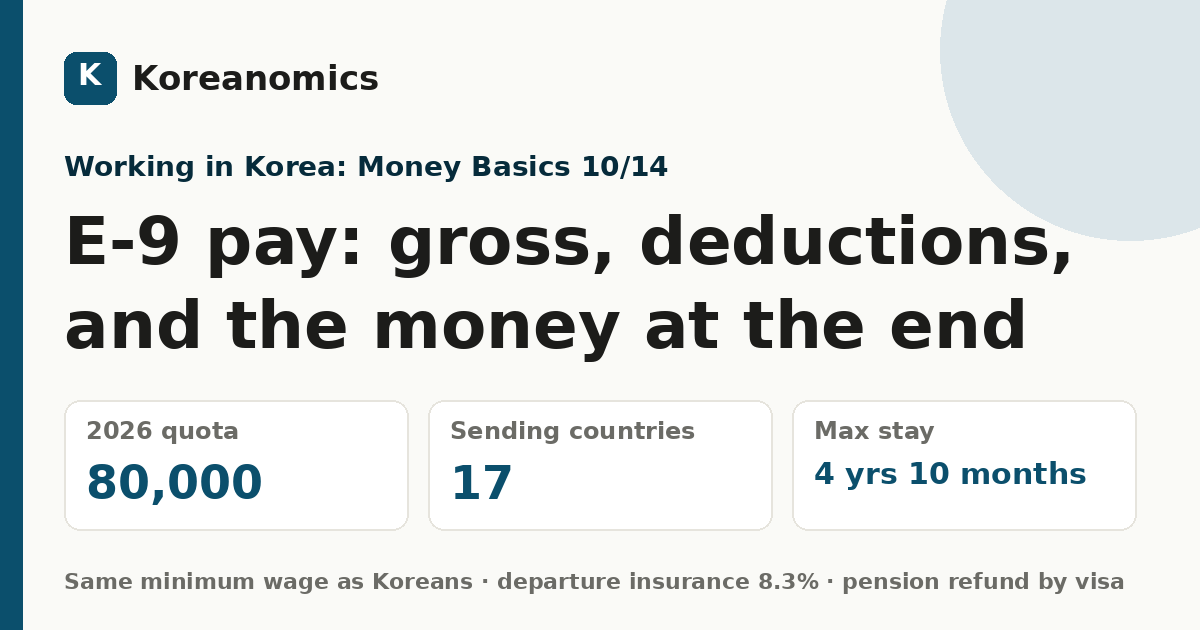
| Annual quota | 80,000 (manufacturing the largest share, then agriculture, shipbuilding, construction, fisheries, services) |
| Sending countries | 17 |
| Maximum stay | 4 years 10 months (3-year permit + one extension of 1 year 10 months) |
| Workplace changes | 3 in the first period + 2 in the extension; employer-caused changes do not count |
| Minimum wage | ₩10,320/hour — identical to Koreans |
| Departure guarantee insurance | 8.3% of ordinary monthly wage, employer-paid, paid out on departure |
| Return-cost insurance | ₩400,000–600,000 by country, worker-paid in the first months, refunded on departure |
Your gross pay
Contracts are written on the standard EPS form in Korean and your language and quote an hourly or monthly basic wage — in practice almost always the minimum wage, ₩10,320 for 2026 — plus the actual working hours. The weekly holiday pay described in Part 8 applies to you. What lifts an E-9 packet above ₩2.16M is overtime: at a five-plus-employee factory, twelve hours of overtime a week at 150% adds about ₩800,000 a month, and regular night shifts add more.
Two groups are legally paid less for the same hours. Workplaces with fewer than five employees owe no overtime or night premium, and agriculture, livestock and fishing are exempt from the working-hours and rest-day provisions of the Labor Standards Act altogether — a 60-hour week on a farm is paid at straight time. Both are legal; both should be visible in the contract before you sign it in your home country.
Deductions that are allowed — and ones that are not
Allowed: the four social insurances (National Pension 4.75% if enrolled; health 3.595% plus long-term care; employment insurance 0.9% only if you chose the unemployment part; industrial accident insurance is fully employer-paid), income tax under the monthly withholding table (small at these wages — typically ₩10,000–40,000 a month), and housing and meal costs within the caps in Part 8, with your written consent.
Not allowed: anything else. Recruitment fees, "visa costs", uniform charges, deductions for breakage, deposits to prevent you leaving, and "penalty" deductions for absence are all illegal. Nor may an employer hold your passport or ARC. Each of these is grounds for an employer-caused workplace change and for a Labour Office complaint.
The Korean withholding tax you pay monthly is settled in January through the year-end settlement (Part 3); with no dependents and no credits, the settlement is usually a small refund. The 19% flat rate is never advantageous at E-9 wages — do not elect it.
The money at the end
Three sums are waiting when you leave, and they add up to several months' pay:
- Departure guarantee insurance (출국만기보험) — the employer has paid 8.3% of your ordinary wage into a Samsung Fire policy each month in place of statutory severance. Over 4 years 10 months on a ₩2.16M wage that is about ₩10.4M. Claim it at the Incheon Airport counter on departure or from home within 14 days (the insurer pays into your foreign account); if the statutory severance formula (Part 5) gives more, the employer owes the difference — ask the EPS centre to compute it before you go.
- Return-cost insurance (귀국비용보험) — your own ₩400,000–600,000 back.
- National Pension lump-sum refund — for E-9 holders of every nationality, your 4.75% and the employer's 4.75% with interest, roughly ₩11–12M over the full period at the minimum wage. Apply at any NPS branch within a month of departure or at the airport (Part 4). Claims are possible for five years after leaving.
Unpaid wages are the fourth: the Wage Claim Guarantee fund covers three months of unpaid pay and three years of severance if the employer cannot pay, and complaints can be filed through a representative after you have left.
Staying longer
The diligent-worker re-entry (성실근로자 재입국) lets a worker who finished 4 years 10 months without changing employer (or within the same sector under an agreement) return after one month for a second full term, skipping the EPS test. The E-7-4 skilled worker visa (Part 9) is the route to an indefinite stay: four or more years on E-9, 200 of 300 points — Korean language is the biggest block of points, so a TOPIK level 3–4 or KIIP progress is the investment that pays off — and an employer's recommendation. A government plan to allow E-9 workers to stay ten years or more without departure has been announced in policy documents and reported since 2023, but the law has not been amended as of September 2026.
For workers who want to switch from EPS to a professional or remote-work route, the next part covers the digital nomad visa made permanent in June 2026.
Frequently asked questions
Which countries can send E-9 workers in 2026?
Seventeen: the Philippines, Mongolia, Sri Lanka, Vietnam, Thailand, Uzbekistan, Pakistan, Indonesia, Cambodia, China, Bangladesh, Nepal, Kyrgyzstan, Myanmar, Timor-Leste, Laos and — added in 2024 — Tajikistan. Recruitment is only through the EPS test and roster; agents who promise E-9 jobs for a fee are frauds.
Can I change my employer?
Up to three times during the first three years and twice more in the 1-year-10-month extension, but only for permitted reasons (contract end, closure, unpaid wages, abuse, workplace violations). Changes caused by the employer — unpaid wages, violence, illegal accommodation — do not count against the quota. You must apply through the Job Centre within one month of leaving the old job and find a new one within three months.
Do I get my National Pension back?
Yes — E-9 holders receive the lump-sum refund regardless of nationality, including Vietnamese, Nepali, Bangladeshi and Pakistani workers whose countries are otherwise excluded (Part 4). Claim at an NPS branch before departure or at Incheon Airport; the refund is your 4.75% plus the employer's 4.75% plus interest.
What is the 'diligent worker' re-entry?
An E-9 worker who completes 4 years 10 months at the same workplace (or in the same sector under an agreement) without changing employer can leave Korea, wait as little as one month, and re-enter for another 4 years 10 months without retaking the EPS test. A longer-stay scheme allowing 10+ years without departure has been announced in policy plans but is not yet law as of September 2026.
Sources
※ This guide is general information for foreign residents of Korea, not tax, legal or immigration advice. Rules differ by visa, nationality and tax treaty and change every year; confirm with the National Tax Service (126 → 7), NPS (1355), NHIS (033-811-2000) or Immigration (1345) before acting.