Korea Digital Nomad Visa (F-1-D) 2026: Income Thresholds by Age and Region, Insurance, the 3-Year Limit, and the Tax Question — Eligibility Checker
Korea's workation visa is permanent since June 30, 2026. Income needed: ₩52.4M–104.8M a year by age and region (Seoul area vs outside). Checker, documents.
Korea launched its digital nomad visa as a pilot on January 1, 2024, and after two and a half years and fewer than a thousand issuances made it a permanent status, F-1-D, on June 30, 2026 — with lower income thresholds for people willing to live outside the Seoul area. It lets an employee or owner of a foreign business live in Korea for up to three years while working remotely. The bar is money: you must prove an income that, for most applicants, is well above what the equivalent Korean job pays.
Digital nomad visa income checker (2026 rules)
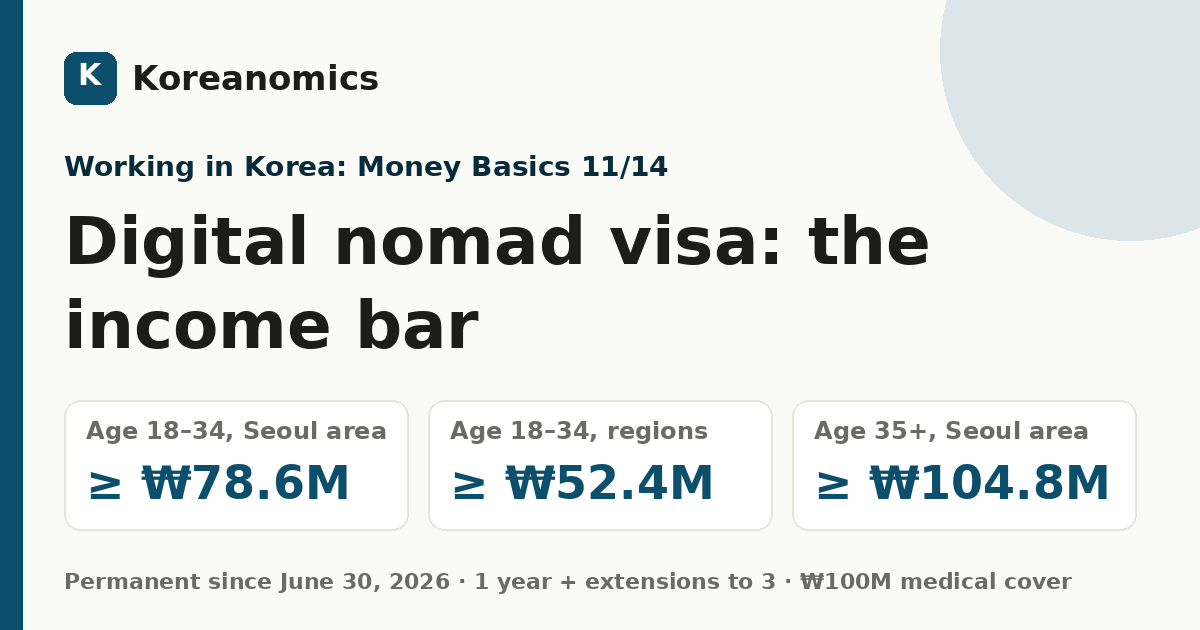
Thresholds: age 18–34 → 1.5 × GNI in the capital region, 1 × GNI elsewhere; age 35+ → 2 × GNI capital, 1.5 × GNI elsewhere. 2025 per-capita GNI ₩52,416,000. Also required: 1+ year with the current overseas employer/business, private medical insurance with ₩100,000,000 cover, clean criminal record.
Who it is for
The F-1-D is for people who already earn abroad: employees of a company outside Korea, or owners/freelancers with a business registered outside Korea, with at least one year in that employment or business. Spouses and minor children can be included. It is not a job-seeking visa and does not allow Korean employment, Korean clients, or opening a Korean business — those need D-10, E-7, D-8 or F-2 status.
The scheme is small: 743 visas were issued between January 2024 and mid-2026, and 398 holders were in Korea when the status was made permanent. The government's stated aim in making it permanent, and adding the regional discount, is to bring spending to cities outside Seoul rather than to attract large numbers.
The income thresholds
Thresholds are set as multiples of the previous year's per-capita gross national income, published by the Bank of Korea each spring. For applications in 2026 (GNI 2025 = ₩52,416,000):
| Capital region (Seoul, Gyeonggi, Incheon) | Outside the capital region | |
|---|---|---|
| Age 18–34 | 1.5 × GNI = ₩78,624,000 | 1 × GNI = ₩52,416,000 |
| Age 35+ | 2 × GNI = ₩104,832,000 | 1.5 × GNI = ₩78,624,000 |
In dollar terms at ₩1,380/$, the four cells are roughly $57,000, $38,000, $76,000 and $57,000. The income is verified from last year's tax assessment, an employment contract plus recent pay slips, or business accounts, translated and apostilled. Under the pilot (2024–mid 2026) the single threshold was 2 × GNI for everyone, which is why older guides quote ₩85–100M.
The other requirements
- Medical insurance with at least ₩100,000,000 (about $72,000) of cover, including repatriation, valid for the stay — a Korean or international policy; travel insurance with a lower limit is refused.
- Criminal record certificate from your home country (apostilled), and for some nationalities a tuberculosis test.
- Proof of accommodation in the region you declared.
- Application at a Korean embassy or consulate abroad (the pilot allowed in-country change from a tourist entry for some nationalities; check the current rules for yours). Fees are around ₩150,000–200,000 depending on the consulate.
The first grant is one year; extensions are in-country at Immigration, with fresh income proof, up to 3 years in total. After three years you must change status or leave. F-1-D time does not by itself lead to F-2 residency or F-5 permanent residence.
Health insurance and tax
Two things attach themselves after six months. National Health Insurance enrolment becomes compulsory at the regional-subscriber foreigner minimum (₩158,630 a month in 2026, Part 6) — this is in addition to the private policy you needed for the visa, and it gives you the full Korean system. Many nomads consider it worth it; it cannot be declined.
Tax is the unsettled part. If you are present 183 days or more in a calendar year you are a Korean tax resident under domestic law. Employment income for work physically performed in Korea is Korean-source income regardless of who pays you; most tax treaties exempt short stays (under 183 days, paid by a non-resident employer with no Korean branch), and after that Korea has the right to tax with your home country giving a credit. For a "short-term resident" foreigner (resident in Korea five years or fewer of the last ten), foreign-source income that is not paid in or remitted to Korea is outside the Korean net — but remote-work salary is generally treated as Korean-source when performed here. In practice: stay under 183 days if you want certainty, and if you do not, file a May comprehensive return and take the treaty credit. The National Tax Service's foreign-language line (1588-0560) will answer general questions; a cross-border accountant is worth it for the specifics.
Nomads who decide they would rather join the Korean labour market — a local job, a start-up, a graduate degree — enter the visa system covered in the next part: the D-10 job-seeker and F-2-7 points visas.
Frequently asked questions
Can I work for a Korean company on the F-1-D?
No. The visa is for people employed by, or running, a business outside Korea. Taking Korean clients or a Korean employer requires a different status (E-7, D-8, D-10, F-2). Immigration checks this at extension through your income documents.
Is the income threshold gross or net, and in which currency?
Gross annual income, evidenced by the previous year's tax return, pay slips or bank statements, converted to won at the rate on the application date. The thresholds are multiples of Korea's per-capita GNI (₩52.4M for 2025), so they move each year when the Bank of Korea publishes the new figure.
Why is the regional threshold lower?
Since the 2026 permanent rules, applicants who will live outside the Seoul capital region (Seoul, Gyeonggi, Incheon) need 1× GNI instead of 1.5× (18–34) or 1.5× instead of 2× (35+). The lower bar is a regional-population measure; you declare a residence outside the capital area and must actually live there.
Do I pay Korean tax?
If you spend 183 days or more in a tax year in Korea you become a Korean tax resident, and income from work you physically perform in Korea is taxable here in principle, with a credit for tax paid at home under most treaties. Many nomads stay under 183 days per year, or rely on a treaty's 183-day employment rule. Above that, file a May comprehensive return. Get advice for your specific country — this is the least settled part of the scheme.
Sources
※ This guide is general information for foreign residents of Korea, not tax, legal or immigration advice. Rules differ by visa, nationality and tax treaty and change every year; confirm with the National Tax Service (126 → 7), NPS (1355), NHIS (033-811-2000) or Immigration (1345) before acting.