Korea's 19% Flat Tax for Foreign Workers: When It Beats the Progressive Rate (2026 Calculator, 20-Year Rule, 21% Proposal for 2027)
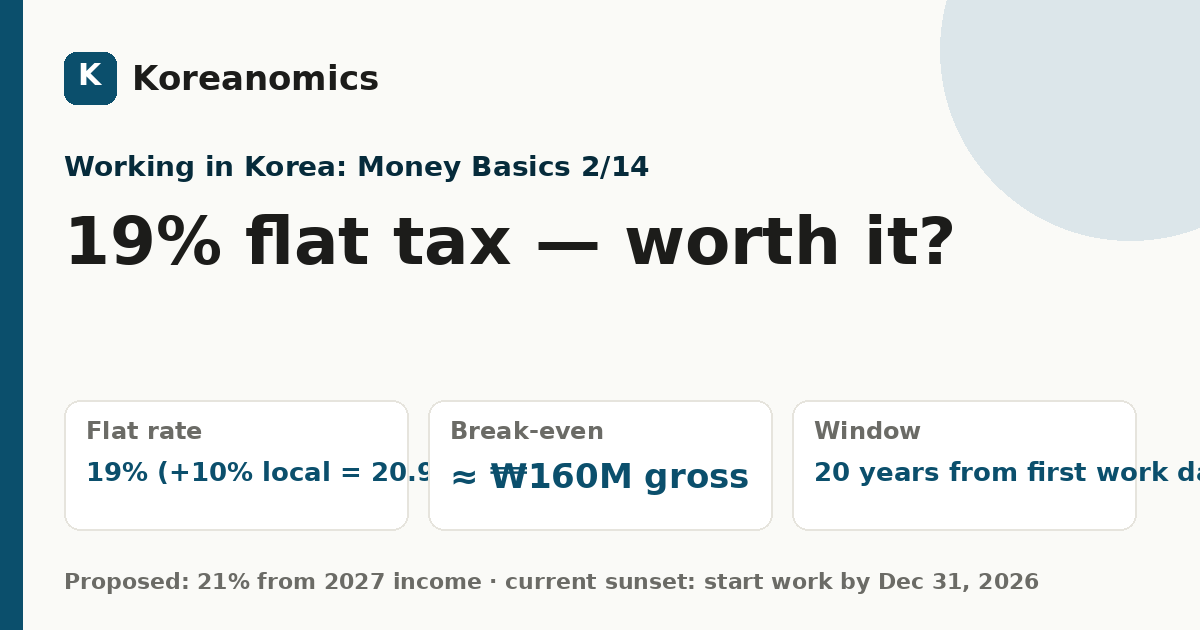
Foreigners in Korea can elect a 19% flat income tax (20.9% with local) instead of 6–45%. It only wins above ≈₩160M. Break-even calculator, 21% proposal.
Contents
Korea offers foreign employees something almost no other OECD country does: instead of the progressive income tax that everyone else pays, you may elect a flat 19% on your gross salary, 20.9% once the 10% local surcharge is added. Recruiters mention it as a perk. For most salaries it is a trap — the progressive system, with its deductions and credits, is cheaper until roughly ₩160 million a year. The calculator below shows your own crossover point, and the rest of the page explains the rules that HR summaries leave out.
Flat 19% vs progressive — which is cheaper for you? (2026)
Both include the 10% local income tax. Progressive: earned-income deduction, basic deduction, pension premium deduction, earned-income credit, standard credit ₩130,000 (replaced by your itemised credits if you enter any). Flat: rate × gross including non-taxable allowances, no deductions. National Pension assumed enrolled.
The rule in one paragraph
Under Article 18-2 of the Restriction of Special Taxation Act, a foreign national who starts working in Korea by December 31, 2026 (the current sunset date) may, for each tax year within 20 years of their first working day in Korea, pay income tax at 19% of total employment income instead of the progressive rates. "Total" means everything: base pay, bonuses, and the allowances that are tax-free for everyone else. In exchange, every deduction and credit in the Income Tax Act is forfeited — no basic deduction, no earned-income deduction, no rent or card credits, no pension-savings credit. Employees of companies in which they or their relatives hold a controlling interest are excluded.
The 20-year window replaced a 5-year one in the 2022 reform (effective 2023). People who were already working here before 2014 count their 20 years from January 1, 2014, so their benefit lasts through tax year 2033.
Why "19% is lower than 24%" is the wrong comparison
Korea's progressive brackets start at 6% and reach 24% only above ₩50M of taxable income — and taxable income is far below gross. A single employee earning ₩100M gross first deducts ₩14.75M (earned-income deduction), ₩1.5M (basic), and about ₩3.8M of pension premiums, leaving ₩80M taxable. The tax on that is ₩13.4M, then the earned-income credit and standard credit take off ₩0.6M, and local tax adds 10%: about ₩12.9M, a 12.9% effective rate. The flat rate on the same person is ₩20.9M. The progressive system wins by ₩8M.
| Gross | Progressive (incl. local) | Effective | Flat 20.9% | Cheaper |
|---|---|---|---|---|
| ₩60M | ≈ ₩4.5M | 7.5% | ₩12.5M | progressive |
| ₩100M | ≈ ₩12.9M | 12.9% | ₩20.9M | progressive |
| ₩150M | ≈ ₩29.6M | 19.7% | ₩31.4M | progressive |
| ≈ ₩162M | ≈ ₩33.9M | 20.9% | ₩33.9M | break-even |
| ₩200M | ≈ ₩48.1M | 24.1% | ₩41.8M | flat |
| ₩300M | ≈ ₩87.0M | 29.0% | ₩62.7M | flat |
Single, no dependents, ₩200,000 monthly meal allowance, pension enrolled, no itemised credits. Several English-language calculators claim the flat rate wins from ₩70–80M; they omit the earned-income deduction and credit, which is why their numbers are wrong by a factor of two.
Every dependent, every credit you would otherwise claim, pushes the break-even higher. A family with two children and a rent credit typically does not benefit from the flat rate until well above ₩180M. Conversely, if your package includes large taxable allowances (housing paid in cash, relocation, school fees) the flat rate's simplicity can be worth it earlier, because those inflate progressive taxable income — enter them in the gross figure above.
How to elect, and how to undo it
For monthly withholding: hand your employer the Application for the flat-rate withholding (단일세율적용 원천징수신청서) by the 10th of the month following your first month of work. Withholding is then 19% each month.
At year-end: attach the Flat-rate election form (외국인근로자 단일세율적용신청서, Form 8-2) to your year-end settlement documents in January–February, or to a May comprehensive return. This is the election that actually determines the year's tax, so you can compare both regimes at year-end and pick the cheaper one. The choice is per tax year; a change for withholding purposes takes effect from the next year.
You must be a non-Korean national at the time of election. Dual nationals who also hold Korean citizenship are treated as Korean.
What changes in 2027 (proposal)
The government's 2026 tax reform bill, announced on August 3, 2026, would raise the flat rate to 21% (23.1% with local tax) for employment income earned from January 1, 2027, and extend the eligibility sunset for new arrivals from December 31, 2026 to December 31, 2029. The 20-year window and the no-deductions rule stay. The National Assembly normally passes the tax bill in December; until then this is a proposal. At 21% the break-even rises to roughly ₩190M. Use the "21%" option in the calculator to see your 2027 position.
If you are arriving in Korea in late 2026 and expect a high salary, the current text of the law makes the election available only if your first working day is on or before December 31, 2026 — the proposal would extend that, but is not yet law.
Who actually benefits
- Executives and specialists on packages above ₩160–200M, especially with large cash allowances.
- People who will never claim Korean deductions anyway (short assignments, no Korean rent contract, no dependents in Korea).
- Anyone who wants predictability: 19% of gross is easy to model for a home-country employer paying a tax-equalised salary.
Everyone else — which is most E-7, E-2, D-10 and F-visa employees — should stay on the progressive system and claim what they are entitled to. What those entitlements are, and how the February refund works, is the subject of the next part.
Frequently asked questions
Is the flat rate automatically applied to foreigners?
No. You must elect it — either by giving your employer the flat-rate withholding application by the 10th of the month after you start work, or by attaching the election form to your year-end settlement papers (or May tax return). If you do nothing, you are taxed on the normal progressive scale, which is better for most people.
Can I switch between flat and progressive every year?
Yes. The election is made per tax year at year-end settlement, so you can compare both and choose the lower one each year. A withdrawal filed mid-year takes effect from the next tax year for monthly withholding, but the year-end settlement is what decides the final bill.
What counts as 'income' under the flat rate?
All employment income, including allowances that are normally non-taxable (the ₩200,000 meal allowance, childcare allowance, overseas-work allowance). Employer-provided housing benefit is generally excluded. Severance pay is retirement income and is taxed separately under its own rules, not at 19%.
I started working in Korea in 2010. Do I still qualify?
Yes, but the clock has a special start. For people already working in Korea before 2014, the 20-year window is counted from January 1, 2014, so the benefit runs through the 2033 tax year. For anyone who started after that, 20 years from the first working day.
Does electing the flat rate affect my pension or health insurance?
No. Social insurance contributions are separate from income tax and continue as normal. It does affect what you can claim: flat-rate electors get no deductions or credits at all — no rent credit, no card deduction, no pension-savings credit, no dependent deductions.
Sources
- Restriction of Special Taxation Act, Art. 18-2 — flat tax for foreign workers
- PwC Worldwide Tax Summaries — Korea, income determination (flat rate, 20-year window)
- Kim & Chang — 2022 tax reform: extension of the flat-rate period to 20 years
- KPMG Korea Tax Brief, August 2026 — 2026 tax reform proposal (21% from 2027)
※ This guide is general information for foreign residents of Korea, not tax, legal or immigration advice. Rules differ by visa, nationality and tax treaty and change every year; confirm with the National Tax Service (126 → 7), NPS (1355), NHIS (033-811-2000) or Immigration (1345) before acting.