Korea Minimum Wage 2026 for Foreign Workers: ₩10,320/hour, Weekly Holiday Pay, Overtime, Probation, and the Legal Housing Deductions for E-9 — Calculator
Korea's 2026 minimum wage: ₩10,320/hour = ₩2,156,880/month with weekly holiday pay (₩10,700 in 2027). Overtime 1.5×, probation 90%, E-9 housing caps.
Contents
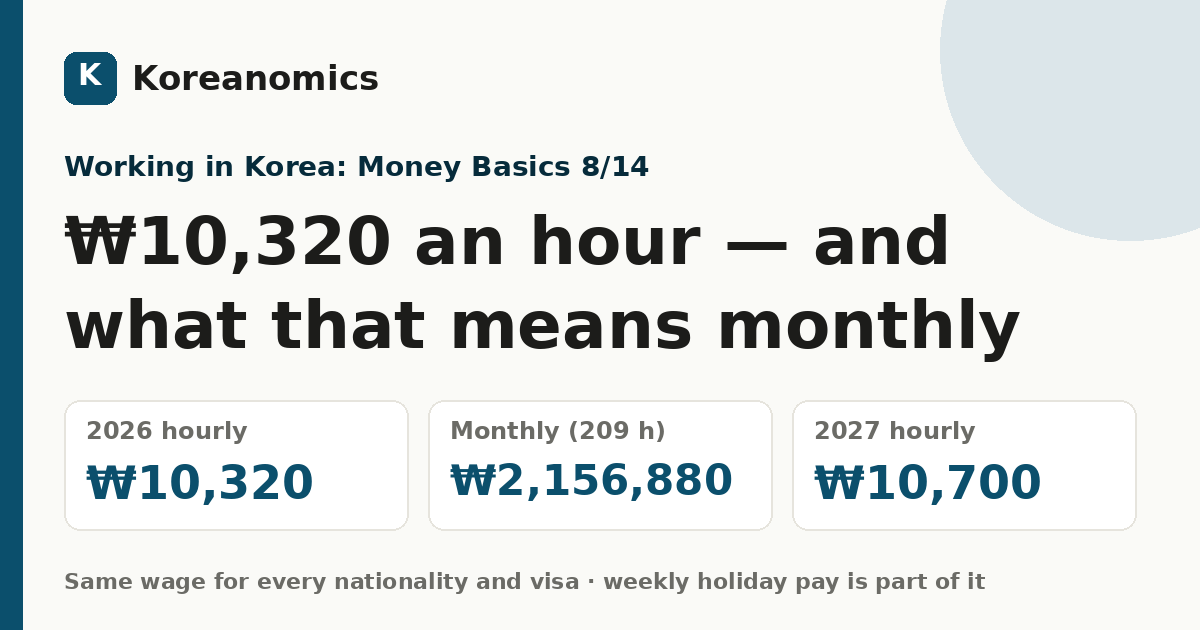
The minimum wage is the floor under every number in this course, and in 2026 it is ₩10,320 an hour, up 2.9% from 2025. For a standard 40-hour week that is ₩2,156,880 a month — a figure that already includes a day of paid rest each week that many foreign workers do not know they are owed. The 2027 rate, decided in July 2026, is ₩10,700 (₩2,236,300 a month). This part explains how the monthly number is built, what overtime and night work must add, and the two deductions that are legal only for E-9 workers.
Monthly pay at the minimum wage — hours, overtime, housing (2026)
Month = 209 hours ÷ 48 weekly hours (≈ 4.354 weeks). Weekly holiday pay = (regular hours ÷ 40) × 8 hours, if 15+ hours a week. Overtime +50%, night +50% (cumulative with overtime), at workplaces with 5+ employees. Housing deduction cap applies to ordinary monthly wage (regular hours + holiday pay), with written consent. Social insurance and tax are not deducted here — see Part 1.
How ₩10,320 becomes ₩2,156,880
The monthly figure the government publishes is 209 hours × the hourly rate. The 209 comes from a 40-hour week plus 8 hours of weekly holiday pay (주휴수당) — the Labor Standards Act gives anyone working 15 hours or more a week one paid rest day — multiplied by 4.345 weeks in an average month. So 48 × 4.345 = 208.6, rounded to 209.
Two consequences. A contract quoting "₩10,320 an hour, 40 hours, ₩1,795,000 a month" is illegal — it omits the holiday pay. And a part-timer on 20 hours a week is owed 4 hours of holiday pay on top, not just 20 × ₩10,320.
The minimum applies to wages for work, so it is compared against base pay plus fixed monthly allowances. Since 2024, 100% of regular bonuses and cash welfare allowances count toward it — an employer can no longer pay ₩1.8M base plus a ₩400,000 "bonus" and claim compliance, but can pay ₩2M base plus a ₩200,000 monthly allowance.
Overtime, night and holiday premiums
At workplaces with five or more employees, hours beyond 8 a day or 40 a week are paid at 150%, night work between 22:00 and 06:00 gets an extra 50% on top (so an overtime night hour is 200%), and work on a paid holiday is 150% for the first 8 hours and 200% beyond. Overtime is capped at 12 hours a week — the "52-hour week" — with exceptions for some E-9 sectors (agriculture, livestock, fisheries are exempt from the working-hours rules entirely, which is why farm workers can legally work 60-hour weeks at straight time).
Workplaces with under five employees owe none of these premiums: a 60-hour week is paid at 60 × the hourly rate. Small restaurants, farms and family businesses employing E-9 and H-2 workers are very often in this category. Check the head-count; it decides a third of your pay.
Our Korean-language sister site has a detailed overtime calculator with the holiday and comp-time rules.
Probation at 90%
An employer may pay 90% of the minimum wage for the first three months only if the contract is for one year or longer, and only for jobs that are not classed as "simple labour" by the Ministry (a list covering cleaning, packing, loading, basic food preparation, delivery and similar). For a one-year E-2 or E-7 contract, 90% for three months is legal; for an E-9 contract in a job on the simple-labour list, it is not.
E-9: the housing and meal deduction
The single most common wage complaint from EPS workers is the dormitory charge. The rule since 2017: an employer may deduct housing and meal costs from an E-9 worker's pay only with prior written consent (a standard form exists in the worker's language) and only up to a percentage of ordinary monthly wage that depends on the kind of accommodation:
| Accommodation | With meals | Lodging only |
|---|---|---|
| Apartment, house, multi-family unit, officetel | 20% | 15% |
| Other (container, prefab, converted building, on-site room) | 13% | 8% |
Since 2021, "other" accommodation that is a vinyl greenhouse or an illegal temporary structure cannot be provided at all, and its cost cannot be deducted. On the 2026 minimum monthly wage the ceiling is ₩431,376 for an apartment with meals and ₩172,550 for a container without. Deductions above these, or taken without a signed consent form, can be recovered through the Labour Office for up to three years back.
If you are paid less
Underpayment of the minimum wage is a crime (up to three years' imprisonment) and, more usefully, a debt: you can claim the shortfall for three years back, plus unpaid weekly holiday and overtime premiums, through a complaint (진정) at the regional Labour Office. E-9 workers can also ask the EPS centre to approve a workplace change on the grounds of wage violation, which does not count against their change quota. Keep your own record of hours — a photo of the timesheet or a daily note on your phone is accepted as evidence.
The next part moves from the floor to the ceiling most professionals hit: the E-7 visa and its 2026 salary thresholds.
Frequently asked questions
Is the minimum wage the same for foreigners?
Yes. The Minimum Wage Act applies to every worker in Korea regardless of nationality or visa, including E-9, H-2, E-8 seasonal workers, students on part-time permits and undocumented workers. Proposals to set a lower wage for foreign caregivers or E-9 workers have been debated but not enacted as of September 2026.
What is weekly holiday pay (주휴수당)?
If you work 15 or more hours a week and attend all scheduled days, you are paid for one extra rest day per week — 8 hours at your hourly rate for a 40-hour week. It is why the monthly minimum is 209 hours × ₩10,320 and not 174 hours. Part-timers get it pro rata; the calculator includes it.
Can my employer pay 90% during probation?
Only if your contract is for one year or more, only for the first three months, and not for 'simple labour' jobs (cleaning, packing, delivery, etc. as defined by the Ministry). E-9 workers on standard 3-year contracts can legally be paid 90% for three months, unless their job is on the simple-labour list.
My employer deducts ₩400,000 for the dormitory. Is that allowed?
For E-9 workers, deductions for housing and meals are allowed only with your written consent and only up to a ceiling: 20% of ordinary monthly wage for an apartment/house with meals (15% housing only), 13%/8% for other kinds of accommodation such as containers or converted structures. On a ₩2.16M wage the maximum is ₩431,000 with meals. Anything above the cap, or deducted without consent, is recoverable.
Sources
- Ministry of Employment and Labor — 2026 minimum wage notice (₩10,320)
- Minimum Wage Commission — 2027 minimum wage decision (₩10,700)
- Labor Standards Act, Art. 55 (weekly holiday), Art. 56 (overtime, night, holiday premiums)
- Ministry of Employment and Labor — guideline on housing/meal deductions for foreign workers (E-9)
※ This guide is general information for foreign residents of Korea, not tax, legal or immigration advice. Rules differ by visa, nationality and tax treaty and change every year; confirm with the National Tax Service (126 → 7), NPS (1355), NHIS (033-811-2000) or Immigration (1345) before acting.