ISA and IRP for Foreigners in Korea (2026): The Tax-Free Investment Account, the 16.5% Pension Credit, the Flat-Tax Catch, and What Happens When You Leave — Calculator
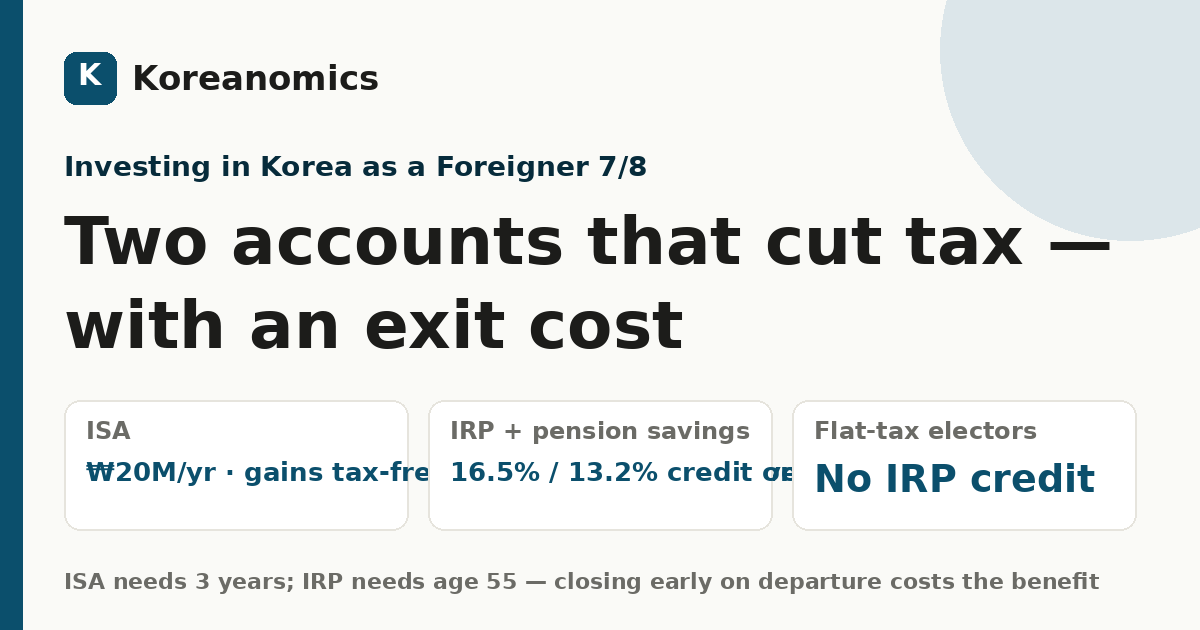
Foreign residents can open Korea's ISA (₩20M/yr, gains tax-free to ₩2–4M then 9.9%) and IRP (16.5%/13.2% credit on ₩9M). Flat-tax electors get no IRP credit.
Contents
Korea has two tax-advantaged accounts that any tax resident — including a foreigner with an ARC — can use: the ISA (개인종합자산관리계좌), a wrapper that makes investment income partly tax-free and the rest lightly taxed, and the pension savings / IRP pair, which pay you a tax credit for contributing and defer tax until retirement. Both are worth understanding; whether either is worth using depends on two foreigner-specific facts — the flat-tax election and how long you will stay. This part covers the 2026 rules, the exit cost, and a calculator for each.
ISA and IRP benefit calculator (2026)
ISA: contributions up to ₩20,000,000/yr and ₩100,000,000 total; net income tax-free up to ₩2,000,000 (₩4,000,000 if salary ≤ ₩50,000,000), the rest at 9.9% instead of 15.4%, settled when closed after 3+ years. IRP/pension savings: credit 16.5% (salary ≤ ₩55,000,000) or 13.2% on up to ₩9,000,000 (₩6,000,000 of it in pension savings); zero for flat-tax electors. The 2026 ISA expansion proposal (higher limits) has not been enacted.
ISA: the wrapper that pays off in three years
The ISA is a single account, at a bank or broker, inside which you can hold deposits, funds, ETFs and (in the brokerage "direct-investment" type) Korean shares. You may put in ₩20,000,000 a year, ₩100,000,000 in total, with unused room carrying forward. When you close it after at least 3 years, the net investment income is taxed once: the first ₩2,000,000 is tax-free (₩4,000,000 if your salary was ≤ ₩50,000,000 when you opened it), and the rest at 9.9% separately — never comprehensively, never counting toward the ₩20M line.
What that is worth depends on what you hold. Korean shares and domestic-equity ETFs are already untaxed on gains outside an ISA, so the ISA adds little for them beyond sheltering dividends. The account earns its keep for interest, dividends, and above all Korean-listed ETFs of foreign indexes (an S&P 500 or Nasdaq ETF listed in Seoul), whose gains are dividend-taxed at 15.4% outside the ISA and count toward comprehensive taxation. Inside, they are 0% then 9.9%, and losses net against gains — which a normal account does not allow. Closing at maturity and rolling into a pension account earns a further 10% credit up to ₩3,000,000.
Foreigners with an ARC and Korean tax residency are eligible; in practice, choose a broker that has processed foreign ISA applications (Part 1's list). A non-resident cannot hold an ISA, so leaving Korea for good means closing it — after three years with the benefit, before three years without it but with no penalty. The 2026 tax-reform proposals to raise the limits and tax-free amounts were not enacted as of September 2026; the numbers above are current law.
For US persons, an ISA holding Korean funds or ETFs is a PFIC problem; a direct-investment ISA holding only individual shares is not.
Pension savings and IRP: a credit now, a lock until 55
A pension savings account (연금저축, at a broker or insurer) and an IRP (individual retirement pension, where severance also lands) share one credit: contribute up to ₩9,000,000 a year (at most ₩6,000,000 of it in pension savings) and receive 16.5% of it back if your salary is ≤ ₩55,000,000, 13.2% otherwise, through the year-end settlement. On the full ₩9M that is ₩1.19–1.49M of tax refunded. Inside, growth is untaxed until you draw it as a pension from age 55 after 5 years, at 3.3–5.5% — a large deferral benefit on top of the credit. Total contributions are capped at ₩18,000,000 a year including the uncredited part; IRPs must keep at least 30% in low-risk assets.
Two foreigner-specific caveats decide whether this is for you:
- The flat-tax election cancels the credit. Under the 19% regime there are no credits; the IRP becomes a tax-deferred account only. If you are on the flat rate (Money Basics Part 2), contribute only what you would anyway save for retirement in Korea.
- Leaving Korea is not a hardship ground. Early withdrawal for hardship (six months' medical costs, bankruptcy, a first home for the account holder) keeps the low pension tax; emigration does not. Closing the account before 55 taxes credited contributions and earnings at 16.5% — which returns the credit (16.5% in, 16.5% out) and taxes the growth. Severance sitting in an IRP is taxed at retirement-income rates when withdrawn (Money Basics Part 5), which is small; your own credited contributions are the part that stings.
The arithmetic: if you will stay in Korea until 55, or can leave the account untouched here until then (the NPS-style age rule applies wherever you live, and payment abroad is possible), the IRP is one of the best deals in Korean tax. If you expect to leave within a few years and take the money with you, the credit is a loan, not a gift — you give it back on the way out, having earned tax-free growth in between, which is roughly neutral.
Which to open first
For a foreign resident on the progressive regime planning to stay several years: IRP/pension savings up to the credit limit first (the 13.2–16.5% is immediate and certain), then the ISA for savings above that, holding the assets whose tax it actually reduces (foreign-index ETFs, bonds, dividend funds). For a flat-tax elector: ISA only. For someone leaving within three years: neither, beyond an IRP receiving severance, which you will withdraw with the small retirement-income tax.
All of this sits inside Korea's regulated financial system, with deposit protection of ₩100,000,000 per institution. The last part of the course looks at the asset class that sits partly outside it — crypto — and what a foreigner can and cannot do with it here.
Frequently asked questions
Can a foreigner open an ISA?
The law (Restriction of Special Taxation Act, Art. 91-18) opens the ISA to any Korean tax resident aged 19+ (or 15+ with employment income), and foreign residents with an ARC qualify. In practice some brokers' branches are unfamiliar with foreign ISA applicants; Kiwoom, Samsung and KIS have opened them. Bring the ARC, and proof of income if you want the 'seomin' (₩4M tax-free) tier.
I elected the 19% flat tax. Can I still get the IRP credit?
No. The flat-rate election forfeits every deduction and credit in the Income Tax Act, including the pension-account tax credit. You can still contribute to an IRP and its tax-deferred growth still applies, but the 13.2–16.5% credit that is the main reason to contribute is unavailable. ISA benefits are unaffected because they are separate taxation rules, not credits.
What happens to my ISA if I leave Korea after 2 years?
Closing before the 3-year minimum forfeits the tax benefit: the account's gains are taxed as they would have been in an ordinary account (15.4% on dividends and interest; domestic-equity gains still untaxed). There is no extra penalty. If you become a non-resident you must close it — non-residents cannot hold an ISA.
And my IRP?
Closing an IRP before 55 taxes your own credited contributions and all earnings at 16.5% as 'other income' — effectively returning the credit you received (plus tax on growth) — and taxes any severance in it at retirement-income rates. Leaving Korea is not a hardship ground for a penalty-free early withdrawal. So an IRP is only worth funding with money you can leave in Korea until 55.
Sources
- Restriction of Special Taxation Act, Art. 91-18 (ISA) — eligibility, limits, tax-free amounts, 9.9% separate taxation
- Income Tax Act, Art. 59-3 (pension account tax credit) and Art. 20-3, 21 (taxation on withdrawal)
- National Tax Service — pension account tax credit guide (연금계좌 세액공제)
- Financial Services Commission — ISA product guide and 2026 status of the proposed expansion (not enacted)
※ Educational information only. Koreanomics does not recommend specific securities or properties and is not a licensed adviser in any jurisdiction. Tax treatment depends on your residency and treaty; confirm with the National Tax Service or a licensed tax adviser.