Korean Stock Taxes for Non-Residents (2026): 22% Dividend Withholding, Treaty Rates by Country (US 15%, China 10%…), Form 29-12, Capital Gains Rules — Treaty Calculator
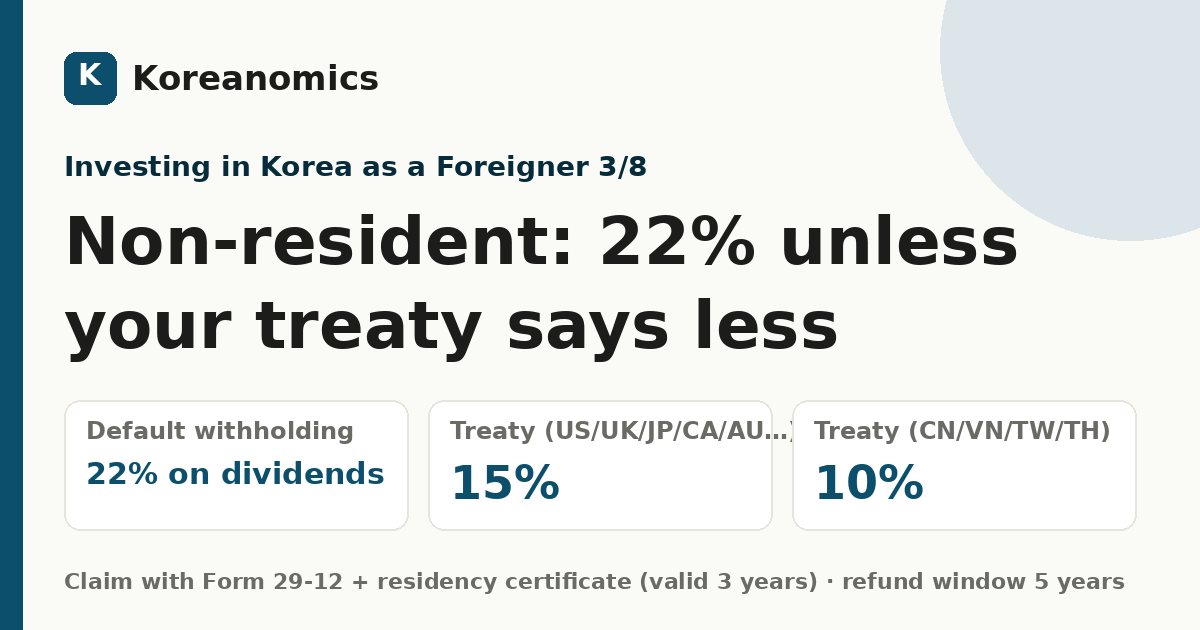
Non-residents pay 22% on Korean dividends unless a treaty cuts it (most 15%, some 10%) via Form 29-12 and a residency certificate. Gains mostly exempt.
Contents
If you invest in Korean shares from abroad — through a Korean non-resident account, an omnibus account at your home broker, or even indirectly through a Korea fund — Korea taxes you at source, and the rate depends on a treaty you have to claim. Do nothing and every Korean dividend loses 22%; file one form and it drops to 15% or 10% for most countries. This part gives the treaty table, the form, the capital-gains position, and a calculator for what a treaty claim is worth.
Non-resident dividend tax by treaty (2026)
Treaty rates are the portfolio-investor rate for individuals (holdings under the substantial-shareholding threshold); some treaties give lower rates to corporate holders of 10–25%+. Rates from the NTS treaty summary as of September 2026 — verify your own treaty article. Non-treaty countries: 22% (20% + local).
Who is a non-resident
You are a non-resident of Korea for tax if you have neither a domicile in Korea nor 183 days of presence in the tax year (from 2026, a continuous 183-day stay that straddles two calendar years also makes you resident). Non-residents are taxed only on Korean-source income — dividends and interest from Korean payers, Korean rental income, gains on Korean real estate and, in limited cases, gains on Korean shares — and always at source or by a separate return, never through the year-end settlement.
A foreigner who leaves Korea after working here becomes a non-resident from the departure date. Shares kept in a Korean brokerage account after leaving are then taxed under this part's rules, and you must tell the broker to reclassify the account; most will require you to close a resident account and reopen as a non-resident.
Dividends: 22%, or the treaty rate
The statutory withholding on dividends paid to a non-resident individual is 20% plus 2% local = 22%. Korea has tax treaties with about 95 countries, and most limit the rate on portfolio dividends to 15% (the United States, United Kingdom, Japan, Canada, Australia, Germany, France, Singapore, India, Hong Kong, the Netherlands, Switzerland, Italy, Spain, Indonesia, Malaysia, New Zealand) or 10% (China, Vietnam, Taiwan, Thailand). A few are higher: the Philippines treaty allows 25% for portfolio holders. Treaty rates for corporate shareholders above 10–25% ownership are often lower still (5–10%).
The reduced rate is not automatic. Under Article 156-2 of the Income Tax Act, you (or the broker on your behalf) file the Form 29-12 (Application for Entitlement to Reduced Tax Rate) with the withholding agent before payment, attached to a certificate of residence from your home tax authority (IRS Form 6166 for Americans; HMRC's certificate for Britons; the NTA's for Japanese). The certificate is good for three years. Without it, 22% is withheld — and the difference can be reclaimed by a correction claim within five years of the withholding, through the broker or a Korean tax agent. Older guides refer to "Form 72-3"; that was the corporate form and is not the one individuals need.
Omnibus-account investors (via Interactive Brokers and similar) generally get the treaty rate applied by the foreign broker's documentation; check your statements for the Korean withholding line.
Capital gains: usually not Korean-taxable
Domestic law taxes a non-resident's gains on Korean listed shares only where the seller and related parties held 25% or more of the company at any time during the year of sale or the five preceding years, or where the sale was off-exchange. Where tax applies, the broker withholds the lower of 11% of the sale proceeds or 22% of the gain (with local tax), and a return can be filed to settle on the actual gain.
On top of that, most of Korea's treaties assign gains on shares to the residence country — the US, UK, Japan, Germany, Canada, Australia and many others — so a non-resident from those countries pays no Korean tax on share gains at any holding size, except for shares in real-estate-rich companies (more than 50% of assets in Korean property). A handful of treaties (e.g. with some Asian and Latin American countries) let Korea tax large holdings. The securities transaction tax (0.20% on sales) applies to everyone.
The practical result: a foreign individual investor buying Korean shares from abroad pays the treaty rate on dividends and nothing on gains, and never files a Korean return unless reclaiming excess withholding.
Interest, bonds, and REITs
Korean government bonds and Bank of Korea monetary stabilisation bonds have been exempt from withholding for non-residents since January 2023 (part of Korea's push for WGBI index inclusion). Corporate bond interest is withheld at 22% or the treaty interest rate (typically 10–12%). Distributions of Korean-listed REITs and ETFs are dividends for treaty purposes and take the dividend rate above.
The home-country side
Korea's withholding is normally creditable at home: on a US return via the foreign tax credit (Form 1116), in the UK against income tax on foreign dividends, in Australia as a foreign income tax offset. The credit is limited to the treaty rate — so if 22% was withheld and your treaty says 15%, the extra 7% is generally not creditable at home and must be reclaimed from Korea. That is the single most common leak in foreign investors' Korean returns, and the reason to lodge the form before the first dividend.
Whether it is worth being a direct investor at all, versus holding a Korea ETF at home, is a question of fees, withholding and access. The next part runs the numbers on EWY, FLKR and KODEX 200.
Frequently asked questions
My broker withheld 22% even though I'm in the US. Can I get the 7% back?
Yes. File a correction claim (경정청구) with the Korean tax office through your broker or a Korean tax agent, attaching the Form 29-12 application and an IRS Form 6166 residency certificate, within 5 years of the withholding. Refunds take a few months. Going forward, lodge the form with the broker so 15% is applied at source.
Are capital gains on Korean shares taxed for non-residents?
For listed shares sold on the exchange, only if you (with related parties) held 25% or more of the company at any time in the year of sale or the 5 previous years. Below that, exempt. And most treaties — including the US, UK, Japan, Germany, Canada and Australia — reserve gains on shares to the residence country anyway, so Korean tax does not apply even above 25% unless the company is real-estate-rich.
I hold EWY in a US account. What Korean tax do I pay?
None directly. The fund pays Korean withholding on the dividends it receives (at the treaty rate for a US fund, 15%), and you receive the fund's distribution taxed under US rules. EWY's 0.59% expense ratio plus the embedded Korean withholding is the real cost — Part 4 compares it with a Korean account.
Does a treaty reduce the 22% for an ETF or REIT distribution?
Distributions from Korean-listed ETFs and REITs are dividends for treaty purposes, so yes, the same reduced rate applies with the same form. Interest on Korean bonds has its own treaty article (often 10% or 12%); Korean government bonds and MSBs have been exempt for non-residents since 2023.
Sources
- National Tax Service — Application of reduced tax rate under tax treaties (Form 29-12) and residency certificate requirement
- National Tax Service — List of Korea's tax treaties and withholding rates (English)
- Income Tax Act, Art. 119 (domestic-source income of non-residents), Art. 156 (withholding), Art. 156-2 (treaty rate application)
- Enforcement Decree of the Income Tax Act, Art. 179 (25% holding test for non-resident share gains)
※ Educational information only. Koreanomics does not recommend specific securities or properties and is not a licensed adviser in any jurisdiction. Tax treatment depends on your residency and treaty; confirm with the National Tax Service or a licensed tax adviser.