Taxes on Korean Stocks for Foreign Residents (2026): 15.4% on Dividends, No Capital Gains Tax for Small Holders, the ₩20M Threshold, Overseas Shares at 22%
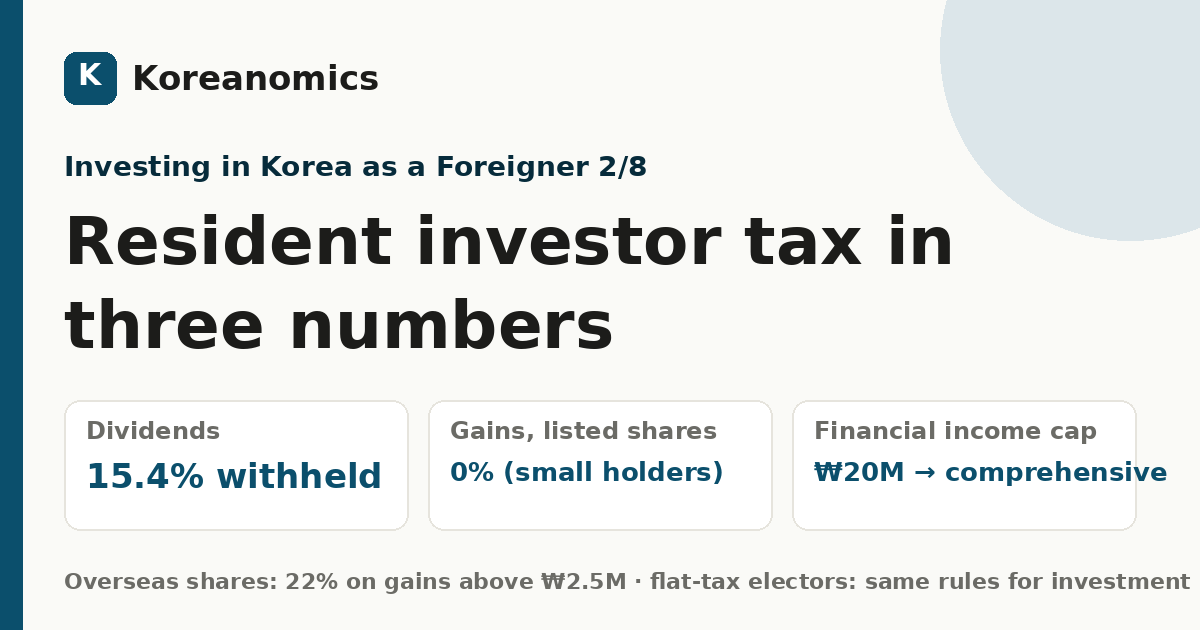
Living in Korea, your Korean shares are taxed like a Korean's: 15.4% on dividends, no tax on gains unless you hold ₩5bn of one stock, comprehensive over ₩20M.
Contents
Once you are a Korean tax resident — 183 days in the year, or a home here — your Korean investments are taxed exactly as a Korean's are, and the Korean system is unusually kind to small equity investors: no capital gains tax on listed shares for anyone below a ₩5 billion-per-stock threshold, a flat 15.4% on dividends, and a ₩20 million financial-income line below which you never file anything. This part covers the resident rules; non-residents and treaties are Part 3.
Investment income tax estimator — resident (2026)
Dividends and interest: 15.4% withheld (14% + local). Above ₩20,000,000 combined, the excess is taxed at progressive rates with the 10% dividend gross-up and credit (approximated). Overseas share gains: 22% above a ₩2,500,000 annual deduction, May return. Korean listed-share gains: exempt unless major shareholder (₩5,000,000,000 per stock).
Dividends: 15.4% and usually nothing more
Every Korean dividend is paid net of 14% income tax plus 1.4% local tax = 15.4%, withheld by the company's paying agent before the cash reaches your brokerage account. For most investors that is the end of it. The annual statement your broker issues in February lists the gross and the tax; you do not report it anywhere.
Two refinements. If your interest plus dividends exceed ₩20,000,000 in a year, the excess is comprehensively taxed: added to salary and other income in a May return at the progressive rates, with the withheld 14% credited and a 10% gross-up mechanism for Korean-company dividends. At a salary of ₩60M this adds roughly 10 percentage points of tax on the excess; at ₩150M, closer to 25. And from tax year 2026, dividends from companies that meet a "high-payout" test can be taxed separately at 14–35% instead of comprehensively, at the investor's option — a new rule from the 2025 tax reform whose company list is published by the NTS; ask your broker whether a holding qualifies before relying on it.
Dividends from foreign companies held through a Korean broker are also 15.4%-withheld in Korea (after the foreign withholding, e.g. 15% in the US, is credited against it).
Capital gains on Korean shares: exempt for almost everyone
Gains on listed shares sold on the exchange are not taxed unless you are a major shareholder of that company — holding ₩5,000,000,000 or more of it (market value) at the end of the previous year, or 1% of a KOSPI / 2% of a KOSDAQ company's shares. Major shareholders pay 20% up to ₩300M of gains and 25% above (22%/27.5% with local tax), on a return in the second month after the half-year of sale. The 2025 attempt to lower the threshold to ₩1 billion was withdrawn; ₩5 billion stands for 2026.
What you do pay is the securities transaction tax, 0.20% of the sale amount in 2026 (it was 0.15% in 2025 and was raised for 2026), deducted by the broker. Domestic ETFs are exempt. Off-exchange sales of listed shares, and sales of unlisted shares, are taxable at 10–20% regardless of size.
The financial investment income tax (금융투자소득세) that would have taxed all gains above ₩50M from 2025 was repealed in December 2024. It is not law, and no bill to revive it is before the Assembly as of September 2026.
Overseas shares: 22% above ₩2.5M
Foreign-listed shares held through a Korean broker — US, Japanese, Hong Kong stocks — are taxed on gains at 22% (20% + local) after a ₩2,500,000 annual deduction, netting gains and losses across all foreign shares in the calendar year, on a May return that your broker will prepare for a fee or that Hometax pre-fills. Because losses offset gains within the year, harvesting a loss in December against a gain is standard practice. Korean-listed ETFs that track foreign indexes are not overseas shares: their gains are taxed as dividend income at 15.4% and count toward the ₩20M line — Part 4 explains why that matters.
If you hold foreign shares in a home-country account and are a short-term resident (5 years or less in Korea of the last 10), gains and dividends there are Korean-taxable only if brought into Korea; after five years, worldwide income is taxable with a foreign tax credit.
Reporting, and where the flat rate fits
Residents with under ₩20M of financial income, no overseas share gains and no major-shareholder sales file nothing. Overseas gains go on the May return (comprehensive return period, May 1–31, penalty-free). Financial income over ₩20M goes on the same return. None of this changes if you elected the 19% flat rate on salary: that election covers employment income only.
For treaty purposes, note that becoming a Korean resident can make you a non-resident at home; a US citizen stays taxable at home regardless, but a Briton or Australian may leave their home system, which changes where dividends on home-country holdings are taxed. The next part looks at the mirror image — a non-resident investing in Korea, and what treaties do to the 22% withholding.
Frequently asked questions
I elected the 19% flat tax on salary. Does it cover dividends?
No. The flat rate applies to employment income only. Dividends, interest, capital gains on overseas shares and rental income are taxed under the normal rules described here. What the flat-rate election does remove is the pension-savings/IRP tax credit (Part 7).
Do I ever pay capital gains tax on Korean listed shares?
Only if you are a 'major shareholder' — holding ₩5 billion or more of one company's shares at the end of the previous year (or 1%/2% of a KOSPI/KOSDAQ company) — or if you sell listed shares off-exchange. Everyone else pays only the 0.20% transaction tax on sale. A financial investment income tax that would have taxed gains above ₩50M was repealed in December 2024 and is not scheduled to return.
What is 'comprehensive taxation of financial income'?
If your interest plus dividends in a calendar year exceed ₩20 million, the excess is added to your other income (salary, rent) and taxed at the progressive 6–45% rates in a May return, with credit for the 14% already withheld. Below ₩20M the 15.4% withholding is final and you file nothing.
I moved to Korea two years ago and still hold shares at home. Are they taxed here?
As a 'short-term resident' (resident in Korea for 5 years or less of the last 10) you are taxed on foreign-source income only to the extent it is paid in Korea or remitted to Korea. Dividends kept in your home brokerage account are outside Korean tax. After the 5-year mark you become taxable on worldwide income, with a foreign tax credit.
Sources
- Income Tax Act, Art. 14 (comprehensive taxation threshold), Art. 94 (capital gains scope), Art. 129 (withholding rates)
- Enforcement Decree of the Income Tax Act, Art. 157 (major shareholder ₩5bn threshold)
- Securities Transaction Tax Act Enforcement Decree — 2026 rate 0.20%
- PwC Worldwide Tax Summaries — Korea, income determination (short-term resident rule)
※ Educational information only. Koreanomics does not recommend specific securities or properties and is not a licensed adviser in any jurisdiction. Tax treatment depends on your residency and treaty; confirm with the National Tax Service or a licensed tax adviser.