Buying Property in Korea as a Foreigner (2026): The Seoul/Gyeonggi Land-Permit Zone to August 2027, Acquisition Tax, Mortgages, Reporting — Cost Calculator
Foreigners can buy Korean property, but since Aug 2025 all of Seoul and 30 Gyeonggi/Incheon areas need a permit (to Aug 25, 2027) with a 2-year live-in rule.
Contents
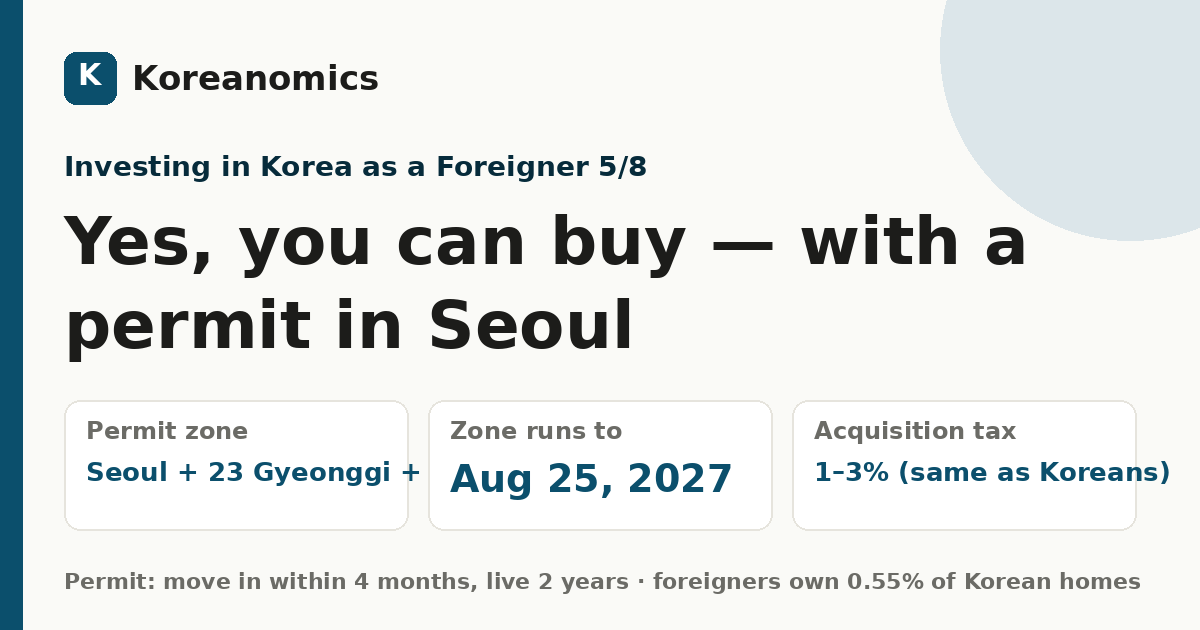
Korea has no nationality restriction on owning property: a foreigner can buy an apartment, a house or land outright, in their own name, resident or not. What changed in August 2025 is where. In response to a surge of foreign — largely Chinese — purchases in the capital, the government designated all of Seoul, 23 Gyeonggi cities and counties and the Incheon districts as a foreigner land-transaction permit zone, and on August 20, 2026 extended it to August 25, 2027. Inside the zone a foreigner needs a permit that comes with a two-year live-in requirement; outside it, the rules are the same as for Koreans plus a report. This part covers the permit, the taxes, the loan, and the steps, with a cost calculator.
Foreign buyer cost check (2026)
Acquisition tax 1% ≤ ₩600M, sliding 1–3% to ₩900M, 3% above; 8%/12% surcharges for 2nd/3rd homes in regulated areas (3rd/4th elsewhere); + local education tax and rural special tax (85㎡+). First-home relief up to ₩2M (price ≤ ₩1.2bn). Loan: LTV 40% in regulated areas (70% for first-time buyers), capped at ₩600M/₩400M/₩200M by price band; 70% elsewhere. Brokerage fee up to 0.4–0.7% negotiable. Permit-zone rules per MOLIT 2025-08 designation.
The permit zone (2025–2027)
Under the Act on Report on Real Estate Transactions, the Ministry of Land can designate zones where foreign individuals and foreign-controlled companies need a permit to buy. On August 26, 2025 it did so for the first time for the housing market: All 25 Seoul districts, 23 Gyeonggi cities/counties and the Incheon districts designated in 2025. The designation was for a year and was extended on August 20, 2026 to August 25, 2027.
Inside the zone, before signing a purchase contract for a home (or the land under it), a foreign buyer applies to the district office with a funding plan (자금조달계획서 — bank statements, loan approval, remittance records; unexplained foreign cash is the main reason for refusal), proof of status (ARC, or for a non-resident the passport and registration number), and a declaration to move in within 4 months and live there 2 years. Purchases to rent out or hold empty are refused; buying without a permit is a criminal offence and the contract is void. Processing takes about 15 days. Effect so far: foreign purchases in Seoul fell 37% in the ten months after designation.
Outside the zone — Busan, Daegu, Daejeon, most of Gyeonggi's outer counties, Jeju's ordinary housing — a foreigner simply reports the purchase within 60 days of contract, as every buyer does, plus a separate foreigner acquisition report if the land is in a military, cultural-heritage or ecological protection area.
Foreigners owned 108,231 Korean homes at the end of 2025, 0.55% of the stock, about 56% of them Chinese nationals and 21% American, concentrated in Gyeonggi (Bucheon, Ansan, Siheung, Pyeongtaek) and Seoul.
Taxes: the same as a Korean, counted by your household
Acquisition tax on a home is 1% up to ₩600,000,000, sliding to 3% at ₩900,000,000 and above, plus a 10% local education surcharge and, for homes over 85㎡, 0.2% rural special tax — about 1.1–3.5% in total. Surcharges of 8% / 12% hit a second/third home in a regulated area (Seoul and 15 Gyeonggi districts) and a third/fourth elsewhere. "Homes" are counted per household as recorded on your alien registration, and homes abroad are not counted under current practice. A first-time buyer of a home priced ₩1.2bn or less gets up to ₩2M off. Payment is due within 60 days of the purchase, at the district office or online (WeTax), before registration. The 2026 local-tax reform proposals to ease acquisition tax had not been enacted as of September 2026.
Property tax (July and September) and, for holdings above ₩900M of assessed value (₩1.2bn for a single-home household), the comprehensive real estate tax in December, apply to foreigners identically; our sister site's Korean-language calculators work for your numbers. Capital gains tax on sale follows the Korean schedule — the 1-home exemption up to ₩1.2bn after two years of holding (and residence, in regulated areas) is available to a foreign resident; a non-resident seller gets no 1-home exemption and the buyer withholds tax at source.
Rental income from a Korean property is Korean-source income for residents and non-residents alike: a non-resident landlord files a Korean return each May through a tax agent; residents pay ordinary progressive tax (our rental-income guide has the 2026 rules).
The mortgage
A foreign resident with an ARC, Korean employment income and a Korean credit record can borrow from Korean banks on the same terms as a Korean: LTV 40% in the regulated areas (70% for first-time buyers), capped by price band at ₩600M (homes up to ₩1.5bn), ₩400M (to ₩2.5bn) and ₩200M above; 70% elsewhere; DSR 40% with a 3%p stress rate on capital-region loans, so the bank tests your repayments at a rate about 3 points above the offered 4.2–7.3%. Terms are up to 30 years in the capital region. The policy loans (Didimdol, Bogeumjari) require Korean nationality or a Korean spouse in most cases. Non-residents cannot in practice obtain a Korean home loan; foreign-bank branches in Seoul lend to their own expatriate clients occasionally.
The year-end settlement receipt (Money Basics Part 3) is the income document every bank asks for; a flat-rate elector's receipt shows gross, which banks accept.
Steps, in order
- Confirm the zone and, inside it, your eligibility for a permit (residence for two years).
- Broker (공인중개사) — commission up to 0.4% (₩900M–1.2bn: 0.5%; 1.2–1.5bn: 0.6%; above: 0.7%), negotiable, paid at closing.
- Register-of-title check (등기부등본, ₩700 online) for liens; a foreign buyer's judicial scrivener (법무사) handles registration, ₩300,000–700,000.
- Contract with 10% deposit; permit (in zone) before or as a condition of contract.
- Funding: remittance from abroad through a Korean bank with a purpose declaration (부동산 취득 신고 to the bank, which files with the Bank of Korea) — keep every receipt for the eventual sale-proceeds remittance.
- Report within 60 days; pay acquisition tax; register title (등기).
- Move in within 4 months if under a permit; keep proof of residence.
Jeju's investment-immigration scheme (F-2 for a ₩1,000,000,000 resort-property purchase, running to December 31, 2026) is the one route where property leads to a visa; it is a different animal and outside this course.
Most foreigners in Korea do not buy — they rent, and the Korean rental system has a deposit structure found nowhere else. The next part explains jeonse.
Frequently asked questions
Do I need to live in Korea to buy?
No. Non-residents can buy, but they must obtain a real-estate registration number from an immigration office (residents use their ARC number), report the purchase within 60 days, and — inside the permit zone — get a permit that requires actually living in the home for two years, which a non-resident cannot satisfy. Outside the zone, a non-resident buyer only reports.
Is the permit zone the same as Korea's 'regulated areas' for loans?
No, they overlap but are different lists. The foreigner land-transaction permit zone (all of Seoul, 23 Gyeonggi cities/counties, 7 Incheon districts) restricts who may buy. The loan 'regulated areas' (Seoul plus 15 Gyeonggi districts as of July 2026) set LTV at 40% and DSR stress rates for everyone. A Seoul apartment is inside both.
Do overseas homes count when Korea decides if I'm a 'multi-home' owner?
Acquisition-tax surcharges (8%/12%) depend on how many Korean homes your household owns; the household is defined by your alien registration record, and homes abroad are not counted under current practice. Property tax and comprehensive real estate tax likewise look at Korean holdings only.
Can I get a Korean mortgage?
Yes, with an ARC, Korean income (payslips, year-end settlement receipt) and a credit history at a Korean bank. The same LTV/DSR rules apply — 40% LTV and a 3.0%p stress rate in the Seoul regulated areas, 70% elsewhere, DSR 40% at banks. Non-residents effectively cannot borrow from Korean banks for a home.
Sources
- Ministry of Land, Infrastructure and Transport — foreigner land transaction permit zone designation (Aug 2025) and extension to Aug 25, 2027 (Aug 20, 2026)
- Act on Report on Real Estate Transactions (부동산 거래신고 등에 관한 법률), Art. 8–9 (foreigners' acquisition report and permit)
- Local Tax Act, Art. 11 and 13-2 (acquisition tax rates on housing)
- MOLIT — foreign-owned housing statistics, end-2025 (108,231 units, 0.55%)
※ Educational information only. Koreanomics does not recommend specific securities or properties and is not a licensed adviser in any jurisdiction. Tax treatment depends on your residency and treaty; confirm with the National Tax Service or a licensed tax adviser.