Crypto in Korea for Foreigners (2026): Which Exchanges Accept You (Upbit Yes, Coinone/Gopax No), the Real-Name Bank Rule, the 2027 Tax at 22%, and the Travel Rule
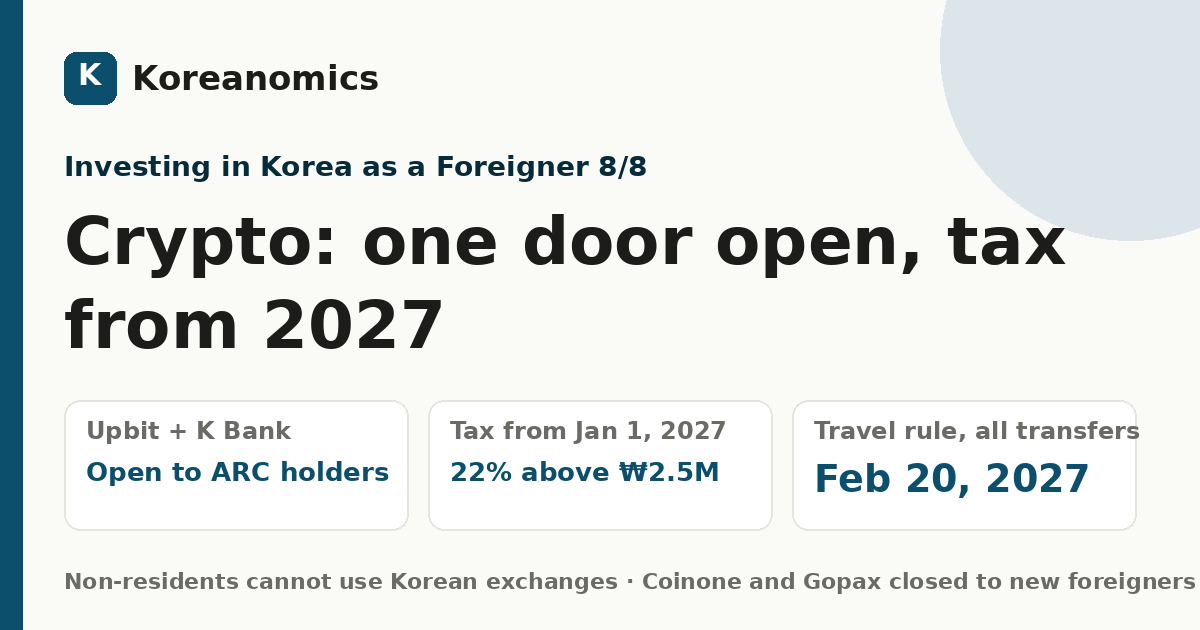
ARC holders can trade on Upbit via K Bank; Coinone and Gopax take no new foreigners; non-residents are shut out. Tax from Jan 1, 2027: 22% above ₩2.5M.
Contents
Korea is one of the world's largest crypto markets by volume and one of the most tightly walled. Trading happens on a handful of licensed won exchanges, each tied to a single bank for real-name accounts, and a foreigner's access depends on which bank will open that account. As of September 2026 the answer is essentially one exchange for foreign residents and none for non-residents. This last part of the course covers who can trade, what it costs, the tax that starts in 2027, and the rules for moving coins in and out.
Korean crypto tax estimator (rules effective January 1, 2027)
Tax = (net gains − ₩2,500,000) × 22% (20% + local), May return. Gains and losses across all virtual assets in the year are netted; losses do not carry forward. Coins held before 2027 will use the higher of actual cost or the December 31, 2026 market price as basis (per the enabling rules as drafted). Until December 31, 2026: no tax on individuals' gains.
Who can open an account
Every licensed Korean exchange must verify customers through a real-name bank account at its partner bank — Upbit with K Bank, Bithumb with KB Kookmin, Coinone with Kakao Bank, Korbit (now Digital X) with Shinhan, Gopax with Jeonbuk Bank. The exchange's foreigner policy is therefore really the bank's, plus anti-money-laundering rules that treat non-residents as higher risk. The 2026 position:
| Exchange | Foreign residents (ARC) | Non-residents |
|---|---|---|
| Upbit (K Bank) | Yes — long-term statuses; K Bank account opened in-app with ARC + passport | No |
| Bithumb (KB) | Restricted; new foreign accounts unverified in 2026 | No |
| Coinone (Kakao Bank) | No new foreign accounts | No |
| Digital X, ex-Korbit (Shinhan) | Policy pending after the September 2026 relaunch | No |
| Gopax (Jeonbuk Bank) | No new foreign accounts | No |
The Act on the Protection of Virtual Asset Users (July 2024) requires exchanges to hold customer deposits at banks, pay interest on them, keep 80% of coins in cold storage and carry insurance — protections a foreign resident on Upbit gets like any Korean. A "phase 2" law covering stablecoins, listings and exchange licensing has been debated since 2025 and had not passed the Assembly as of September 2026; the won-stablecoin provisions in it are the part to watch.
Foreigners on short-term visas, tourists and non-residents cannot open a real-name account and therefore cannot trade on any Korean exchange. This, plus the limits on moving won abroad, is what sustains the kimchi premium.
Costs
Trading fees are low — Upbit 0.05%, Bithumb 0.04% (with a coupon) — and there is no securities transaction tax on crypto. Won deposits and withdrawals through the partner bank are free or a few hundred won. Withdrawing coins to an external wallet costs the network fee plus the exchange's flat charge (Upbit: ~0.0005 BTC-equivalent scaled by coin). New accounts face a 72-hour withdrawal hold on first deposits and the limited-account daily caps of the partner bank until identity checks are complete.
Moving coins in and out: the travel rule
Korea has applied the FATF travel rule since 2022: an exchange sending coins to another VASP must transmit the sender's and receiver's names, and transfers to unregistered foreign exchanges or personal wallets require the destination address to be pre-registered (whitelisted) with identity proof. The ₩1M threshold below which small transfers were exempt is being abolished: from 2027-02-20 every transfer, whatever the amount, carries the rule. In practice: withdrawing from Upbit to a hardware wallet you own works after registering the address with a signed message; withdrawing to Binance or Coinbase works only if the exchange is on Upbit's partner list, and takes a day.
Buying crypto abroad and selling it in Korea (or the reverse) to capture the premium is arbitrage of a currency control. The Foreign Exchange Transactions Act treats systematic movements of value across the border without bank reporting as illegal; individuals have been prosecuted for organised kimchi-premium schemes. A foreign resident's ordinary personal holdings are not the target, but keep the trail clean: won in and out through your own real-name bank account, coins through registered addresses.
Tax: nothing in 2026, 22% from 2027
Individuals' gains on virtual assets are untaxed through December 31, 2026. From 2027-01-01, they become other income: annual net gains across all virtual assets, less a ₩2,500,000 deduction, taxed at 22% (20% + local) and reported in the May return — first filing in May 2028. Losses net within the year but do not carry forward. Cost basis for coins bought before 2027 will be the higher of actual cost and the end-2026 market value, so pre-2027 gains are not caught. This start date was delayed in 2021, 2022 and 2024; a fourth delay was debated in 2026 and rejected as of September, so plan on it.
For non-residents, Korean exchanges are required to withhold on any sale (the lower of 10% of proceeds or 20% of gain, plus local) from the same date — academic, since non-residents cannot hold accounts. A foreign resident who becomes a non-resident on leaving Korea should close the exchange account before departure; Upbit will suspend it when the ARC lapses.
Crypto held on foreign exchanges or in self-custody by a Korean tax resident is within the 2027 tax if realised while resident (a short-term resident is taxed on foreign-source income only if remitted, but a sale on a foreign exchange with proceeds left abroad is, in the NTS's view, still reportable for a resident of five years or more). US persons report Korean-exchange holdings on their US return in any case.
Where this course leaves you
Eight parts in, you have the mechanics of a Korean brokerage account, the two tax regimes for residents and non-residents, a way to price a Korea ETF in either country, the property permit rules, the jeonse system, the two tax-advantaged accounts and their exit costs, and the crypto position. None of it tells you what to buy. The Korean-language stock course on our sister site — starting with the account — adds order types, valuation, DART filings and the habits that matter more than any of the rules above.
Frequently asked questions
Which Korean exchange can I actually use as a foreigner?
As of September 2026: Upbit, with a K Bank real-name account, accepts foreign residents holding an ARC (F, E-7, D-2 and other long-term statuses; short-term and tourist visas are refused). Coinone and Gopax stopped onboarding foreigners; Bithumb's policy has tightened and is unverified for new foreign accounts; Korbit was acquired by Mirae Asset and relaunched as Digital X on September 16, 2026, with foreigner policy not yet announced. Check the exchange's own notice — these change without warning.
Can I use Binance or Coinbase from Korea instead?
Foreign exchanges are not licensed in Korea and block Korean residents from most services; Binance's Korean-language app was withdrawn in 2021 and Gopax (which Binance owns) is the licensed entity. Using a VPN to trade on an unlicensed exchange breaches their terms and leaves you outside Korean consumer protection. Transferring coins from a Korean exchange to your own wallet or a foreign exchange is legal under the travel rule with a registered address.
How is crypto taxed in Korea right now?
For individuals, not at all until December 31, 2026. From January 1, 2027, gains from virtual assets are 'other income' taxed at 20% plus 2% local = 22% on annual net gains above a ₩2.5M deduction, reported in the May return. The start date was postponed three times (2022, 2023, 2025); as of September 2026 it stands, with the enabling rules for cost-basis tracking being finalised.
What is the 'kimchi premium'?
The gap between Korean-exchange won prices and global dollar prices for the same coin, historically 2–10% and occasionally more. It exists because Korean exchanges are walled off — non-residents cannot buy in Korea, residents cannot easily buy abroad, and won is not freely convertible on crypto rails. Arbitraging it requires moving money out of Korea in size, which the foreign-exchange rules and the ₩50,000 no-proof remittance cap make impractical for individuals and illegal in structured form.
Sources
- Act on the Protection of Virtual Asset Users (가상자산 이용자 보호법), in force July 19, 2024
- Income Tax Act, Art. 21(1)27 and Art. 37 — virtual asset income (effective January 1, 2027)
- Financial Intelligence Unit — travel rule: abolition of the ₩1M threshold, all transfers from February 20, 2027
- Upbit — account opening for foreigners (notice) and K Bank real-name account requirements
- Korea Herald — Mirae Asset relaunches Korbit as Digital X (September 16, 2026)
※ Educational information only. Koreanomics does not recommend specific securities or properties and is not a licensed adviser in any jurisdiction. Tax treatment depends on your residency and treaty; confirm with the National Tax Service or a licensed tax adviser.