Jeonse Explained for Foreigners (2026): How Korea's Deposit-Only Lease Works, Jeonse vs Wolse Cost Calculator, Deposit Protection (HUG), and the 5 Checks Before You Sign
Jeonse: a lease with a deposit of 50–80% of the home's value and no monthly rent. The 2026 math, jeonse-to-wolse at 5%, deposit protection, fraud checks.
Contents
Jeonse (전세) is the Korean lease that confuses every newcomer: you hand the landlord a deposit equal to 50–80% of what the home is worth, live there for two years paying no rent, and get the whole deposit back when you leave. The landlord's income is what they earn by investing your money; your cost is the interest you forgo. It exists nowhere else at this scale, it is the reason Korean households hold so much of their wealth in deposits, and — because a deposit of several hundred million won sits with a private individual for two years — it carries a risk that wolse (monthly rent) does not. This part explains the economics, gives you a jeonse-vs-wolse calculator, and lists the checks that keep a foreign tenant's deposit safe.
Jeonse vs wolse — monthly cost comparison (2026)
Jeonse monthly cost = opportunity cost of your own cash at the rate entered + interest on any jeonse loan. Wolse cost = rent + opportunity cost of the smaller deposit. Legal conversion rate for changing jeonse into wolse mid-lease: 5% a year (Bank of Korea base rate 3% + 2 points). HUG guarantee premium ≈ 0.115%/yr (apartments).
How the numbers work
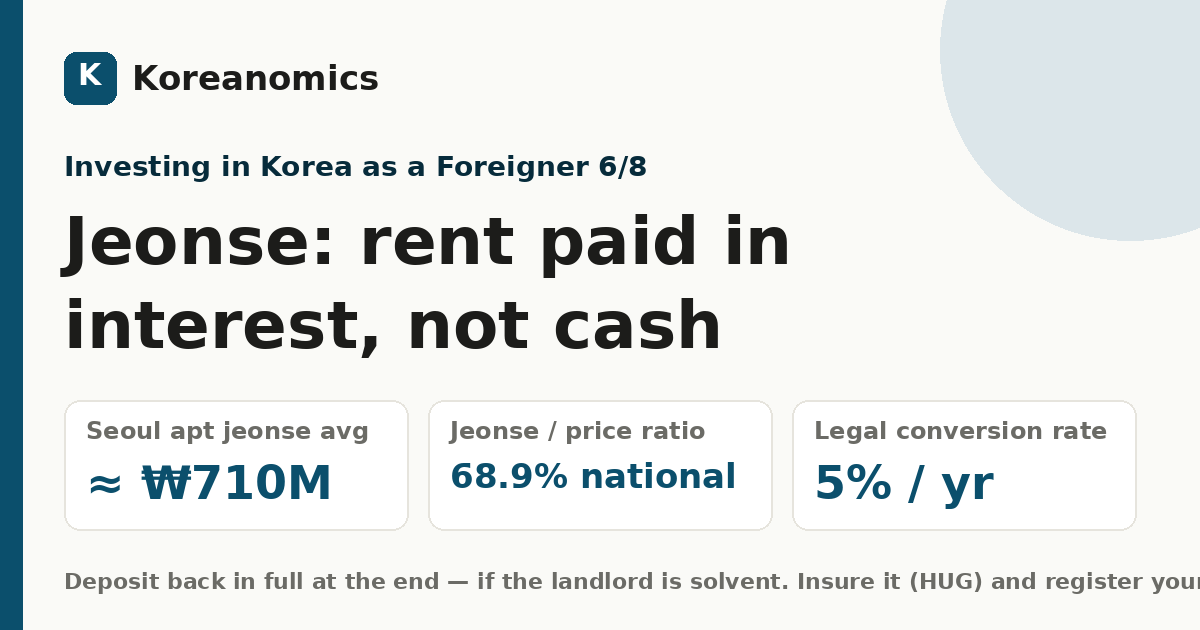
A Seoul apartment that would sell for ₩1.0 billion typically rents on jeonse for ₩600–700 million — the jeonse ratio is 68.9% nationally, 62.8% in the capital region and 74.7% in the provinces, as of May 2026. The average Seoul apartment jeonse is about 약 7억 1,000만 원 (KB 2026-08). The landlord either invests the deposit or, more often, has used it to finance buying the apartment in the first place (the "gap investment" that makes jeonse a form of interest-free leverage for owners).
For the tenant, the cost is the return the deposit would have earned. With one-year bank deposits at about 3.4%, a ₩600M jeonse costs roughly ₩1.7M a month in forgone interest — usually less than the equivalent wolse, which is why Koreans with the cash (or a cheap jeonse loan) prefer it. Wolse (월세) is the alternative: a smaller deposit (₩10–100M) plus monthly rent; semi-jeonse (반전세) is anything in between. The law fixes the exchange rate between them: when a landlord converts deposit into rent during a lease, the rent may not exceed 5% a year of the converted amount (3% base rate + 2 points).
Leases run two years, with a right to renew once for two more at no more than a 5% increase — a landlord can refuse only to move in themselves or for a few other listed reasons. For a foreigner on a three-year contract, that is four years of housing at a predictable cost.
Protecting the deposit as a foreigner
A jeonse deposit is an unsecured loan to your landlord. Three steps make it a secured one under the Housing Lease Protection Act, and every one of them is available to a foreign tenant:
- Move in and take possession.
- Register the address. Koreans do a 전입신고; foreigners file a change of place of stay (체류지 변경 신고) at the immigration office (or the district office, which forwards it) within 15 days. Article 88-2 of the Immigration Act deems this equivalent to a Korean's resident registration, giving you opposability (대항력) — a new owner or a bank cannot evict you without repaying the deposit.
- Fixed-date stamp (확정일자) on the contract at the district office (₩600) or online through the Internet Registry Office. This gives your deposit priority over later mortgages.
Do all three on moving day; priority runs from the day after registration. Then insure the deposit with the Korea Housing & Urban Guarantee Corporation (HUG, 전세보증금 반환보증) or SGI: HUG covers deposits up to ₩700,000,000 in the capital region (₩500,000,000 elsewhere) where the deposit is within 90% of the home's value including prior mortgages, at a premium of about 0.115% a year for apartments. Foreigners with an ARC can apply, within the first half of the lease. If the landlord does not return the deposit, HUG pays you and pursues them.
The five checks before signing
- Title register (등기부등본, ₩700 at iros.go.kr): the owner named must be the person you contract with and receive the deposit; any mortgage (근저당) plus your deposit should be under 70–80% of the market price; look for seizure or provisional registration entries.
- Market price on KB, the Korea Real Estate Board or recent transactions (실거래가): a deposit above 80% of value is the classic fraud pattern, common with villas (multi-unit low-rise) where prices are opaque.
- Landlord's tax arrears: for deposits over ₩10,000,000 you may check the landlord's unpaid national and local taxes before contract (unpaid taxes outrank your deposit in a forced sale).
- Other tenants' deposits in a multi-unit building (확정일자 부여현황 from the district office) — the total ahead of you matters.
- Contract terms through a licensed broker (공인중개사), with the broker's insurance certificate; the deposit is transferred to the owner's own account, never a "manager's".
Standard contracts are in Korean; an English-Korean bilingual version is available from Seoul Global Center, and the Korean text governs.
Jeonse loans and the foreigner gap
The cheapest way Koreans finance jeonse — government-backed loans at 2–4% — is largely closed to foreigners. Commercial banks lend against jeonse contracts to some F-2/F-5/F-6 holders and to E-7 employees of large companies at about 4–5%, but policies vary by bank and branch and often require a Korean guarantor. The practical options are a semi-jeonse negotiated with the landlord, or a wolse with a deposit you can afford. Company housing loans (from some large employers) are the other route.
If you do hold a large deposit, the question becomes what to do with the rest of your savings while it sits there. The next part covers the two tax-advantaged accounts open to foreign residents — the ISA and the IRP — and the flat-tax catch.
Frequently asked questions
Can a foreigner sign a jeonse lease and get the same protection as a Korean?
Yes. The Housing Lease Protection Act protects any tenant who (1) moves in, (2) registers the address — for foreigners, the 'change of place of stay' report at the immigration office or district office, which the courts treat as equivalent to a Korean's 전입신고 — and (3) gets a fixed-date stamp (확정일자) on the contract at the district office or online. Do all three on moving day.
Is jeonse cheaper than wolse?
Usually, if you have the cash. At the legal conversion rate of 5% (base rate 3% + 2 points), ₩100M of deposit is worth ₩417,000 of monthly rent. If you can earn more than 5% on that money elsewhere, wolse is cheaper; if not, jeonse is. Jeonse loans at 4–5% make jeonse cheaper than paying rent for most people who can borrow — but foreigners' access to jeonse loans is limited.
Can I get a jeonse loan as a foreigner?
The government-backed loans (버팀목 etc.) are for Korean nationals (with limited exceptions for spouses of Koreans). Some commercial banks offer jeonse loans to F-visa holders and long-term E-7 employees of large companies, at market rates; most decline other visas. Assume you need the cash, or negotiate a semi-jeonse (part deposit, part rent).
What is jeonse fraud (전세사기) and how do I avoid it?
The landlord takes a deposit larger than the property could repay — because it is mortgaged, or worth less than the deposits stacked on it, or owned by a shell company — and cannot return it. Check the title register for mortgages, compare the deposit to the market price (under 70–80%), confirm the landlord's identity and tax arrears, insure with HUG, and never pay to anyone but the registered owner.
Sources
- Housing Lease Protection Act (주택임대차보호법) — opposability, fixed date, renewal right, 5% cap, conversion rate
- Korea Housing & Urban Guarantee Corporation (HUG) — jeonse deposit return guarantee, conditions and caps
- KB Real Estate — Seoul apartment average jeonse price, August 2026
- Korea Real Estate Board — jeonse-to-price ratio, May 2026
※ Educational information only. Koreanomics does not recommend specific securities or properties and is not a licensed adviser in any jurisdiction. Tax treatment depends on your residency and treaty; confirm with the National Tax Service or a licensed tax adviser.