KOSPI ETFs: Buy in Korea (KODEX 200, TIGER 200) or at Home (EWY, FLKR, KORU)? Fees, Withholding and Tax Compared (2026 Calculator)
A Korean-listed KOSPI 200 ETF costs 0.05–0.15% a year with no capital gains tax for residents; EWY 0.59%, FLKR 0.09%, KORU 1.32% with embedded withholding.
Contents
There are two honest ways to own "Korea" as an index: an ETF listed in Seoul in a Korean account, or an ETF listed in New York (or London, or Tokyo) in your home account. They hold nearly the same companies. They differ in fees by a factor of ten, in how dividends are taxed, and in whether your gains are taxed at all — and which one wins depends entirely on whether you live in Korea. This part compares KODEX 200 and TIGER 200 with EWY, FLKR and KORU, and gives a calculator for the gap over a holding period. It is a comparison of wrappers, not a recommendation to buy Korean equities.
Korea ETF cost comparison — 20-year wealth per wrapper
Korean-listed ETF (resident): fee, 15.4% on distributions reinvested, no tax on gains. Foreign-listed ETF: fee, 15% Korean withholding inside the fund (treaty rate for US funds), then your home tax on distributions; gains taxed at home on sale at the rate you enter. Residents holding a foreign-listed ETF via a Korean broker: 22% on gains above ₩2.5M (Part 2). Simplified: no rebalancing, FX ignored, all distributions reinvested.
The line-up
| ETF | Listed | Index | Annual fee | Notes |
|---|---|---|---|---|
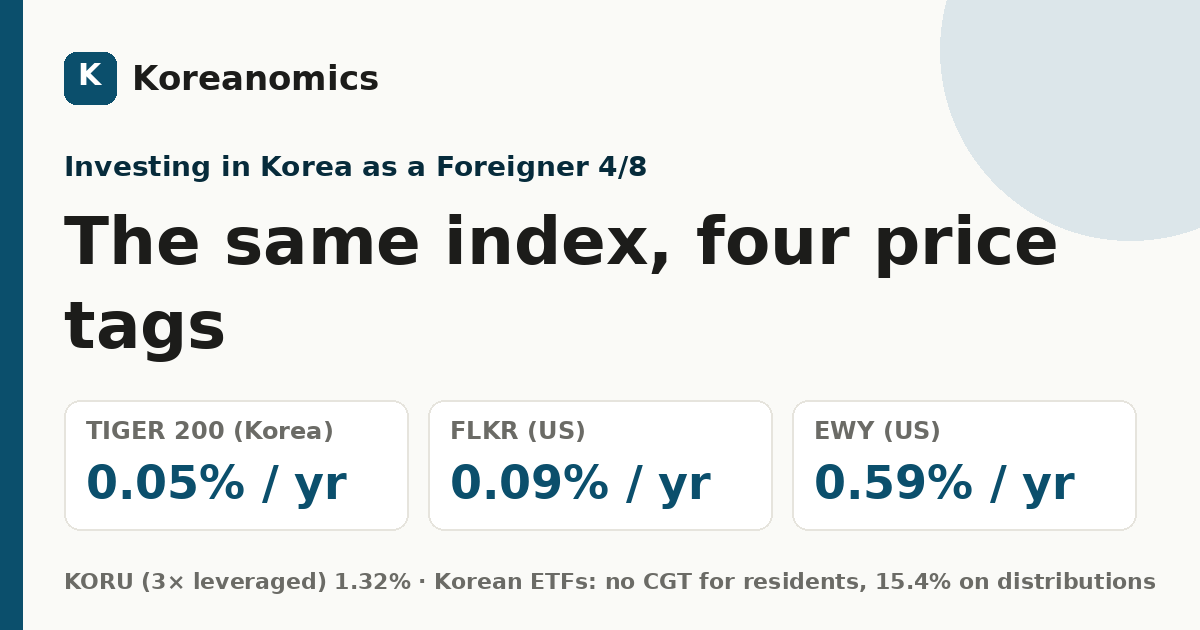
| KODEX 200 (069500) | Seoul | KOSPI 200 | 0.15% | Largest Korean equity ETF, ₩7–8 trillion, very liquid |
| TIGER 200 (102110) | Seoul | KOSPI 200 | 0.05% | Cheapest; also KBSTAR/RISE 200, ACE 200 in the same range |
| EWY iShares MSCI South Korea | NYSE Arca | MSCI Korea 25/50 | 0.59% | The default "Korea" in US accounts, ~$24bn |
| FLKR Franklin FTSE South Korea | NYSE Arca | FTSE Korea RIC Capped | 0.09% | Same exposure, a sixth of the fee, thinner trading |
| KORU Direxion Daily Bull 3× | NYSE Arca | 3× daily MSCI Korea | 1.32% | Daily-reset leverage; a trading product, not a holding |
London (HSBC/iShares MSCI Korea UCITS), Tokyo and Hong Kong list Korea ETFs too, at 0.5–0.7%.
The Korean ETF market itself is large — about 약 1,100~1,160개 ETFs and 약 450조 원 (2026-08 말) of assets — and the KOSPI 200 products are among the most liquid securities on the exchange. Trading them costs almost nothing: no transaction tax, commissions near zero, ticks of ₩5.
If you live in Korea: the Korean wrapper wins on every line
A Korean tax resident holding TIGER 200 pays 0.05% a year, 15.4% on distributions, nothing on gains (a domestic-equity ETF is exempt like listed shares), and no transaction tax on sale. The same person holding EWY through a Korean broker pays 0.59% a year, loses 15% of the dividends to US-fund-level Korean withholding and then 15.4% again in Korea on the distribution, and owes 22% on gains above ₩2.5M when selling (Part 2). Over 20 years on ₩30M at a 6% price return, the calculator's gap is several million won — mostly the fee and the gains tax. Holding the Korean ETF inside an ISA (Part 7) widens it further.
The one group this does not apply to is US citizens and green-card holders, for whom any non-US fund is a PFIC; for them the Korean account is for individual shares, and Korea-as-an-index is bought at home.
If you live abroad: FLKR or a non-resident account
From the US, the honest comparison is FLKR against EWY: identical exposure for most purposes, 0.09% against 0.59%, so EWY's only case is liquidity for very large or very frequent trades. Both suffer the same Korean withholding inside the fund (15% under the US treaty) and are then taxed as ordinary US ETFs — qualified dividends, long-term capital gains rates. For an investor in the UK, Australia or Europe, a UCITS Korea ETF listed in London or Dublin avoids US estate-tax exposure and 30% US withholding on distributions, at a fee around 0.65%.
A non-resident Korean brokerage account (Part 1) holding TIGER 200 is the cheapest wrapper of all — 0.05%, treaty-rate withholding on distributions, no Korean gains tax, and home tax on gains — but the account is slow to open and the shares are in won, so it makes sense only for someone with a lasting Korean connection or a large allocation. Omnibus accounts via foreign brokers will admit ETFs from 2027-01-01, which should close most of this gap for retail investors.
Leveraged and inverse: read the fine print
KORU (3× daily) and the Korean-listed KODEX 레버리지 (2× daily) and KODEX 200선물인버스2X reset daily; over months their return is not 2× or 3× the index and volatility erodes them. Korean rules require residents to complete a short online course before trading leveraged or inverse ETFs. They belong in this comparison only to note that their fee is a small part of their cost.
Currency
Every one of these is a won bet. EWY is priced in dollars but its assets are won, so a 10% won fall shows up as a 10% loss in EWY just as it does in KODEX 200 converted back. Korean-listed ETFs of foreign indexes come in hedged (환헤지, suffix "(H)") and unhedged versions; Korea ETFs listed abroad are unhedged. The 24-hour won market since July 2026 has narrowed but not removed the spread on conversion.
The next part leaves paper assets for the one Korean investment with a permit regime built specifically around foreigners: property.
Frequently asked questions
What is the difference between KOSPI, KOSPI 200 and MSCI Korea?
KOSPI is the whole main board (about 800 companies). KOSPI 200 is the 200 largest, which KODEX 200 and TIGER 200 track — Samsung Electronics and SK hynix alone are roughly a third of it. MSCI Korea, which EWY and FLKR track, is about 90 large and mid caps including some KOSDAQ names, with similar concentration. Over long periods the three move together; the fee and tax wrapper matter more than the index choice.
Is a Korean-listed ETF really tax-free for residents?
For a domestic-equity ETF, gains on sale are not taxed and there is no transaction tax; only the distributions are taxed at 15.4%. This applies to any Korean tax resident, foreign or not. ETFs listed in Korea that track foreign indexes (a KODEX S&P 500, say) are different: their gains are taxed as dividend income at 15.4% and count toward the ₩20M comprehensive-taxation line.
Can a US citizen living in Korea buy KODEX 200?
Legally yes, but a Korean ETF is a PFIC under US tax law, which makes the US reporting punitive (Form 8621, excess-distribution rules). US persons are usually better off with individual Korean shares in a Korean account, or with EWY/FLKR in a US account. Non-US foreigners have no such problem.
Why does EWY's yield look lower than the index yield?
Korean companies pay dividends net of Korean withholding before they reach the fund — 15% for a US-domiciled fund under the treaty — and the fund's 0.59% fee comes out of the same cash. A Korean-resident holder of TIGER 200 pays 15.4% on distributions and 0.05% in fees, so keeps more of the same dividend stream.
Sources
※ Educational information only. Koreanomics does not recommend specific securities or properties and is not a licensed adviser in any jurisdiction. Tax treatment depends on your residency and treaty; confirm with the National Tax Service or a licensed tax adviser.