Returns, Refunds and Secondhand in Korea (2026): The 7-Day Online Cancellation Right, Why Shops Can Refuse a Refund, the 1372 Consumer Hotline, and Buying and Selling on Karrot (당근), Bunjang and Joonggonara Safely
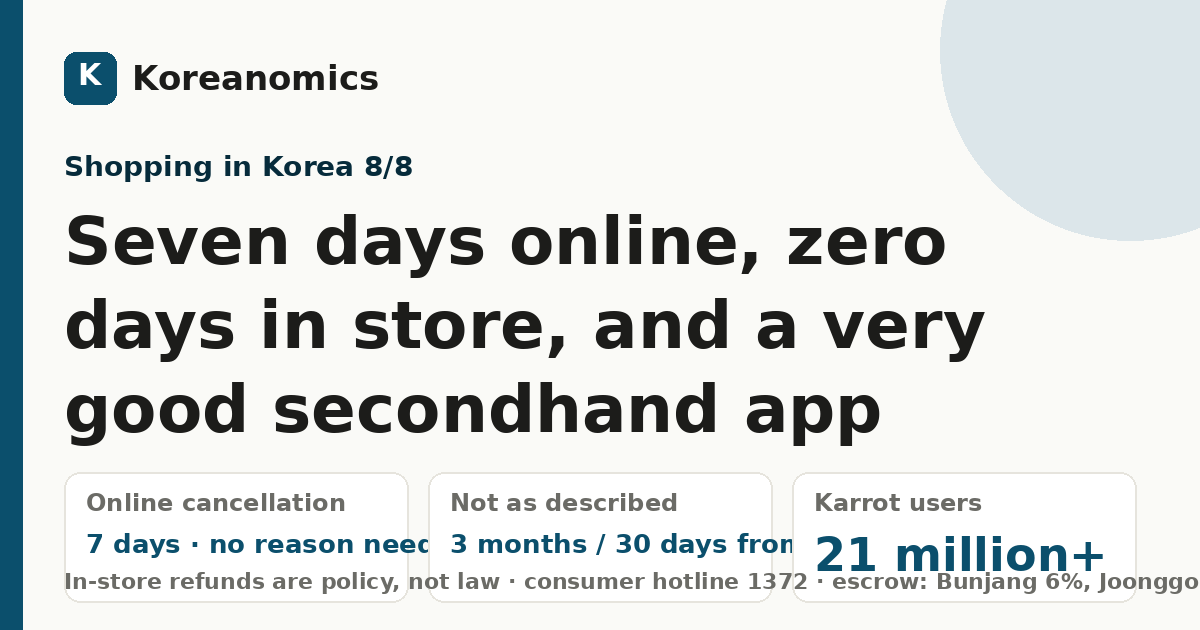
Online: 7 days to cancel by law (3 months if not as described). In-store: no legal right unless defective. 1372 hotline. Karrot 21M users, Bunjang 6% escrow.
Contents
Korean consumer law is generous online and silent in store, which surprises shoppers from both directions: the American who expects to return anything and the European who expects a two-year guarantee. And when you arrive with nothing and leave with a flat's worth of things, the secondhand apps — one of them used by 21 million people a month — are the other half of Korean shopping. This last part covers the rules, the hotline, and how to buy and sell used goods without being scammed.
Online: the seven-day right
The E-Commerce Consumer Protection Act, Article 17 gives every consumer the right to cancel an online (or phone or TV) purchase within 7 days of receiving it, for any reason, and 3 months from receipt or 30 days from discovery when the goods differ from the listing or are defective. Return shipping is the buyer's for change of mind and the seller's for faults; refunds are due within 3 business days of the return. Exceptions the sellers will cite: used or damaged goods, opened sealed goods where the seal is the value (cosmetics, underwear, software, food), perishables, custom-made goods, and digital content once played — and a seller who wants to exclude an item must have told you clearly before purchase. The platforms — Coupang (Part 4), Naver Shopping, Gmarket, 11st, Musinsa, the mart apps — have return buttons built on this law, usually more generous (Coupang's Rocket window is 30 days for unopened items), with a courier collection from your door. Marketplace sellers on those platforms are bound by the same law, and the platform's dispute process enforces it.
In store: policy, not law
There is no statutory right to return an in-store purchase you simply do not want. The Fair Trade Commission's Consumer Dispute Resolution Standard (소비자분쟁해결기준) governs defective goods — repair, exchange or refund depending on the fault and the item's age, with clothing, shoes and electronics each having their own table — and it is what 1372 mediators apply. Change-of-mind returns are the shop's policy: department stores and the big chains (Uniqlo, Musinsa Standard, Olive Young, Hi-Mart, Daiso) generally allow exchange or refund within 7–14 days with the receipt, tags on and unworn; Olive Young refunds unopened cosmetics; small shops and Dongdaemun exchange, rarely refund; sale items are often marked 교환·환불 불가 (no exchange or refund). Ask before paying — 환불 돼요? — and keep the receipt (영수증), which is also what the tax refund and the warranty run on. Card payments can be reversed at the till on the day (취소); after that it is a refund to the card in 3–7 days.
The hotline and the escalation
1372 (소비자상담센터, weekdays 9–18, Korean) is the single front door for consumer complaints: counsellors mediate with the seller, and unresolved cases go to the Korea Consumer Agency's dispute-resolution committee, free and binding-ish (sellers usually comply). The same service runs the consumer.go.kr (소비자24) portal, where you can file in writing. For foreigners the barrier is language; the immigration contact centre (1345) offers three-way interpretation for public services, and the platforms' in-app disputes are the practical route for online purchases. Fraud — a shop that took the money and vanished — is a police matter (112) and a card-chargeback matter with your bank.
Secondhand: Karrot, Bunjang, Joonggonara
당근 (Karrot) — over 21 million monthly users, the country's most-used app after the messengers — is hyperlocal: listings from your verified neighbourhood, chat in the app, meeting in person, cash or 당근페이 transfer, a "manner temperature" (매너온도) reputation score starting at 36.5 °C, and a 나눔 (free giveaway) category that furnishes many a foreigner's first flat. No fees for private sellers. The domestic app is Korean-only (the English-language "Karrot" app is the company's separate overseas product); with live translation it is usable in an afternoon. 번개장터 (Bunjang) is the national marketplace with shipping — fashion, sneakers, electronics, K-pop goods — and mandatory 번개페이 escrow on most listings, with a seller fee raised to 6% in September 2025. 중고나라 (Joonggonara), the oldest, runs on Naver Café listings and its own app with a 1% escrow fee reintroduced in 2025. For cars: 엔카 (Encar); for phones: the carriers' trade-in programmes and Bunjang; for furniture and appliances when leaving Korea: Karrot, listed two to three weeks before the flight, priced at 30–50% of new for good-condition items, and 나눔 for the rest — the buyer collects, which solves the disposal problem (the leaving-Korea checklist has the timeline).
Not getting scammed
Meet in person and pay on collection for anything over ₩50,000; many police stations have a marked, camera-covered safe-trade spot (안전거래존 / 안심거래존 — the name varies by force) in front of the building for exactly this. Check a stranger's account number or phone on 더치트 (thecheat.co.kr), the fraud database Koreans consult before any transfer. Prefer escrow (안전결제) on shipped items and refuse a seller who insists on a direct transfer to skip the fee. Common scams: the seller who asks you to move to another messenger, the "my relative will send it" transfer, the fake escrow link, and — for sellers — the buyer who sends a screenshot of a transfer that never arrives. Reputation scores and account age are the first filter; a fresh account selling a phone at half price is the second.
The end of the course
Olive Young timed to a sale week with the refund, the pharmacy's counter drugs and the night pharmacy finder, the skin clinic's real price list, a foreign card in Coupang and the WOW break-even, the sizes decoded, the calendar, the phone bought unlocked on an MVNO plan, and the rules for when it goes wrong. For the money that pays for all of it, the Money Basics course starts with your payslip.
Frequently asked questions
Can I return something to a shop?
Only if the shop's policy allows it or the item is defective. Korea's consumer dispute standard gives no general right to return an in-store purchase for change of mind; most chains and department stores allow exchange or refund within 7–14 days with the receipt and tags as policy, small shops and markets often exchange only, and sale items and opened cosmetics are usually final. Defective goods must be repaired, replaced or refunded under the dispute-resolution standard. Ask before paying: 환불 돼요? (refund possible?).
What are my rights on an online purchase?
Strong ones. Under the E-Commerce Consumer Protection Act (Article 17) you can cancel any online order within 7 days of receiving it without giving a reason — the seller pays the return shipping if the goods were faulty or not as described, you pay it for change of mind — and if the goods differ from what was advertised you have 3 months from receipt, or 30 days from discovering the problem. Exceptions: goods you have used or damaged, opened sealed items where the seal was the value (cosmetics, software), perishables, custom-made items, and digital content once accessed. Coupang, Naver and the marts build their return buttons on this law.
Who do I complain to?
1372, the Consumer Counselling Centre (소비자상담센터) run through the Korea Consumer Agency — phone 1372 or the consumer.go.kr website, Korean-language, weekdays. It mediates with the seller and escalates to the Consumer Agency's dispute-resolution process, which is free. English support is limited; a Korean-speaking friend or the immigration contact centre's interpretation line (1345) helps. For platforms, the in-app dispute process comes first.
Is Karrot safe for a foreigner?
Yes, and it is the best way to furnish an apartment or empty one. 당근 (Karrot) is a neighbourhood marketplace — listings within a few kilometres, verified by GPS, with in-app chat, a 'manner temperature' reputation score and 당근페이 for payment. The app is Korean-language (the international 'Karrot' app is a separate product for other countries), so machine translation is part of the workflow. Meet in daylight in a public place — many police stations offer marked 'safe trade' spots — pay on collection, and check the seller's temperature and account age.
Sources
- law.go.kr — Act on Consumer Protection in Electronic Commerce, Article 17 (withdrawal of subscription)
- Korea Consumer Agency — 1372 Consumer Counselling Centre
- Daangn (Karrot) — 2025 annual results: 21 million+ monthly users
- The Scoop — Bunjang escrow (번개페이) fee raised to 6% (September 2025); ZDNet Korea — Joonggonara reintroduces 1% fee
※ This article summarises publicly available rules as of the date shown. Your situation may differ; confirm with the relevant Korean authority (National Tax Service, Ministry of Employment and Labor, National Pension Service, Immigration) or a licensed professional before making decisions.