Korean Pharmacy Guide for Foreigners (2026): How the Prescription System Works, What Over-the-Counter Medicine Costs, the 13 Convenience-Store Medicines, Late-Night Pharmacies and a Symptom-to-Korean-Name Lookup
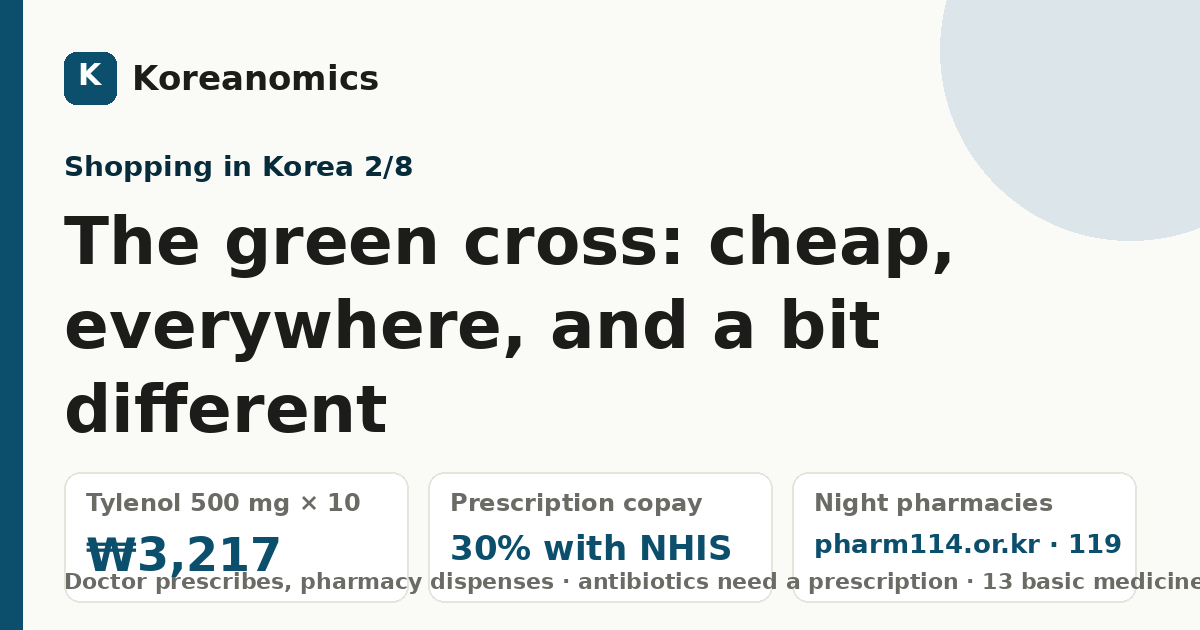
Tylenol 500 mg ₩3,217 for 10, cold syrup ₩3,000, Fucidin ₩7,429 (survey, Dec 2025). Prescriptions 30% with NHIS. Night pharmacies, 13 CVS medicines, lookup.
Contents
Korean pharmacies (약국) are on every commercial street under a green cross or a large 약, open long hours, staffed by a pharmacist who will diagnose a cold at the counter, and cheap. What confuses foreigners is the line between counter and prescription — drawn in 2000 and stricter than in many countries — and the brand names, which are Korean. This part explains the system, gives the 2026 prices from the pharmacists' own survey, lists the convenience-store medicines, and has a lookup from your symptom to the Korean product and the generic name to show.
This lookup is a shopping aid — which Korean product name and generic ingredient to ask for — not medical advice. Follow the package directions and see a clinic for anything persistent, for children, in pregnancy or alongside other medicines.
Symptom to Korean medicine lookup
Brand names are common Korean products; the generic name is what to show if the brand is not stocked. Prices are the Korean Pharmaceutical Association's December 2025 national averages where surveyed, otherwise typical ranges. This is a shopping guide, not medical advice — follow the package dose, and see a clinic for anything that lasts, for children, in pregnancy, or with other medicines.
How the system works
Doctors prescribe, pharmacies dispense (의약분업, since 2000). Clinics (의원) are everywhere and cheap with national health insurance — a consultation runs ₩5,000–20,000 in copay, the prescription is sent electronically or printed, and the pharmacy beside the clinic (there is always one) fills it while you wait, charging 30% of the drug price for insured patients. Without NHIS you pay the full price, which is still low by US standards. Foreign residents are on NHIS from six months' residence or from their first job (the health-insurance guide has the rules); tourists pay full price at clinics and pharmacies and claim on travel insurance.
Over the counter (일반의약품): painkillers, cold and flu remedies, digestives and antacids, antihistamines, ointments, patches, eye drops, first-generation oral contraceptives, nicotine replacement, and the pharmacist's own recommendation, which is usually good. Prescription only (전문의약품): antibiotics, blood-pressure, cholesterol and diabetes drugs, asthma inhalers, most strong steroid creams, sleeping pills, ADHD and psychiatric medicines, the morning-after pill, and opioids. Bring a supply and a doctor's letter for anything on that list; a Korean clinic will re-prescribe most of them on sight of the packaging.
What it costs
The Korean Pharmaceutical Association's December 2025 survey of hundreds of pharmacies gives the national averages: Tylenol 500 mg × 10 ₩3,217, Geworin × 10 ₩3,626, Pancol S cold syrup × 5 ₩3,015, Panpyrin Q × 5 ₩3,175, Festal Plus × 10 ₩3,276, Fucidin 10 g ₩7,429, Madecassol Care 10 g ₩7,099. Prices are not regulated for OTC and vary ±20–30% between pharmacies — the ones near tourist areas and hospitals are dearer, the ones in residential blocks cheaper. A 2026 supply-price rise pushed Tylenol up about ₩500. There is no VAT refund on medicine.
The 13 convenience-store medicines
Since 2012, convenience stores sell 13 designated products 24 hours a day, one pack per person, not to under-12s: Tylenol 500 mg and 160 mg tablets, children's Tylenol 80 mg tablets and syrup, children's ibuprofen syrup, two cold remedies (판콜에이, 판피린티), four digestives (베아제, 닥터베아제, 훼스탈골드, 훼스탈플러스) and two pain patches (제일쿨파프, 신신파스아렉스). Two of the thirteen are no longer produced, so about eleven are on the rack. A proposal to expand the list to about 20 items — adding, for example, antihistamines and antidiarrhoeals — was under discussion in 2026 and not yet in force at the time of writing. For everything else at 2 am, the night pharmacy.
Night, holiday and English
공공심야약국 (public late-night pharmacies, typically to midnight) and 휴일지킴이약국 (holiday-duty pharmacies) are listed on pharm114.or.kr and the E-Gen (응급의료포털) app by district and date, and 119 — the emergency number, with English operators — will tell you the nearest open pharmacy or hospital. (The old 1339 health line was merged into 119 in 2013; guides that still list it are out of date.) Pharmacies near university hospitals keep hospital hours. For English, Itaewon, Myeongdong, Gangnam and hospital-adjacent pharmacies are your best odds; elsewhere, the generic name written down does the job, and the packaging carries the ingredient in English.
Bringing medicine in
Personal-use quantities of prescription medicine with the prescription or a doctor's letter are fine; controlled substances (ADHD stimulants, strong opioids, some anxiety medicines, medical cannabis) need advance permission from the Ministry of Food and Drug Safety and cannabis in any form is illegal for Koreans and foreigners alike. Pseudoephedrine cold tablets are pharmacist-only here, not banned. Next: the reason many people fly to Korea in the first place — the skin clinic, and what it charges in 2026.
Frequently asked questions
Can I buy antibiotics or my usual prescription over the counter?
No. Since 2000 Korea separates prescribing from dispensing: antibiotics, blood-pressure and diabetes medicines, strong painkillers, sleeping pills, most steroid creams and the contraceptive pill's newer generations need a prescription from a clinic (₩5,000–20,000 for a visit with NHIS), which the pharmacy next door fills. Over the counter you get painkillers, cold and flu remedies, antacids and digestives, antihistamines, ointments, patches, the morning-after pill (no — that needs a prescription too), and first-generation contraceptive pills.
What does medicine cost?
Little. A December 2025 pharmacists' association survey put the national average at ₩3,217 for ten 500 mg Tylenol, ₩3,626 for ten Geworin, ₩3,015 for five bottles of Pancol cold syrup, ₩3,175 for five Panpyrin Q, ₩3,276 for ten Festal digestive tablets, ₩7,429 for Fucidin and ₩7,099 for Madecassol ointment — with pharmacies varying ±20–30%. Prescription drugs are charged at 30% of the price for anyone on national health insurance, more for the uninsured.
Are there pharmacies open at night and on Sundays?
Yes — designated public late-night pharmacies (공공심야약국, usually to 24:00) and holiday-duty pharmacies (휴일지킴이약국), listed by district on pharm114.or.kr and in the 응급의료포털 (E-Gen) app, or by calling 119, which has English operators and will tell you the nearest one. Pharmacies near hospitals keep long hours, and the 13 convenience-store medicines cover 3 am.
Will the pharmacist speak English?
Often a little, more in Itaewon, Myeongdong, Gangnam and near the big hospitals, rarely in the suburbs; the ingredient names on packaging are in Korean and English, and showing the generic name (acetaminophen, ibuprofen, loratadine, omeprazole) works everywhere. The lookup above gives the Korean brand and generic for common needs.
Sources
- Korean Pharmaceutical Association / Kpanews — nationwide survey of common OTC medicine prices, December 2025
- Ministry of Health and Welfare — 13 designated over-the-counter medicines for convenience stores (2012–), expansion under review 2026
- Pharm114 — public late-night and holiday pharmacy finder
- National Health Insurance Service — outpatient pharmacy co-payment (30%)
※ This article summarises publicly available rules as of the date shown. Your situation may differ; confirm with the relevant Korean authority (National Tax Service, Ministry of Employment and Labor, National Pension Service, Immigration) or a licensed professional before making decisions.