Grocery Shopping in Korea (2026): E-mart, Homeplus and Lotte Mart vs Coupang vs Markets, the Closure-Day Rule, Costco's Card Problem, and What Eggs, Rice, Milk and Pork Cost — Weekly Basket Calculator
Eggs ₩7,271/30, rice ₩62,673/20 kg, pork belly ₩2,802/100 g, milk from ₩2,390 (2026). Where to shop, mart closure days, Costco ₩43,000. Basket calculator.
Where you buy groceries in Korea changes the bill by a third. The same tray of eggs is ₩7,000 at a mart, ₩6,000 on Coupang with a membership, ₩5,500 at the market stall — and the mart may be closed the day you go. This part covers the six kinds of shop, the closure-day rule, Costco's payment quirk, and the 2026 prices of a week's staples from the agricultural price service, with a basket calculator.
Weekly grocery basket (2026)
Per-person weekly basket built from KAMIS retail (August 2026): eggs ₩7,271/30, rice ₩62,673/20 kg, pork belly ₩2,802/100 g, hanwoo ribeye ₩15,736/100 g; online lowest for milk (₩2,390/L) and kimchi (₩7,825/kg); our estimates for vegetables, tofu (₩1,500–3,000), fruit and chicken (₩6,000–9,000/kg). Shelf prices at marts are the baseline (×1); the other options scale it.
The six kinds of shop
Big marts — E-mart, Homeplus, Lotte Mart, plus E-mart Traders and Lotte Mart Maxx as the warehouse formats — are the default: everything under one roof, English on many labels, foreign cards accepted, free parking with purchase, and the evening markdowns (fresh fish, sushi and bakery 30–50% off after 19:00–20:00). Their own brands (No Brand, Homeplus 심플러스, Lotte 요리하다) are 20–40% under the national brands. Corporate supermarkets (SSG Food Market, Lotte Super, GS The Fresh, Homeplus Express) are the neighbourhood size of the same thing.
Online has overtaken the marts for packaged goods: Coupang with Rocket Delivery (next morning, free for WOW members at ₩7,890 a month, see the Coupang guide) and Rocket Fresh for chilled food by 7 am; Market Kurly for premium fresh food; the marts' own apps (SSG.com/E-mart Mall, Homeplus, Lotte ON) with same-day delivery slots; and quick-commerce (B마트 from Baemin) for a 30-minute basket. Online lowest prices — milk at ₩2,390 a litre, a 3 kg tub of kimchi at ₩24,720 — run well under the shelf.
Traditional markets (시장 — Gwangjang, Mangwon and Namdaemun in Seoul; Gukje and Bujeon in Busan; every town has one) are cheapest for vegetables, fruit, seafood, tofu and prepared side dishes, sold by the pile with haggling limited to a rounding-down. Cash or a Korean card; the government's Onnuri gift certificates (온누리상품권, sold at banks at 5–10% off face value) spend here. Costco (Yangjae, Yangpyeong, Sangbong, Gwangmyeong, Ilsan, Busan, Daegu, Daejeon and more): ₩43,000 Gold Star, ₩86,000 Executive, Hyundai Card or cash only, unbeatable on imported cheese, butter, beef and the ₩2,000 hot-dog set. Convenience stores (Part 3) for the emergency egg; specialist shops — Foreign Food Mart in Itaewon, the halal grocers around the mosque, the Russian and Uzbek shops in Dongdaemun, the Filipino market on Sundays at Hyehwa, High Street Market — for what the marts do not stock.
The closure-day rule
Large marts and corporate supermarkets must close two days a month and cannot deliver on those days either. The 2012 law chose the second and fourth Sunday; since 2024 municipalities have been switching to a weekday — 76 of them by the government's April 2024 count, including Seoul's Seocho-gu and Dongdaemun-gu and Busan, with more since — so the answer is local: the store app or the door sign says which days. Online orders from a closed store are not delivered that day; Coupang and Kurly, which are not marts, deliver every day. Traditional markets and convenience stores never close.
What things cost (2026)
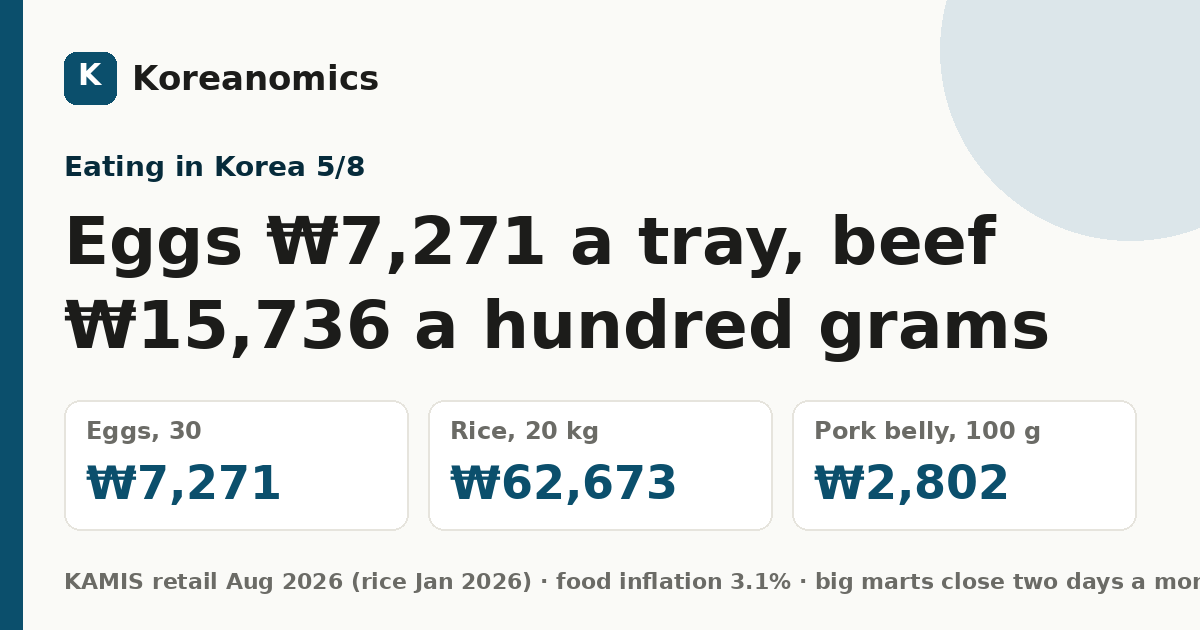
From the agricultural price service KAMIS and the year's news: eggs ₩7,271 per tray of 30 (August; up 12% on the year after avian-flu culls), rice ₩62,673 per 20 kg bag (January; up 18%, the reason the government released stocks), pork belly ₩2,802 per 100 g retail (₩17,877 per 200 g in a restaurant — Part 1), hanwoo ribeye ₩15,736 per 100 g, and vegetables that swing with the weather (napa cabbage rose 37% in a month before Chuseok). Milk is ₩2,800–3,400 a litre on the shelf, tofu ₩1,500–3,000 a block, bananas ₩3,000–4,500 a kilo (the cheap fruit), apples and grapes ₩2,000–5,000 each in gift season. The Chuseok holiday basket for four cost ₩302,500 at a traditional market versus ₩397,700 at a mart in September 2026 — the 25% gap that keeps the markets alive.
Habits that save money
Buy rice in 10 kg bags online; buy kimchi rather than make it (₩8,000 a kilo, and the good brands are good); shop vegetables at the market or on the mart's evening markdown; use the mart app's coupons (they are real: ₩5,000 off ₩50,000 is standard); learn 1+1 and 2+1 (Part 3); and cook Korean — the next parts cover the delivery apps and then the pantry that makes home cooking cheaper than any restaurant.
Frequently asked questions
Which supermarket is cheapest?
For packaged goods, online — Coupang, or the marts' own apps (SSG for E-mart, Homeplus, Lotte ON) with same-day delivery — is usually 10–25% below the shelf. For fresh produce and meat the traditional market and the discount chains' own-brand lines (No Brand at E-mart, 심플러스 at Homeplus) win. Costco is cheapest per unit on bulk imports and meat, if you have the card. The three big marts are within a few percent of each other; their mobile apps and the closure-day discounts matter more than the logo.
Why was the mart closed on a Sunday?
By law, large marts and corporate supermarkets close two days a month to protect traditional markets. For a decade that was the second and fourth Sunday, and in many towns it still is; since 2024 a growing list of municipalities — 76 by the government's count, including Seocho and Dongdaemun in Seoul and Busan — moved the closure to a weekday, typically Wednesday. Check the store's app or the sign at the door; closure days differ by district, not by chain.
Can a foreigner join Costco Korea?
Yes, with a passport or residence card at the membership desk: Gold Star about ₩43,000 a year, Executive ₩86,000 (with 2% reward). A foreign Costco card works at Korean warehouses. The catch is payment: Costco Korea takes cash, Costco gift cards and Hyundai Card only — no other credit card, Korean or foreign — so budget for cash or get a Hyundai card.
Is food expensive in Korea?
Staples are moderate: rice, eggs, tofu, vegetables in season, pork and chicken. Three categories are expensive by any standard — beef (hanwoo ribeye ₩15,736 per 100 g retail), fruit (apples and grapes are gifts here, priced accordingly) and imported goods (cheese, butter, wine, cereals). Food inflation was 3.1% in August 2026 and eggs, rice and beef all rose double digits over the year. Shop Korean, cook Korean, and it is cheap; eat like at home and it is not.
Sources
- KAMIS (aT) via Korea Institute for Food and Climate — weekly retail prices, 21 August 2026 (eggs, pork belly, hanwoo)
- Energy Economy News — rice 20 kg retail ₩62,673 and eggs ₩7,170, January 2026 (aT data)
- korea.kr — large-mart mandatory closure moved to weekdays in 76 municipalities (2024)
- Costco Korea — membership (Executive ₩86,000; Gold Star upgrade difference ₩43,000)
- Danawa — online lowest prices for milk, kimchi, gochujang (September 2026)
※ This article summarises publicly available rules as of the date shown. Your situation may differ; confirm with the relevant Korean authority (National Tax Service, Ministry of Employment and Labor, National Pension Service, Immigration) or a licensed professional before making decisions.