Korean BBQ Ordering Guide (2026): Cuts, Why '1 Portion' Is Now 150 g, the Two-Portion Minimum, Hanwoo Grades and What a Table Really Costs — Portion Calculator
Samgyeopsal ₩17,877 per 200 g in Seoul, but most restaurants now serve 150 g portions. Cuts explained, hanwoo grades, how many portions to order per person.
Contents
The first surprise at a Korean barbecue restaurant is that "one portion" (1인분) is a weight, not a person, and that the weight has been shrinking. The second is that you cannot order just one. This part explains the menu, the grades, the two-portion rule, what goes on the grill first and how much a table for two, four or six really costs in 2026 — with a calculator that uses the Korea Consumer Agency's price survey.
Korean BBQ portion and cost calculator (2026)
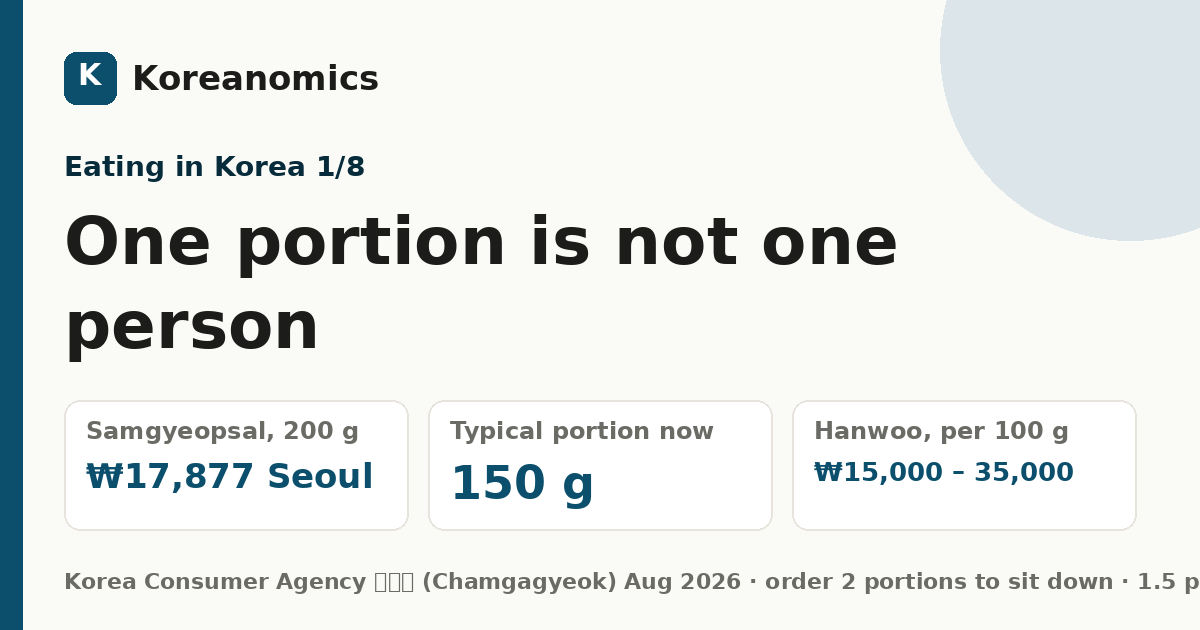
Default price is the Korea Consumer Agency's Seoul average for samgyeopsal, ₩17,877 per 200 g (August 2026; Busan ₩18,175). Change the grams to what your menu prints — 150 g is now the common portion, 130–200 g the range. Hanwoo: ₩15,000–35,000 per 100 g at restaurants (our estimate; retail ribeye is ₩15,736/100 g).
Reading the menu
A barbecue menu (고깃집) lists cuts by name with a weight and a price per portion. Pork first — it is what most tables order:
| Korean | What it is | Notes |
|---|---|---|
| 삼겹살 samgyeopsal | Pork belly, thick-cut | The default; fatty, forgiving, best cooked well |
| 목살 moksal | Pork neck / collar | Leaner, more meat flavour, the regular's choice |
| 항정살 hangjeongsal | Pork jowl | Marbled, chewy, often priced above belly |
| 갈매기살 galmaegisal | Skirt / diaphragm | Lean, intense; not seagull (갈매기) despite the name |
| 양념갈비 yangnyeom galbi | Marinated pork rib | Sweet-soy marinade; burns easily, cook on foil |
| 대패삼겹살 daepae | Paper-thin frozen belly | Cheap, fast, a student favourite |
Beef (소고기) is either 한우 hanwoo — Korean-raised, graded, expensive — or 수입 (imported), usually American or Australian, at a third of the price. Cuts: 등심 (ribeye/sirloin), 안심 (tenderloin), 살치살 (chuck flap, the marbled favourite), 차돌박이 (thin brisket, seconds on the grill), 갈비 (short rib, plain 생갈비 or marinated 양념갈비), LA갈비 (cross-cut short rib, always marinated).
The portion weight is printed beside the price, and it has been drifting down: 200 g was standard, 150 g is now the common portion, and 130 g or even 100 g appears at trendy places that keep the sticker price familiar by shrinking the plate. The Consumer Agency tracks samgyeopsal at ₩17,877 per 200 g for Seoul (August 2026, up on the year), which is why the calculator asks for the grams — the same price can mean very different value.
The rules nobody prints
Two portions minimum. A table must order at least two portions (2인분 이상), whatever its size; a solo diner either orders two or finds a 혼고기 restaurant with single grills. Included: lettuce, perilla, ssamjang, raw garlic, onion in soy, kimchi, salad and the side dishes, all refilled free on request. Extra: rice (공기밥, ₩1,000–2,000), stews (된장찌개 or 김치찌개, ₩3,000–8,000, meant for sharing), cold noodles (냉면, often a half-size 후식냉면 after meat), egg-and-rice (계란찜/볶음밥), drinks. Some restaurants add a small grill charge; none add service, and there is no tipping (Part 2 covers the bill). Water is free and self-service.
Hanwoo grades
Korean beef is graded by the Animal Products Quality Evaluation institute on marbling, colour, texture and maturity into 1++, 1+, 1, 2, 3 — the plus signs mark the marbled top of the scale, and menus quote the grade with the cut. Because grading has become generous — a large share of graded hanwoo now scores 1++ — the grade tells you less than the cut and the restaurant do. Prices in 2026 are high — retail ribeye is ₩15,736 per 100 g (KAMIS, August), restaurants charge roughly ₩15,000–35,000 per 100 g, and beef is up about 15% on the year — so hanwoo portions are sold in 100–150 g units, and a table of two can spend ₩100,000 on meat alone before rice. A hanwoo 정육식당 (butcher-restaurant, where you buy the meat at counter price and pay a small table charge to grill it) is the way to eat it at half the restaurant price.
Cooking and eating order
Most restaurants grill for you at least at the start; if not, the order is: fat side down for belly, one flip when the underside is golden, cut with the scissors into bite pieces, move cooked pieces to the cool edge. Garlic and kimchi go on the grill too. Eat by wrapping (쌈): a lettuce leaf, a perilla leaf, meat, a dab of ssamjang, garlic, one bite. Cold noodles or a stew comes last, and the rice is for the stew. The staff change the grill plate when it blackens — let them.
What a table costs (2026)
Using Seoul survey prices: two people with normal appetite on samgyeopsal at 200 g portions need two portions (about ₩36,000 in meat), three if hungry, plus a stew, two rices and two beers (about ₩20,000) — ₩55,000–75,000, or ₩28,000–38,000 each. On 150 g portions the same appetite needs three or four. On imported beef the meat costs a little more; on hanwoo, double or triple. Lunch specials (점심특선) at barbecue restaurants — a set with a smaller portion, stew and rice for ₩12,000–16,000 — are the value play if you want the experience without the evening bill.
Barbecue is the meal foreigners plan for; the next part is about the ones you eat every day — what a lunch costs in Seoul and Busan in 2026, and the customs around the bill.
Frequently asked questions
How many portions do we need?
Count 1.5 portions of pork per adult when a portion is 150 g (so 3 portions for two people), or 1 portion each when it is 200 g and you are also ordering rice and stew. Menus print the grams next to the price — read them, because the same ₩17,000 buys 200 g at one place and 130 g at the next. Order two cuts first, add a third when the plate is empty; you can always order more, never less.
Why did the waiter refuse my order for one portion?
Most barbecue restaurants have a two-portion minimum per table (2인분 이상), because a single portion does not justify firing up a grill. A solo diner orders two portions or looks for a restaurant advertising 혼고기 (solo barbecue) — increasingly common in Seoul, with individual grills.
Is hanwoo worth the price?
Korean-raised beef (한우) costs roughly two to three times imported beef and is graded 1++, 1+, 1, 2, 3 by marbling; 1++ is the richest and priciest. It is a treat, not a weeknight meal: ₩15,000–35,000 per 100 g at a restaurant in 2026, sold in 100–150 g portions, with beef prices up about 15% on the year. Imported (수입) beef or pork gives the same experience for a third to a half of the money.
What is included, and what do I pay extra for?
Lettuce and perilla leaves for wrapping, ssamjang, garlic, sliced onion, kimchi, the salad and the side dishes are included and refilled free — just ask. Rice, stews (된장찌개, 김치찌개), cold noodles (냉면) and drinks are extra, and the grill charge (판값), where one exists, is a few thousand won. There is no tipping.
Sources
※ This article summarises publicly available rules as of the date shown. Your situation may differ; confirm with the relevant Korean authority (National Tax Service, Ministry of Employment and Labor, National Pension Service, Immigration) or a licensed professional before making decisions.