Vegetarian, Vegan, Halal and Allergies in Korea (2026): The Hidden Ingredients, the 22 Labelled Allergens, Where to Eat, Temple Food, and a Korean Restaurant Card Generator
Kimchi has fish sauce; most soups use anchovy or beef stock. Korea labels 22 allergens on packets, not menus. Vegan, halal, allergy strategies + Korean card.
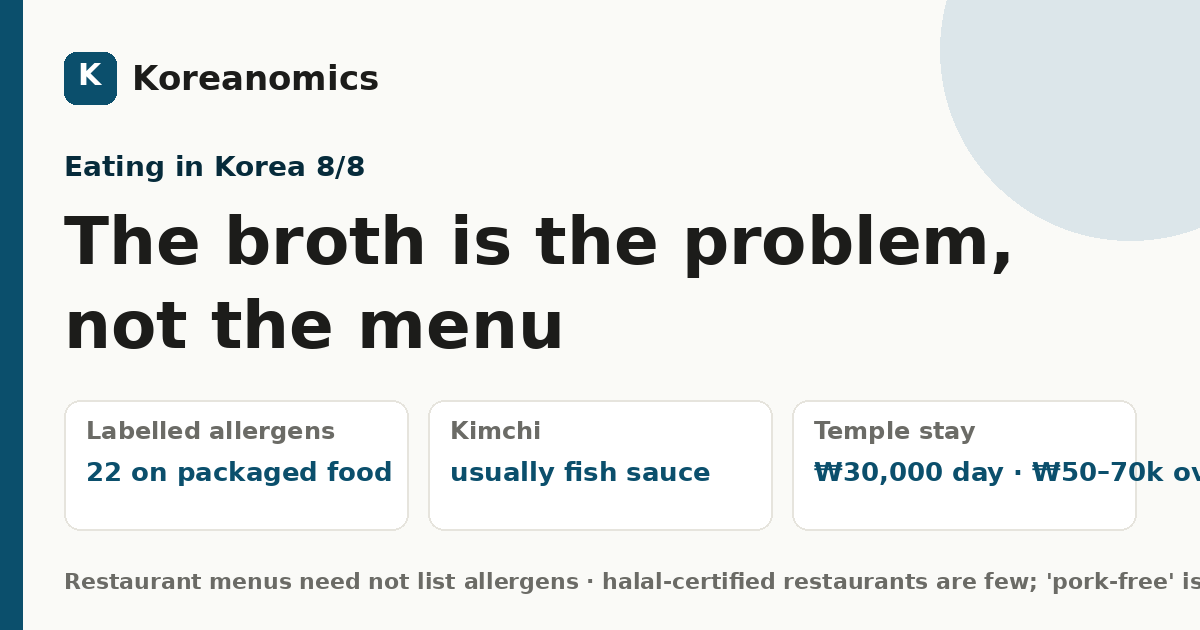
Korea is easy for people who eat everything and quietly hard for everyone else: the vegetables are seasoned with fish, the soups are built on anchovies or beef bones, the labelling law covers packets but not menus, and "no meat" is often heard as "no beef". This part is a strategy for each restriction — vegetarian, vegan, halal, allergy — with the hidden ingredients to ask about, the places that work, and a generator for a Korean card you can hand to the staff.
Korean restaurant card generator
Copy the Korean text into your phone's notes or screenshot it. Broth and fish sauce are the two things staff most often forget to mention — the card asks about both explicitly. For a severe allergy, the emergency number is 119 (English available) and the word for allergy is 알레르기 (al-le-reu-gi).
The hidden ingredients
Five things are in Korean food without being on the menu. Fish sauce and salted shrimp (액젓, 새우젓) in almost all kimchi and many side dishes — vegan kimchi (비건김치) exists in marts and online, and some restaurants use it, but assume not. Anchovy-kelp stock (멸치육수) under most soups, stews and noodle broths, including doenjang jjigae and kalguksu. Beef and bone broth (사골, 소고기 육수) under the rest — seolleongtang, galbitang, tteokguk, most ramyeon soup bases, and the "vegetable" stews at many places. Meat in the garnish: bibimbap's beef, gimbap's ham, kimchi fried rice's spam, the pork in a bean-sprout soup. And sesame, everywhere, unlabelled.
For dairy and egg the picture is better: traditional Korean cooking uses little of either, though egg is a garnish on many noodle and rice dishes and appears in gimbap and jeon.
Vegetarian and vegan
Order the plainly plant dishes and specify: bibimbap 고기·계란 빼주세요 (no meat, no egg; the gochujang is vegan), kongguksu (cold soy-milk noodles, summer), vegetable gimbap (야채김밥, still has egg unless asked), tofu dishes (두부조림, 두부김치 without the pork), japchae without beef, vegetable jeon (감자전, 호박전, 파전 — batter may contain egg; 부추전 often not), ssambap (rice and leaves with ssamjang), and the wild-greens sets of the temple towns (산채정식, ask about the broth). Restaurants marked 채식 or 비건 — Seoul's official portal lists several hundred vegetarian-friendly ones and HappyCow covers the dedicated vegan places, concentrated in Itaewon, Hongdae, Yeonnam and Gangnam — and Loving Hut and Plant are the chains. Convenience stores carry a growing vegan line (CU and GS25 both mark it), and the Korean Vegetarian Union keeps a directory. Temple food is the guarantee: vegan by definition, and free of the five pungent vegetables too.
Halal
Korea has few formally halal-certified restaurants (a handful nationally, certified by the Korea Muslim Federation), and the Tourism Organization's four tiers — halal-certified, self-certified, Muslim-friendly (halal menu available), pork-free — are the realistic map: most Muslim residents and visitors use the pork-free and Muslim-friendly Korean restaurants for seafood, chicken and vegetable dishes and check the broth. The Itaewon mosque area (Usadan-ro) has the country's densest halal cluster and grocers; Busan (near Busan Station and Haeundae) and Incheon have smaller ones; the halal-marked Korean products — Samyang's export Buldak, some Nongshim lines, Korean cosmetics — are in marts. Alcohol in cooking (mirin, cooking wine 맛술) is common in marinades; the card above asks.
Allergies
Packaged food is well labelled — the Food and Drug Safety ministry's list of 22 allergens must appear in a box on every packet, and "may contain" (혼입 가능) warnings are standard — but restaurant menus are not required to list allergens except for large franchises' children's items. Peanut is rare in Korean cooking; tree nuts appear as pine nuts on porridge and walnuts in snacks; shellfish is the big one (salted shrimp in kimchi, crab in some stews, oyster in many soups and in some kimchi); wheat is in soy sauce, most noodles and all batters (rice-based options: 쌀국수, tteok); soy is in nearly everything; and buckwheat is naengmyeon and makguksu. Sulphites appear in dried fruit and some wines. The strategy for a serious allergy: simple grilled and rice dishes over stews and mixed dishes, the written card, and the manager rather than the server.
Where the course leaves you
Order a barbecue without over-ordering, know what lunch costs in Seoul and Busan, use the convenience store and the delivery apps on your terms, cook five dishes from twelve jars, and eat here with a restriction. The Shopping and Beauty course picks up where the food ends — Olive Young, pharmacies, Coupang and Korean sizes.
Frequently asked questions
Is Korean food vegetarian-friendly?
Less than it looks. Vegetables are everywhere, but the seasoning is not: kimchi almost always contains fish sauce or salted shrimp, soups start from anchovy or beef-bone stock, doenjang stew is made on anchovy stock, and even bibimbap comes with beef unless you ask. Dishes that are reliably plant-based when ordered plainly: bibimbap without meat and egg (고기·계란 빼주세요), kongguksu (cold soy-milk noodles, summer), gimbap made without ham and egg (야채김밥), tofu dishes, temple food, and the vegetable pancakes (야채전, 감자전). Say 채식 (vegetarian) or 비건 and expect follow-up questions about fish and egg.
Is there halal food?
Yes, concentrated: the streets around Seoul Central Mosque in Itaewon (Turkish, Pakistani, Malaysian, Indonesian restaurants and halal grocers), the Korea Tourism Organization's list of halal-certified, self-certified, Muslim-friendly and pork-free restaurants, and halal fried-chicken and kebab chains in Seoul, Busan and Incheon. Formally halal-certified Korean restaurants are only a handful nationwide; most Muslim visitors use 'pork-free' Korean restaurants with seafood and vegetable dishes, and check the broth. Convenience stores and marts stock halal-marked instant noodles (Samyang's export Buldak line, for one).
Do restaurants list allergens?
Packaged food must label 22 allergens (eggs, milk, buckwheat, peanut, soy, wheat, pine nut, walnut, crab, shrimp, squid, mackerel, oyster, abalone, mussel, peach, tomato, chicken, pork, beef, sulphites — with oysters, abalone and mussels counted separately). Restaurant menus generally do not, apart from large franchises' children's items. Sesame, the ingredient in everything, is not on the Korean list at all. For a serious allergy, show a written Korean card — the generator above makes one — and choose simple dishes over stews.
What is temple food?
Buddhist monastic cooking: vegan, and also without garlic, onion, spring onion, chives and leeks. You can eat it at a temple stay (₩30,000 for a day programme, ₩50,000–70,000 for a night at most temples in 2026; the 'Happy Double' subsidised programme offers ₩30,000 overnights at about 120 temples), at the temple-food restaurants in Seoul (Balwoo Gongyang near Jogyesa is the famous one) and at the Korean Temple Food Center. It is the surest fully plant-based meal in the country.
Sources
- Ministry of Food and Drug Safety — allergen labelling standards (식품등의 표시기준)
- Korea Tourism Organization — Muslim-friendly restaurant classification (halal-certified, self-certified, Muslim-friendly, pork-free)
- Templestay (Cultural Corps of Korean Buddhism) — programmes and prices
- Korean Vegetarian Union — vegetarian restaurant directory
※ This article summarises publicly available rules as of the date shown. Your situation may differ; confirm with the relevant Korean authority (National Tax Service, Ministry of Employment and Labor, National Pension Service, Immigration) or a licensed professional before making decisions.