What Eating Out Costs in Korea (2026): Seoul vs Busan Prices for 8 Everyday Dishes, No Tipping, Free Water and Banchan, Delivery Dual Pricing — Food Budget Calculator
Kimchi stew ₩8,769, cold noodles ₩12,692, gimbap ₩3,869 in Seoul (2026); Busan 5–15% cheaper. No tipping, free refills, delivery dual pricing. Budget tool.
Contents
Korean restaurant prices are public data: the Korea Consumer Agency surveys eight everyday dishes every month in every major city and publishes the averages on its 참가격 portal. That makes it possible to say what a lunch costs in Seoul and Busan in 2026 rather than guess. This part gives the numbers, a budget calculator, and the four customs around a Korean bill that trip visitors up.
Daily food budget calculator (2026)
Built from the Consumer Agency survey (Seoul: kimchi-stew set ₩8,769, bibimbap ₩11,615, cold noodles ₩12,692, gimbap ₩3,869, samgyeopsal 200 g ₩17,877) plus typical café and Western-restaurant prices (₩5,000 coffee, ₩18,000–25,000 pasta or burger set, delivery with fees). The "regional" option scales Busan down 5%. Alcohol not included: soju ₩5,000–6,000, beer ₩5,000–7,000 a bottle in restaurants.
The survey prices, Seoul and Busan
| Dish | Seoul (2026) | Busan (June 2026) |
|---|---|---|
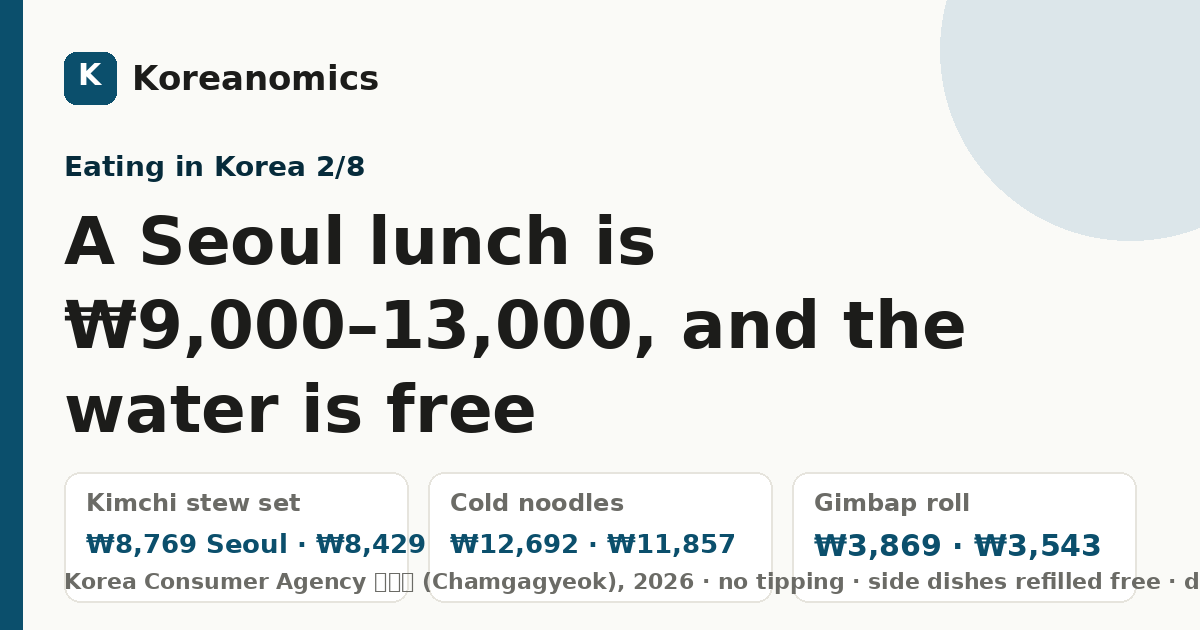
| 김치찌개 백반 kimchi-stew set with rice and sides | ₩8,769 | ₩8,429 |
| 비빔밥 bibimbap | ₩11,615 | ₩9,686 |
| 칼국수 knife-cut noodle soup | ₩10,038 | ₩8,071 |
| 자장면 black-bean noodles | ₩7,692 | ₩7,000 |
| 냉면 cold noodles | ₩12,692 | ₩11,857 |
| 삼계탕 ginseng chicken soup | ₩18,154 | ₩17,286 |
| 삼겹살 pork belly, 200 g | ₩17,877 | ₩18,175 |
| 김밥 seaweed rice roll | ₩3,869 | ₩3,543 |
Seoul figures are the Consumer Agency's monthly averages (March–August 2026 depending on the dish; kalguksu crossed ₩10,000 for the first time in March). Prices rose 2–5% over the year, in line with the 3.1% August inflation print. Busan sits 5–15% lower on most dishes and slightly higher on samgyeopsal — pork is a Busan speciality. Regional cities (Daegu, Gwangju, Daejeon) are at or a little under Busan.
Three things the table hides. A 백반 (set) means the dish plus rice, soup and five or six side dishes — it is a complete meal, not a starter. The lunch set at most restaurants (점심특선, 11:30–14:00) is ₩1,000–3,000 below the dinner price for the same food. And the cheapest hot meals in the country are gimbap shops (김밥천국-style chains): gimbap, ramyeon, tteokbokki, a kimchi-stew set, all under ₩8,000, open early and late.
What is not on the menu
No tipping, anywhere. Not in restaurants, taxis, cafés, hotels or salons; staff are paid wages and the terminal has no tip screen. Leaving cash on the table causes a chase down the street to return it. VAT is included in the menu price (the receipt shows it separately: 부가세). Water is free (self-service from a cooler, or a kettle of boiled barley tea) and so are the side dishes and their refills — ask for 반찬 더 주세요 or press the table bell. No bread, no cover charge. Extra rice is ₩1,000–2,000; alcohol is where restaurants make their margin — soju and beer ₩5,000–7,000 a bottle, three to four times the shop price.
Paying: at the counter on the way out, not at the table, usually by card (foreign Visa/Mastercard almost always works; American Express less often). Splitting the bill is done at the counter — say 따로 계산 (separate) — and is normal for friends, unusual for hosts and guests, where the older or inviting person pays.
Delivery dual pricing
A 2025–26 development worth knowing: as delivery-app commissions rose, chains and independents began listing higher prices on the apps than at the table — commonly 10–30% — on top of the delivery fee. It is legal, increasingly disclosed ("매장 가격과 다를 수 있습니다"), and it means the ₩9,000 kimchi stew is ₩11,000 delivered plus ₩3,000 in fees. Part 6 puts numbers on when delivery is worth it.
Cheaper still
Convenience-store lunch boxes (₩4,500–6,500, Part 3), university cafeterias (open to the public at most campuses, ₩4,000–6,000), department-store food halls after 19:00 (30–50% off sushi and prepared food), traditional market stalls (₩3,000–6,000 a plate), and Korea's national cheap lunch: a gimbap and a cup of instant noodles for under ₩6,000. The next part covers the convenience store, which is where most of that happens.
Frequently asked questions
Do I tip in Korea?
No — not in restaurants, cafés, taxis or hotels, and the card terminal will not ask. Prices include VAT and service. The one thing that looks like a tip is the delivery fee on apps, which is a fee, not a gratuity; and some restaurants charge more for the same dish on delivery apps than at the table (이중가격제, dual pricing) to cover platform commissions.
How much should I budget for food per day?
Eating every meal out in Seoul: about ₩25,000–35,000 a day on Korean everyday food (a gimbap or convenience-store breakfast, a ₩9,000–12,000 lunch set, a ₩12,000–18,000 dinner), ₩50,000+ with a barbecue dinner and drinks, ₩70,000+ for Western restaurants and cafés with ₩5,000–7,000 coffees. Cooking at home cuts it to ₩12,000–18,000. Busan and the regional cities run 5–15% below Seoul on the survey items.
Why is the bill lower than the menu suggested?
Korean menus show the final price: 10% VAT is included, there is no service charge, and water, side dishes (반찬) and refills of them are free. Most restaurants add nothing. The exceptions are places that charge for a grill plate, a corkage for outside alcohol, or extra rice.
Is Korea an expensive country to eat in?
Korean food in Korean restaurants is cheap by rich-country standards — a full lunch with soup, rice and five side dishes for ₩9,000 (about US$6.50). Imported and Western food is not: beef, cheese, wine, fruit and bakery cafés cost more than in most of Europe or the US. Eat Korean and it is a bargain; eat like you do at home and it is Tokyo.
Sources
※ This article summarises publicly available rules as of the date shown. Your situation may differ; confirm with the relevant Korean authority (National Tax Service, Ministry of Employment and Labor, National Pension Service, Immigration) or a licensed professional before making decisions.