Trash, Recycling, Your Address and Utilities in Korea (2026): The Bag System, Food Waste, Fines up to ₩1,000,000, Road-Name Addresses and Setting Up Gas, Power and Internet
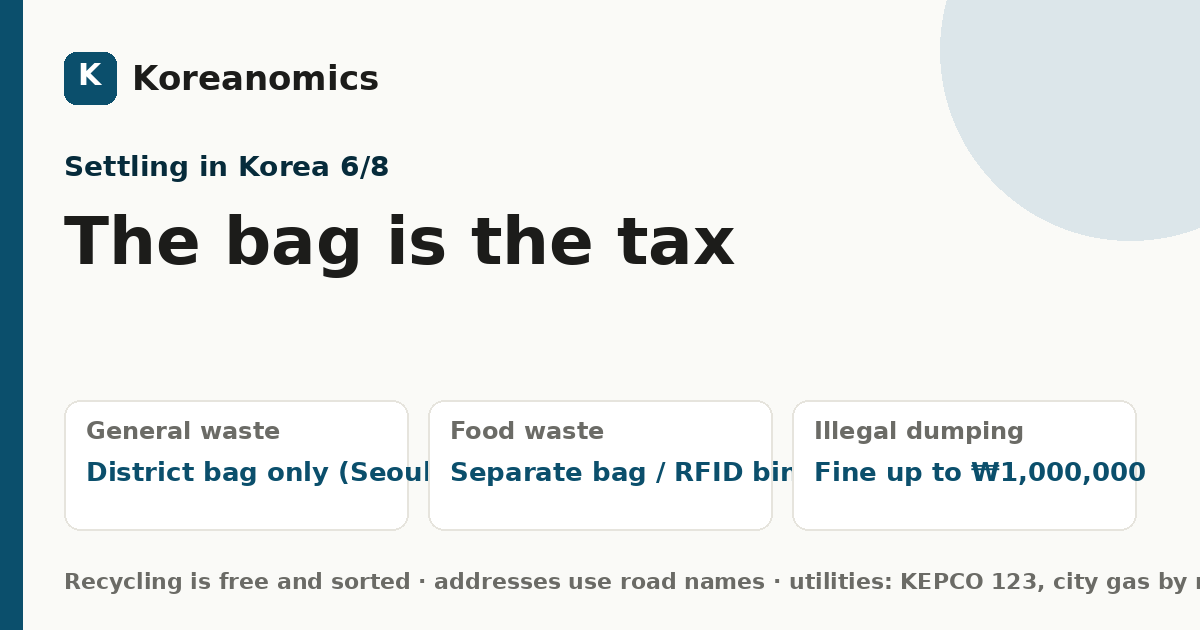
General waste goes only in your district's paid bag (Seoul 20L ₩490), food waste separately, recycling sorted. Fines, road-name addresses, utilities.
Contents
Korea recycles a higher share of household waste than almost any country, and it does so with a simple economic trick: you cannot throw anything away except in a bag you paid for, and the bag is cheap only if what is in it is small. Everything else — cardboard, plastic, glass, cans, food waste — has its own free or separate stream, and the whole neighbourhood can see whether you used them. Add the address system (two formats, one official) and three utilities to put in your name, and you have the domestic paperwork of the first month. This part covers all of it.
The bag system (종량제)
General waste goes in a volume-based bag (종량제 봉투) sold by your district: sizes 5, 10, 20, 50 and 75 litres, price set by the district and printed on the bag. Seoul's 20-litre bag has been ₩490 since 2017 in most districts; Busan and other cities are similar or slightly higher. Buy them at any supermarket or convenience store in your district — a bag from another district is not collected. For a single person a 10-litre bag a week is typical; the price is the point, because bulky things cost more to throw away than to recycle.
Put bags out on your building's collection nights (apartment complexes have a permanent bin area; villas and one-rooms have a kerb spot and a schedule on the wall or in the group chat), tied shut. Large items — furniture, appliances, mattresses — need a bulky-waste sticker (대형폐기물 스티커) bought online at the district's website or at the community centre, ₩2,000–15,000 depending on the item, and are collected on a booked day. Old appliances can be collected free by the manufacturer-funded 폐가전 무상수거 service (1599-0903).
Food waste (음식물 쓰레기)
Separate, always. Two systems: in newer apartment complexes an RFID bin in the bin area opens with your unit's card, weighs what you put in and bills the unit monthly (a few thousand won); everywhere else a dedicated food-waste bag (2, 3 or 5 litres, ₩100–500) or a bin with a paid sticker. Drain liquid first. Bones, shells, eggshells, fruit stones, corn cobs, tea bags and coffee grounds are not food waste in the legal sense (they go in the general bag) — the test is whether livestock could eat it, because that is what the collected waste becomes.
Recycling (재활용)
Free, sorted at the bin area into: paper/cardboard (flattened, tape and labels removed), plastic (rinsed, labels off, caps separate in many buildings), PET bottles (clear ones separately since 2021 — labels off, crushed), glass (rinsed; beer and soju bottles can be returned to a shop for a ₩100–130 deposit), cans/metal, styrofoam (clean, tape off), vinyl/plastic film (clean bags only), and clothing in the green textile bins. Batteries and small electronics have their own boxes at community centres. Contaminated packaging — a greasy pizza box, a dirty plastic tray — goes in the general bag. Recycling days are fixed in villas (usually one or two evenings a week) and continuous in apartment bin areas.
The system is enforced socially before it is enforced legally: apartment managers open unmarked bags, and a photograph of your envelope in a general-waste bag on the building notice board is a common first warning. The legal backstop is the Waste Control Act: illegal disposal carries a fine of up to ₩1,000,000 and districts run camera-watched dumping spots.
Addresses
Korea has used road-name addresses (도로명주소) as the sole official format since 2014: road name + building number, then the building name and unit. A full address reads, for example, 서울특별시 강남구 테헤란로 152, 강남파이낸스센터 10층 — and the five-digit postcode. The older lot-number (지번) format — district + neighbourhood (동) + lot number — still appears on older leases and some maps, and taxi drivers still navigate by neighbourhood; both describe the same building, and juso.go.kr converts between them in English. Use the road-name form for immigration (Part 1: the change-of-stay report within 15 days), banks, deliveries and every form; write it in Korean where a form allows, because English transliterations are inconsistent.
Two habits: learn your address in Korean well enough to say it to a taxi driver and type it into Coupang, and put the apartment name and unit (동·호) on everything — buildings in a complex are numbered, not named by street.
Utilities in your name
| Utility | Provider | How to set up |
|---|---|---|
| Electricity | KEPCO (한국전력), nationwide | Call 123 (English option) or the KEPCO app with your Residence Card and move-in date; the previous tenant's meter reading is taken and the account transferred. Bills monthly by post, app or autopay; villas often include it in the management fee. |
| City gas (heating, hot water, stove) | Regional company (Seoul City Gas, Samchully, Yesco, Busan City Gas …) | Book a technician visit for the move-in day through the company listed on the boiler sticker; they open the valve, check the boiler and set up billing. Same call on moving out. |
| Water | City waterworks (Seoul Arisu etc.) | Usually in the landlord's or building's name and billed via management fee; one-room buildings rarely need action. |
| Internet/TV | KT, SK Broadband, LG U+ | 100Mbps–1Gbps from ₩22,000–40,000 a month on a 3-year contract with installation in 1–3 days; many officetels and one-rooms include it in the fee. Needs Residence Card and bank account; cancellation before 3 years costs a penalty, and moving transfers the line for a fee. |
| Management fee (관리비) | Building | Monthly, covers cleaning, security, elevators, sometimes water/heating; ₩50,000–150,000 for a one-room, ₩200,000–400,000 for an apartment. Read the itemised bill; it is where "hidden" rent lives. |
Autopay (자동이체) from your Korean account is the norm and is set up by phone or in the utility's app; without it, bills come as paper giros paid at a bank, ATM or convenience store. Ondol floor heating runs on the gas boiler: keep it on low in winter rather than off — pipes and bills both prefer it.
The move-in checklist
Report the address within 15 days (Part 1), stamp the lease's fixed date at the district office the same visit (Investing Part 6), transfer electricity and book gas for the move-in day, note the RFID card or bag rule for food waste, buy the district's bags, find the recycling schedule, and learn the address in Korean. The next part takes you out of the neighbourhood: converting your driver's licence.
Frequently asked questions
Why did the convenience store refuse to sell me a trash bag?
Because bags are sold per district (구). A Gangnam-gu bag is not valid in Seocho-gu, and the store only stocks the local one. Ask for '종량제 봉투' and say the size — 10, 20 or 50 litres. Supermarkets and convenience stores in your own district all have them; prices are set by the district and printed on the bag.
What happens if I put everything in one bag?
In an apartment complex the building manager will find the bag (they are checked), photograph it and post a notice; repeat offenders are reported to the district, which under the Waste Control Act can fine illegal disposal up to ₩1,000,000. In villas and one-rooms, unsorted or unmarked bags are simply not collected and sit on the kerb with a red sticker. The system works because everyone can see who did not follow it.
Do I really have to separate food waste?
Yes — it is the rule foreigners most often break and neighbours most often notice. Food waste goes in a separate small paid bag (음식물 쓰레기 봉투, 2–5 litres) or, in most newer apartment complexes, into an RFID bin that weighs it and bills your unit monthly. Not food waste: bones, shells, eggshells, fruit stones, tea bags, and anything an animal could not eat — those go in the general bag.
My mail comes with two addresses. Which is real?
The road-name address (도로명주소: street name + building number, e.g. 테헤란로 152) has been the official one since 2014 and is what forms, deliveries and the immigration office want. The older lot-number address (지번: neighbourhood + lot, e.g. 역삼동 737) still appears on old documents and some maps. Both point to the same building; use the road-name one everywhere and add the unit (동/호) after it.
Sources
※ This article summarises publicly available rules as of the date shown. Your situation may differ; confirm with the relevant Korean authority (National Tax Service, Ministry of Employment and Labor, National Pension Service, Immigration) or a licensed professional before making decisions.