Korea's Residence Card (ARC) in 2026: Who Needs It, the 90-Day Deadline, Fees, the Mobile ID, and the 15-Day Address Rule
Stay over 90 days and you must register within 90 days of arrival (₩30,000). Now the Residence Card, with a mobile version since 2025. Deadlines and fines.
Contents
Every foreigner who stays in Korea longer than 90 days gets a Residence Card — still universally called the ARC, for Alien Registration Card, the name it carried until 2021. It is a plastic ID with a 13-digit number that works like a Korean's resident registration number: the bank needs it, the phone company needs it, the hospital, the landlord, the tax office, Coupang and Kakao all need it. Nothing in the rest of this course happens without it, which is why it is Part 1, and why the first thing to do after landing is to book the appointment.
Who must register, and by when
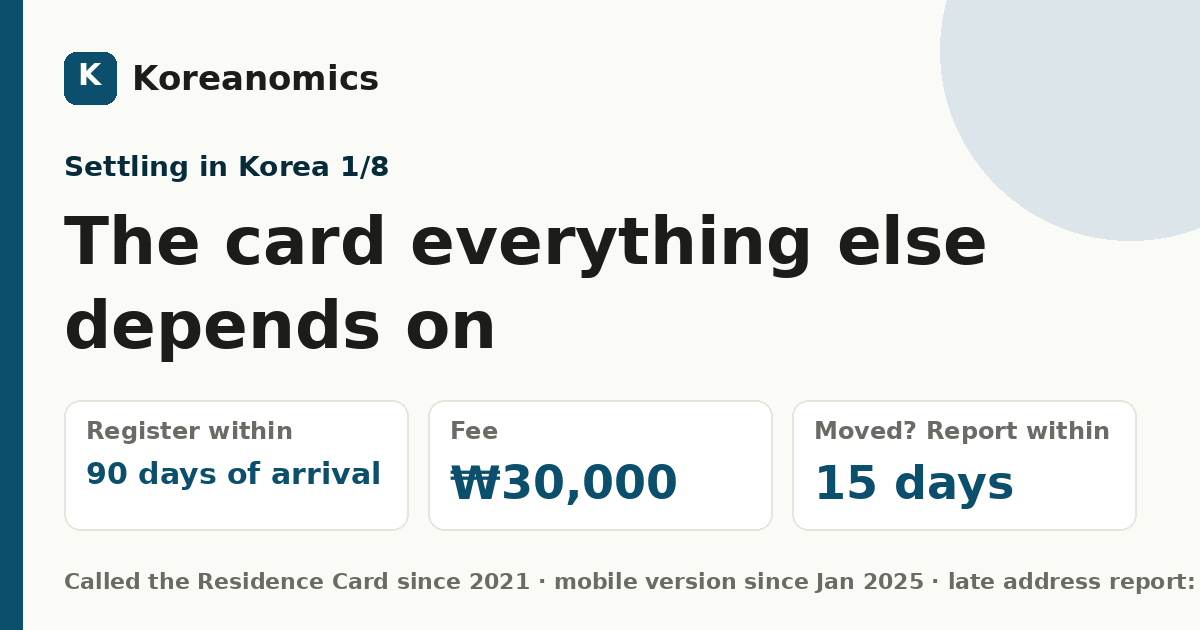
Anyone entering on a visa that allows a stay of more than 90 days — E-series work visas, D-2 students, D-10 job-seekers, F-visas, H-2, the digital-nomad F-1-D — must apply for registration at the immigration office covering their address within 90 days of arrival. Tourists and short-term visitors (B, C visas, K-ETA entries) do not register. Diplomats and a few official categories are exempt.
The deadline counts from the date of entry stamped in your passport, and the office is chosen by where you live, not where you work. The application itself is quick; the queue is not. Immigration offices in Seoul, Suwon, Incheon and Busan take online reservations only through HiKorea (hikorea.go.kr → Reservation), and slots in September (student arrivals) and March run out weeks ahead. Reserve from abroad if you can.
Documents and fee
| Item | Detail |
|---|---|
| Application form | Available at the office or on HiKorea |
| Passport | Original, with the entry stamp |
| Photo | 1, 3.5 × 4.5 cm, white background, taken within 6 months |
| Proof of address | Lease, dormitory certificate, or employer's housing letter |
| Status-specific documents | Employment contract and business registration (E-7, E-2), enrolment certificate (D-2), marriage documents (F-6), etc. |
| Fee | ₩30,000, paid by revenue stamp or card at the office |
Processing takes 2–4 weeks; the card is collected at the office or delivered by registered mail for a small fee. You get a receipt on the day, which some banks and employers accept in the meantime. If your visa has a Korean address on file already (most do), the address you give at registration becomes your official place of stay — which is what the 15-day rule below is about.
The mobile Residence Card (2025)
Since January 10, 2025, registered foreigners aged 14 and over can carry the card on their phone through the government Mobile ID app, with the same legal validity as the plastic one. Two ways to get it: scan a QR code at an immigration office (free, but you have to go back if you reinstall), or register an IC-chip card issued from January 2025 onward for ₩35,000, after which you can re-issue the mobile ID on a new phone yourself. Banks and phone shops have been accepting the mobile version since 2025, and airlines take it for domestic flights. Keep the plastic card anyway — foreign-facing services are slow to update.
The 15-day address rule
Whenever you move, you must file a change of place of stay (체류지 변경신고) within 15 days — at an immigration office, at the district (구청) or community (주민센터) office of the new address, or online on HiKorea with a scan of the new lease. It is free, takes minutes, and the online version is processed in about three days.
Why it matters: the Immigration Act treats it as an offence with an administrative fine of up to ₩1,000,000, scaled by how late you are, and unpaid fines surface at your next extension. Practically, this report is also what gives a foreign tenant the same legal protection as a Korean's 전입신고 — the opposability of your jeonse or wolse deposit (Investing course, Part 6) runs from the day after you file. Do it on moving day, together with the fixed-date stamp on your lease.
Changes you must also report
Beyond the address, the Act requires reporting within 15 days: a new passport (number or expiry), a change of name or nationality, and — for E-visa holders — a change of workplace (in fact a permit is needed before changing, see Money Basics Part 9). Students report a change of school. All of these go through HiKorea or the office.
Renewal, loss, and leaving
The card's expiry matches your visa; extending the visa extends the card. A lost card is re-issued for ₩30,000 after a report at the office (bring a photo). On final departure you hand the card to the immigration officer at the airport — registration is cancelled, which triggers the pension refund and other exit payments in Money Basics Part 14. If you hold an F-visa and plan to return within its validity, keep the card and ask for a re-entry permit exemption instead.
The number itself
The 13 digits are your identity key in Korea: the first six are your birth date, the seventh is a code (5–8 for foreigners, indicating sex and century), and the rest are assigned. Every online service that offers "본인인증" (identity verification) checks this number against a phone contract in your name — which is why Part 3 of this course, the phone, comes after Part 2, the bank, and why the order matters. The next part opens the bank account.
Frequently asked questions
Is it the 'ARC' or the 'Residence Card'?
Both mean the same card (외국인등록증). Since January 2021 the English name printed on it is 'Residence Card' — the Ministry of Justice dropped 'Alien' — but banks, phone shops, HR departments and most foreigners still say ARC. If a form asks for your 'alien registration number', it is the 13-digit number on this card.
What happens if I register after 90 days?
Late registration is not a parking-ticket-style fine. Under Article 95 of the Immigration Act, failing to register is a criminal offence punishable by up to one year in prison or a fine of up to ₩10 million; in practice Immigration imposes a fine scaled to the delay and it goes on your record, which matters at every future extension. Book the appointment before you land.
Can I open a bank account or get a phone before the card arrives?
Only partly. While the card is being made (typically 2–4 weeks) you receive a receipt (등록증 발급 신청 확인서); some bank branches will open a limited account on the receipt plus passport, and prepaid SIMs need only a passport. A postpaid phone plan, internet banking without limits and most apps that verify identity need the physical card and its number.
I moved apartments. Do I really have to report it?
Yes, within 15 days, and it is the rule foreigners break most often. Report at any immigration office, the district (구청) or community (주민센터) office, or online through HiKorea. Late reporting carries an administrative fine of up to ₩1,000,000, graduated by how late you are, and an unreported address means your NHIS bills, tax notices and visa mail go to the wrong place.
Sources
- HiKorea — Foreigner registration: who, when, fee, documents
- Gov.kr — Report of change of place of stay (체류지 변경신고), 15-day rule, processing
- Ministry of Justice / korea.kr — 'Alien' removed from the card's English name (cards issued from January 2021)
- Korea Herald — Mobile residence card for foreigners launched January 10, 2025
- Immigration Act, Art. 31 (registration), Art. 36 (change of stay), Art. 95 and 100 (penalties)
※ This article summarises publicly available rules as of the date shown. Your situation may differ; confirm with the relevant Korean authority (National Tax Service, Ministry of Employment and Labor, National Pension Service, Immigration) or a licensed professional before making decisions.