T-money vs WOWPASS vs Climate Card (2026): Which Seoul Transit Card to Buy, Fares, Transfer Rules, Airport Trains, and Busan's Cards — Cost Calculator
Seoul subway is ₩1,550 a ride with free transfers; Climate Card day passes (₩5,000–20,000) pay off above 4 rides a day. WOWPASS adds currency exchange. Busan.
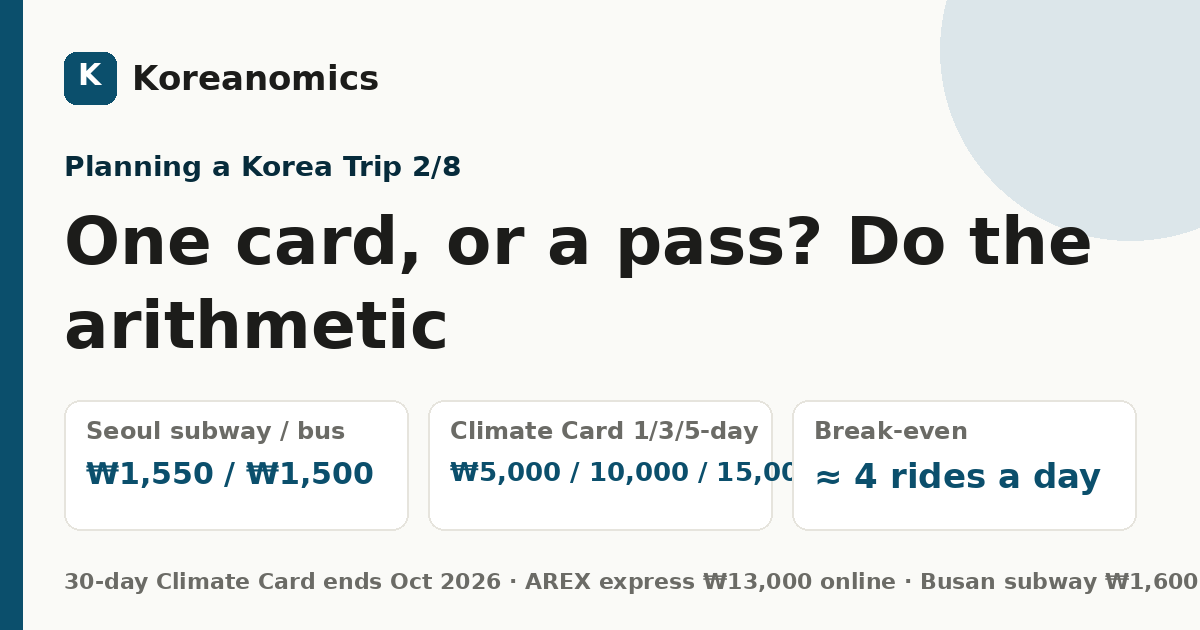
Seoul's transit is cheap, dense and cashless in a specific way: the gates want a Korean transit card, not your foreign contactless card, and the passes that promise "unlimited" travel come with exclusions that catch tourists on their airport day. This part compares the three cards you will be offered, gives the 2026 fares and transfer rules, and lets you calculate which option is cheapest for your itinerary — plus the Busan equivalents for Part 4.
Seoul transit cost calculator (2026)
Pay-per-ride: ₩1,550 per subway ride (bus ₩1,500), transfers free within 30 min up to 4 times — modelled as 1 fare per "ride". Climate Card short-term: 1/2/3/5/7 days = ₩5,000/8,000/10,000/15,000/20,000, Seoul only, excludes AREX, Sinbundang and Gyeonggi/Incheon; day-trip rides outside Seoul are charged normally (≈ ₩3,000 return per trip assumed). Card purchase: T-money ≈ ₩3,000, WOWPASS ≈ ₩5,000 (both non-refundable). Airport fares per Part 2 tables.
The cards
| T-money | WOWPASS | Climate Card (short-term) | |
|---|---|---|---|
| What | Transit + small-payments card | Prepaid debit card for foreigners with T-money built in | Unlimited Seoul subway + bus pass |
| Price | ₩2,500–4,000 (non-refundable) | ≈ ₩5,000 (non-refundable) | ₩5,000 (1 day) · ₩8,000 (2) · ₩10,000 (3) · ₩15,000 (5) · ₩20,000 (7) + ₩3,000 card |
| Load with | Cash at convenience stores/machines (no foreign cards) | Foreign cash at 16-currency kiosks, or app | Cash at station machines (some new machines take overseas cards since 2026) |
| Works for | All subways, buses, taxis, convenience stores nationwide | Shops and restaurants like a Korean debit card; transit via the T-money chip (loaded separately) | Seoul subway lines 1–9, Ui, Sillim, Seoul city buses |
| Excludes | — | — | AREX, Sinbundang Line, Gyeonggi/Incheon lines and buses, express/intercity buses, KTX |
| Refund | Balance under ₩20,000 at convenience stores (₩500 fee); larger at the T-money centre | Balance via app/kiosk; card not refunded | Not refundable |
T-money is the default: buy at the airport convenience store, load ₩20,000, tap in and out on every ride. Any card marked T-money or Cashbee works nationwide — Busan, Jeju, Gyeongju included — and pays for taxis and convenience-store snacks. WOWPASS matters for travellers whose foreign cards get refused (older terminals, small restaurants, some vending machines) or who want to avoid ATM fees: load it with dollars, euros or yen at a kiosk and it behaves like a Korean debit card, with the transit chip as a bonus. Climate Card short-term passes are worth it on heavy sightseeing days inside Seoul only; the airport train and any trip outside the city fall back on T-money.
The 30-day Climate Card (₩62,000) that residents used is being retired in autumn 2026 — no new loads after August 31, no use after September 29 — in favour of a Seoul option within the national K-Pass (20–53% of fares refunded above 15 rides a month, open to registered foreigners). The 1–7-day tourist passes continue.
Fares and transfers (2026)
- Seoul subway: ₩1,550 for the first 10 km by card (₩1,650 by single ticket), +₩100 per 5 km beyond; children ₩550, teens ₩900.
- Seoul bus: ₩1,500 city (blue/green), ₩3,000 red express to Gyeonggi.
- Transfers: free between subway and bus (and bus to bus) if you re-tap within 30 minutes (60 minutes 9 pm–7 am), up to 4 transfers — only with a card, and only if you tap out on buses too. Distance surcharges apply across the whole journey.
- Taxi: base ₩4,800 for 1.6 km, 20–40% night surcharge; card and T-money accepted; hail with the Kakao T app (foreign cards accepted on many but not all vehicles — set "pay in car").
- Busan: subway ₩1,600 (zone 1) / ₩1,800 (zone 2), city bus ₩1,550, taxi base ₩4,800; same T-money card, same transfer logic.
Airport to city
| From Incheon (T1) to Seoul Station | Time | Fare |
|---|---|---|
| AREX all-stop (T-money) | ~60 min | ≈ ₩5,000 |
| AREX express (non-stop, reserved seat) | 43 min (T1) / 51 min (T2) | ₩13,000 online/app · ₩17,700–18,300 at the counter |
| Airport limousine bus (to hotels/districts) | 60–90 min | ₩17,000 standard · ₩18,000 premium |
| Taxi | 50–80 min | ≈ ₩70,000–90,000 + ₩6,600 toll |
The all-stop train is the value choice and is covered by T-money (not by the Climate Card); the express is worth it with luggage at rush hour; buses win for Gangnam and hotels far from Seoul Station. Gimpo (domestic and some Japan/China/Taiwan flights) is on subway lines 5 and 9 and AREX, 30–40 minutes to the centre for a normal fare.
Practical
Tap in and out on buses; keep the card near the reader for a second; carry ₩5,000–10,000 in cash for markets and small taxis; charge at any convenience store ("충전해 주세요"); and for a group, one card per person — cards cannot be shared through a gate. Children under 6 ride free.
With a card in hand, the next question is money: how the tax refund works for shopping, what duty-free allows, and the 2025 change that ended VAT refunds on cosmetic procedures — Part 3.
Frequently asked questions
Do I need a card at all? Can't I tap my Visa?
Not on Seoul's subway or buses yet — the gates take T-money-type cards, not foreign contactless bank cards (a pilot for overseas cards has been running on some new ticket machines since 2026, but not at the gates). Single-journey paper tickets exist but cost ₩100 more and forfeit transfers. So yes: buy a T-money card at any convenience store or the airport, load cash, and tap in and out.
T-money or WOWPASS?
They overlap. A plain T-money card (₩2,500–4,000) is a transit card that also pays at convenience stores and taxis. WOWPASS (about ₩5,000) is a prepaid Korean debit card for foreigners that you load with foreign cash at kiosks, usable in shops that do not take foreign cards, with a T-money chip on the back for transit. If you carry a working foreign card, T-money is enough; if you want to pay like a local everywhere and avoid ATM fees, WOWPASS earns its cost.
Is the Climate Card worth it for a tourist?
Only if you ride a lot. The short-term passes — ₩5,000 for 1 day, ₩8,000 for 2, ₩10,000 for 3, ₩15,000 for 5, ₩20,000 for 7 — cover unlimited Seoul subway and city buses but exclude the airport railway, the Sinbundang Line and everything outside Seoul. At ₩1,550 a ride the 3-day pass needs more than 6 rides in three days and the 1-day pass more than 3 rides. Most sightseeing days hit 4–6 rides, so it is a small win; a day trip to Suwon or Incheon on it does not work.
What is happening to the 30-day Climate Card?
Seoul is retiring the ₩62,000 unlimited 30-day pass in autumn 2026 — no new loads after August 31 and no use after September 29 — replacing it with a Seoul option inside the national K-Pass card. The short-term tourist passes continue. Residents should switch to K-Pass (20–53% of fares refunded after 15 rides a month; foreigners with a Residence Card can register).
Sources
- Seoul Metropolitan Government — Climate Card FAQ: end of the 30-day pass (2026) and continuing short-term passes
- Korea Herald — Seoul subway fare ₩1,550 from June 28, 2025
- Busan Metropolitan City / Sedaily — urban rail ₩1,600 (zone 1), city bus ₩1,550 (from October 2023)
- AREX — Airport Railroad express train fares (online discount vs counter)
- T-money — card purchase, charging and refund
※ This article summarises publicly available rules as of the date shown. Your situation may differ; confirm with the relevant Korean authority (National Tax Service, Ministry of Employment and Labor, National Pension Service, Immigration) or a licensed professional before making decisions.